Union Public Service Commission (UPSC)
The Union Public Service Commission (UPSC) is India's central recruiting agency for the top government jobs. It is a constitutional body set up under Article 315 of the Constitution. It holds exams like the Civil Services Examination, advises the government on recruitment and promotion rules, and is consulted on disciplinary matters of civil servants. In matters of police leadership, it also prepares the panel from which states choose their DGP.
Why does it exist?
If ministers could hire officers directly, jobs could go to friends and supporters instead of the most able people. A neutral, independent commission makes hiring based on merit. This keeps the civil service professional and loyal to the Constitution, not to any one government. That is why the Constitution protects the UPSC's independence.
Where did it come from?
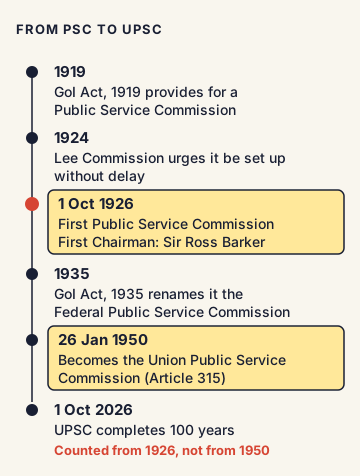
- The Government of India Act, 1919 provided for a Public Service Commission.
- The Lee Commission (Royal Commission on the Superior Civil Services in India, report in 1924) urged that it be set up without delay.
- The first Public Service Commission was set up on 1 October 1926, with Sir Ross Barker as its first Chairman. It had a Chairman and four members, and its role was mainly advisory.
- The Government of India Act, 1935 renamed it the Federal Public Service Commission and also provided for provincial commissions.
- On 26 January 1950, with the Constitution in force, it became the Union Public Service Commission. The UPSC completed 100 years on 1 October 2026.
The constitutional provisions (Part XIV, Articles 315 to 323)
- Article 315: There shall be a UPSC for the Union and a Public Service Commission for each state. Two or more states can agree to have a Joint State Public Service Commission (JSPSC), created by a law of Parliament.
- Article 316 (appointment and term): The Chairman and members are appointed by the President. They hold office for six years or until the age of 65, whichever comes first. At least half of the members must have held office for at least ten years under the Government of India or a state government. A member can resign by writing to the President.
- Article 317 (removal): The President can remove the Chairman or a member for misbehaviour, but only after the Supreme Court inquires into it on the President's reference and advises removal. The President can also remove a member who is declared insolvent, takes up other paid work, or is unfit because of mental or physical infirmity. The President may suspend a member while the Supreme Court inquiry is going on.
- Article 318: The President decides the number of members and their service conditions. Their service conditions cannot be changed to their disadvantage after appointment.
- Article 319 (bar on later jobs): The Chairman of the UPSC cannot take any further job under the Government of India or a state government. A member of the UPSC can become the UPSC Chairman or a State PSC Chairman, but cannot take any other government job.
- Article 320 (functions): Conducting exams for Union services; being consulted on methods of recruitment, principles for appointments, promotions and transfers, disciplinary matters, and claims for legal costs and injury pensions of civil servants.
- Article 321: Parliament can give the UPSC extra functions by law.
- Article 322: The UPSC's expenses are charged on the Consolidated Fund of India, which means Parliament does not vote on them. This protects its independence.
- Article 323: The UPSC gives an annual report to the President, which is laid before both Houses of Parliament, with a note explaining any case where the government did not accept its advice.
How does it work in practice?
The Constitution does not fix the number of members; the President decides it. The UPSC conducts many exams each year, including the Civil Services Examination (for IAS, IPS, IFS and other services), Engineering Services, Combined Defence Services and others. For senior police posts, the UPSC runs an empanelment committee that shortlists three officers for a state's DGP post, as required by the Prakash Singh judgment.
As of October 2026, the UPSC Chairman is Dr. Ajay Kumar, a former Union Defence Secretary, who took charge in May 2025.
Is the UPSC's advice binding?
No. The UPSC is an advisory body. The government can reject its advice, but it must explain such cases in the annual report placed before Parliament. In State of U.P. v. Manbodhan Lal Srivastava (1957), the Supreme Court held that consulting the Commission under Article 320(3) is not mandatory in the sense that failing to consult it does not by itself make a government decision invalid.
Commonly confused concepts
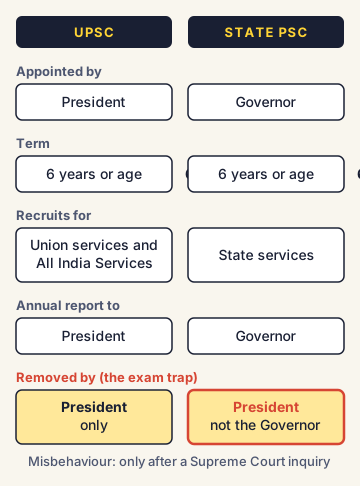
- UPSC vs State PSC: UPSC members are appointed by the President, serve until 65, and recruit for Union and All India Services. State PSC members are appointed by the Governor, serve until 62, and recruit for state services. But State PSC members, like UPSC members, can be removed only by the President, not the Governor.
- UPSC vs Staff Selection Commission (SSC): The UPSC is a constitutional body that recruits for Group A and some Group B posts. The SSC is created by an executive resolution and recruits for most Group B and Group C posts.
- UPSC vs DoPT: The UPSC recruits and advises. The Department of Personnel and Training (DoPT) is the government ministry department that manages service rules, training and cadre allocation.
- Charged vs voted expenditure: UPSC expenses are charged (not voted on by Parliament), like the salaries of Supreme Court judges and the CAG.
Issues, criticism and the way forward
- Advisory nature: Since its advice can be rejected, critics say its role in promotions and discipline is limited.
- Exam reform debates: Long recruitment cycles, the effect of the exam pattern on candidates from different backgrounds, and the number of attempts have been debated by several committees, including the Kothari Committee (1979), Satish Chandra Committee (1989), Alagh Committee (2001) and Baswan Committee (2016).
- State resistance in DGP selection: Some states see the UPSC's role in choosing DGPs as a limit on their power over the State subject of police. The Supreme Court has backed the UPSC panel system.
- Way forward: Faster exam cycles, more transparency in empanelment, and timely proposals from states are commonly suggested.
Concepts to Know
- Constitutional body: A body created directly by the Constitution. It can be changed only by amending the Constitution, which makes it more secure than a body made by a law or an order.
- All India Services: Services like the IAS, IPS and Indian Forest Service whose officers are recruited by the Centre but serve in states.
- Consolidated Fund of India: The main account of the Government of India, into which all its revenue goes and from which it spends.
- Insolvent: A person legally declared unable to pay their debts.
- Part XIV, Articles 315 to 323
- First Public Service Commission: 1 October 1926; first Chairman Sir Ross Barker; recommended by the Lee Commission (1924)
- Federal Public Service Commission under the GoI Act, 1935; UPSC from 26 January 1950
- Article 316: appointed by President; 6 years or age 65; half the members with 10 years of government service
- Article 317: removal for misbehaviour only after a Supreme Court inquiry
- Article 319: UPSC Chairman not eligible for any further government job
- Article 322: expenses charged on the Consolidated Fund of India
- Article 323: annual report to the President, laid before Parliament
- State PSC members: appointed by Governor, age limit 62, removed by President
- Chairman as of October 2026: Dr. Ajay Kumar
● Tracked since March 23, 2026 · last seen October 08, 2026 · updates as the daily brief publishes