UN Decade on Ecosystem Restoration (2021-2030)
The UN Decade on Ecosystem Restoration is a ten-year global campaign, from 2021 to 2030, to stop the damage to nature and to repair damaged land, forests, rivers, wetlands and seas. The United Nations General Assembly declared it in 2019. It is led by two UN bodies: the UN Environment Programme (UNEP) and the Food and Agriculture Organization (FAO).
It is not a treaty with legal duties. It is a "movement" that asks governments, companies, communities and citizens to restore nature at a very large scale.
What does "ecosystem restoration" mean?
An ecosystem is a living community of plants, animals and tiny organisms, together with the soil, water and air around them. A forest, a lake, a grassland, a mangrove coast and a coral reef are all ecosystems. When people cut forests, drain wetlands, overgraze land or pollute rivers, the ecosystem becomes degraded: it loses its plants and animals and stops giving us its services.
Restoration means helping a degraded ecosystem recover. Sometimes this needs active work, like planting native trees or removing a dam. Sometimes it only needs us to stop the damage and let nature heal by itself.
Why does the world need a decade for this?
Healthy ecosystems give us food, clean water, fertile soil, protection from floods and a stable climate. Today a very large part of them is damaged. According to UN data, more than 1.56 billion hectares of land (over 15% of the Earth's land surface) is degraded. Wetlands are disappearing faster than forests. Damaged ecosystems also release carbon, which makes climate change worse.
Protecting what is left is not enough any more; we also have to repair what is broken. The Decade is meant to push the world from small pilot projects to restoration at the scale of whole landscapes and countries.
Where did it come from?
- In March 2018, El Salvador announced it would seek a UN Decade on Ecosystem Restoration. Countries of the Central American Integration System supported the idea.
- In September 2018, El Salvador presented the proposal at the 73rd session of the UN General Assembly, with the support of about 70 countries.
- On 1 March 2019, the UN General Assembly adopted resolution 73/284, which proclaimed 2021-2030 as the UN Decade on Ecosystem Restoration. It asked UNEP and FAO to lead it.
- The Decade was formally launched on World Environment Day, 5 June 2021. Pakistan hosted World Environment Day that year.
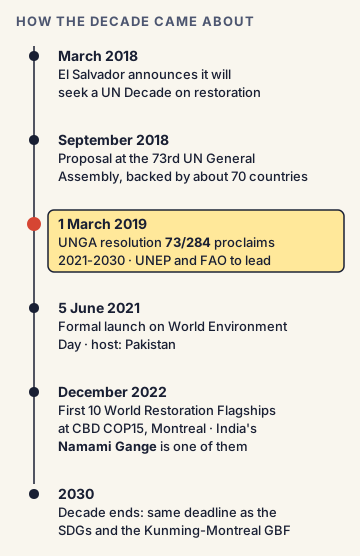
The end date, 2030, was chosen on purpose. It is the deadline for the Sustainable Development Goals (SDGs) and for the targets of the Kunming-Montreal Global Biodiversity Framework. So the Decade works as the "action campaign" behind these goals.
How does it work?
The Decade does not give countries legal targets. Instead, it does three things:
- Builds a movement: It asks everyone to join, under the slogan of "Generation Restoration". Governments, cities, farmers, companies, schools and youth groups can all take part.
- Sets common rules of good practice: The Decade's partners agreed on ten principles for ecosystem restoration. These say, for example, that restoration should involve local people, should use native species, should look at the whole landscape and not one small plot, and should aim for long-term recovery, not just tree counts.
- Rewards the best projects: Every year the UN names World Restoration Flagships. These are large projects that show real, measured results. Flagships can get technical help and funding support.
The World Restoration Flagships and India
The first ten flagships were announced in December 2022, during the biodiversity summit (CBD COP15) in Montreal. They were chosen from more than 150 projects in about 70 countries. India's Namami Gange programme, which aims to clean and revive the river Ganga, was one of these first ten. Other early flagships included the Trinational Atlantic Forest Pact (Brazil, Paraguay and Argentina), the Altyn Dala Conservation Initiative in Kazakhstan, the Shan-Shui Initiative in China and the Central American Dry Corridor.
How does the Decade link with other global goals?
The Decade is a campaign. The actual numbers come from other agreements that it supports:
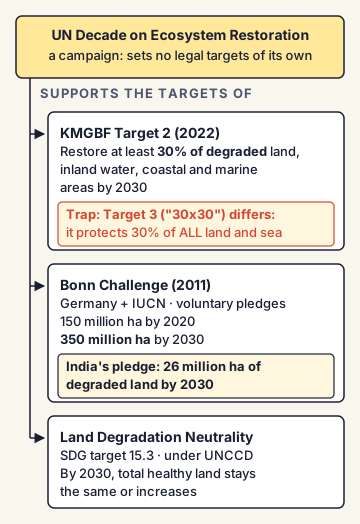
- Kunming-Montreal Global Biodiversity Framework (2022), Target 2: at least 30% of degraded land, inland water, coastal and marine areas should be under effective restoration by 2030.
- Bonn Challenge (2011): launched by Germany and the International Union for Conservation of Nature (IUCN). It aims to bring 150 million hectares of degraded and deforested land into restoration by 2020 and 350 million hectares by 2030.
- Land Degradation Neutrality (SDG target 15.3): under the UN Convention to Combat Desertification (UNCCD), countries aim that by 2030 the amount of healthy land stays the same or increases, so that new damage is balanced by restoration.
- SDG 14 (Life below water) and SDG 15 (Life on land).
India's position and Indian examples
- Under the Bonn Challenge, India pledged in 2015 to restore 21 million hectares. At the UNCCD COP14 in New Delhi in 2019, India raised its target to 26 million hectares of degraded land by 2030.
- India's second Bonn Challenge progress report says India restored about 21.76 million hectares between 2011 and 2020.
- Namami Gange was recognised as a World Restoration Flagship in 2022.
- Other Indian efforts that count as restoration include the Green India Mission (under the National Action Plan on Climate Change), MISHTI for mangroves and Amrit Dharohar for wetlands (both announced in the 2023-24 Budget and launched on 5 June 2023), and compensatory afforestation under the CAMPA funds.
Commonly confused concepts
- Restoration vs afforestation vs reforestation: Reforestation means planting trees where a forest existed before. Afforestation means planting trees where there was no forest, for example on a grassland. Restoration is wider: it means bringing back a healthy, working ecosystem. Planting trees on a natural grassland can actually be harmful, so it is not restoration.
- Conservation vs restoration: Conservation protects ecosystems that are still in good shape (for example, a national park). Restoration repairs ecosystems that are already damaged.
- UN Decade on Ecosystem Restoration vs UN Decade of Ocean Science for Sustainable Development: Both run from 2021 to 2030. The ocean decade is led by UNESCO's Intergovernmental Oceanographic Commission and is about ocean research. The restoration decade is led by UNEP and FAO and is about repairing all ecosystems.
- KMGBF Target 2 vs Target 3: Target 2 is about restoring 30% of degraded areas. Target 3 ("30x30") is about protecting 30% of all land and sea by 2030.
- Bonn Challenge vs Land Degradation Neutrality: The Bonn Challenge is a voluntary pledge of hectares to restore (with IUCN and Germany). Land Degradation Neutrality is a goal under the UNCCD and SDG 15.3 that compares total healthy land over time.
Issues, criticism and the way forward
- Promises are bigger than action: The 2026 mid-point report shows only about a quarter of the pledged 1 billion hectares is under restoration.
- Land gets all the attention: About 92% of restoration is on land. Rivers, wetlands, mangroves, seagrass and coral reefs are falling far behind, even though they are being lost fast.
- "Under restoration" is not "restored": Counting hectares does not tell us if the ecosystem has actually recovered. Experts ask for better monitoring of results, such as soil health, water quality and return of species.
- Tree-planting drives: Planting a single tree species (a monoculture) or planting trees on natural grasslands can harm biodiversity and local people. The Decade's ten principles warn against this.
- Damage continues: Restoration cannot keep up if forests, wetlands and seas continue to be destroyed. The CBD's head has said that we cannot fix nature with one hand while destroying it with the other.
- Money and data gaps: Many countries, especially poorer ones, lack funds and monitoring systems. The way forward suggested in the report: triple implementation, invest in monitoring, focus more on freshwater and marine ecosystems, and tackle the causes of damage, not only the symptoms.
Concepts to Know
- Ecosystem: A natural community of living things (plants, animals, microbes) together with the soil, water and air they live in, all working as one system.
- Degraded land: Land that has lost much of its natural productivity or plant cover because of overuse, pollution, erosion or deforestation. Such land grows less food and holds less water.
- Hectare: A unit of area. One hectare is 10,000 square metres, about the size of a large cricket ground. 100 hectares make one square kilometre.
- UNEP and FAO: UNEP is the UN's main body for the environment, based in Nairobi. FAO is the UN's food and farming body, based in Rome.
- Sustainable Development Goals (SDGs): 17 goals adopted by all UN members in 2015, to be met by 2030, covering poverty, health, climate, nature and more.
- IUCN (International Union for Conservation of Nature): A global body of governments and nature groups. It also publishes the Red List of threatened species.
- Monoculture: Growing only one species over a large area. It is easy to plant but supports very little other life.
- Proclaimed by UN General Assembly resolution 73/284 on 1 March 2019; period 2021-2030
- Proposed by El Salvador (2018), with the support of about 70 countries
- Led by UNEP and FAO
- Launched on World Environment Day, 5 June 2021 (host: Pakistan)
- Ten principles for ecosystem restoration guide the Decade
- First ten World Restoration Flagships announced in December 2022 at CBD COP15, Montreal; India's Namami Gange among them
- Linked targets: KMGBF Target 2 (30% of degraded areas under restoration by 2030), Bonn Challenge (350 million ha by 2030), SDG 15.3 (Land Degradation Neutrality)
- India's restoration target: 26 million hectares of degraded land by 2030 (raised at UNCCD COP14, New Delhi, 2019)
● Tracked since October 30, 2026 · last seen October 30, 2026 · updates as the daily brief publishes