ULLAS
Nav Bharat Saaksharta Karyakram (New India Literacy Programme)
ULLAS is the Government of India's programme to teach adults who never learnt to read, write or do basic arithmetic. It covers people aged 15 years and above who missed school or dropped out early. Its full name is ULLAS: Nav Bharat Saaksharta Karyakram, also called the New India Literacy Programme (NILP). ULLAS stands for "Understanding of Lifelong Learning for All in Society".
It runs from 2022-23 to 2026-27 under the Ministry of Education, and it is the scheme under which states and UTs are now declared "fully literate".
Why does India need it?
Imagine a farmer who cannot read the label on a pesticide bottle, or a mother who cannot check the amount on a bank slip or read a medicine name. Such a person depends on others for small daily tasks and can easily be cheated. Census 2011 put India's literacy rate at 74.04%, which meant crores of adults still could not read or write.
Schools help children, but they do not reach adults who have already missed school. ULLAS tries to fill this gap, so that every adult can read, write, count and use basic digital and financial tools on their own.
Where did it come from?
India has run adult literacy drives for decades. Each new programme built on the lessons of the last:
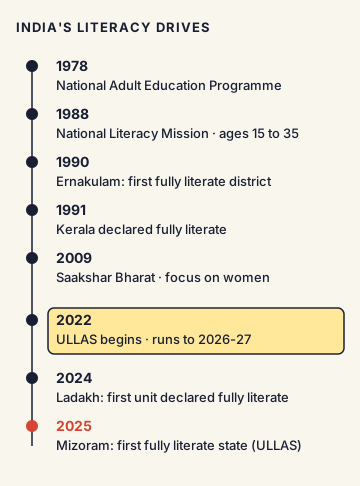
- National Adult Education Programme (1978): an early national effort to teach adults.
- National Literacy Mission (1988): aimed at "functional literacy" (the ability to use reading and writing in daily life) for people aged 15 to 35. Its Total Literacy Campaigns made Ernakulam in Kerala the first fully literate district in 1990, and Kerala was declared fully literate in 1991.
- Saakshar Bharat (2009): replaced the National Literacy Mission in September 2009, with a special focus on women.
- Padhna Likhna Abhiyan (2020-22): a short bridge scheme.
- ULLAS / New India Literacy Programme (2022-27): launched in line with the National Education Policy (NEP) 2020, which calls for 100% literacy among youth and adults.
What does it teach? The five components
ULLAS goes beyond just reading and writing. It has five parts:
- Foundational Literacy and Numeracy: reading, writing and basic arithmetic.
- Critical Life Skills: financial literacy, digital literacy, legal literacy, health care, child care, family welfare and similar daily-life skills.
- Basic Education: an "equivalency" path, so adults can earn certificates equal to school classes (preparatory, middle and secondary stages).
- Vocational Skills: skills that help adults earn a living.
- Continuing Education: ongoing courses in arts, science, culture, sports and recreation, so learning does not stop.
How does it work, step by step?
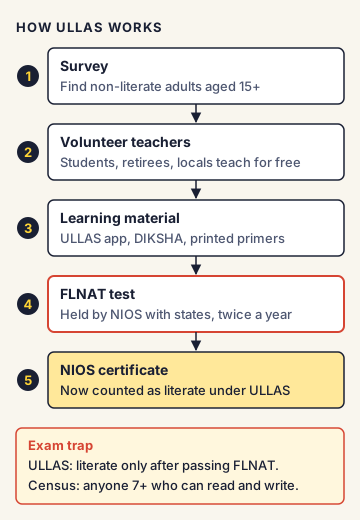
- Survey: Schools and local officials go door to door to find adults who cannot read or write. Their names are entered on the ULLAS portal and mobile app.
- Volunteer teachers: The scheme runs mainly on volunteerism (people teaching for free as a public service). School and college students, teachers, retired people and community members teach learners, often at home or in a nearby school. Schools work as the local unit for the programme.
- Teaching material: Learning content is available in many Indian languages through the ULLAS app and the government's DIKSHA digital platform, as well as printed primers.
- Testing: Learners take the FLNAT (Foundational Literacy and Numeracy Assessment Test). It is conducted by the National Institute of Open Schooling (NIOS) together with state authorities, usually twice a year. It checks reading, writing and numeracy.
- Certification: Those who pass get a certificate from NIOS and are counted as "literate" under ULLAS.
Key parts and facts
- Outlay: ₹1,037.90 crore for five years (FY 2022-23 to 2026-27): ₹700 crore Central share and ₹337.90 crore State share.
- Target: 5 crore learners in five years, that is about 1 crore per year, for foundational literacy and numeracy.
- Type of scheme: Centrally Sponsored Scheme, meaning the Centre and the states share the cost and the states carry it out.
- Funding pattern (Centre : State): 60:40 for most states; 90:10 for the North Eastern and Himalayan states; 60:40 for UTs with a legislature (90:10 for Jammu and Kashmir); 100% Central funding for UTs without a legislature, such as Lakshadweep.
- When is a state or UT "fully literate"? Under the scheme's rules, when the literacy rate reaches about 95%, that is, when the non-literate adults found in the survey are less than 5% of the population (excluding children under seven). So "fully literate" does not mean every single person can read.
- First declarations: Ladakh became the first administrative unit declared fully functionally literate (June 2024). Mizoram became the first fully literate state (May 2025, literacy about 98.2%). It was followed by Goa, Tripura, Himachal Pradesh, Sikkim and Uttarakhand (the sixth state, 2026). Several UTs, such as the Andaman and Nicobar Islands and Jammu and Kashmir, were declared in 2026.
India's position and Indian examples
Kerala has long been the model for mass literacy, through people's campaigns in the late 1980s and early 1990s. Small states and UTs, especially in the North East and the hills, have moved first under ULLAS because they already had high literacy and fewer non-literate adults to teach. Larger states with low literacy, such as those in the Hindi heartland, face a much bigger task because the number of non-literate adults there runs into crores.
Commonly confused concepts
- Census literacy vs ULLAS literacy: The Census treats a person aged 7 and above who can read and write with understanding in any language as literate. ULLAS targets adults 15 and above, and counts them as literate only after they pass the FLNAT test.
- "Fully literate" vs "100% literate": A "fully literate" declaration under ULLAS means about 95% literacy, not literally every person.
- ULLAS vs NIPUN Bharat: NIPUN Bharat (2021) aims to ensure that children gain foundational reading and maths skills by the end of Class 3. ULLAS is for adults who missed school.
- ULLAS vs Saakshar Bharat: Saakshar Bharat (2009) was the older adult literacy scheme. ULLAS (2022) replaced the earlier approach with a broader five-part model, digital learning and volunteer teachers.
- Literacy vs education: Literacy is the basic skill of reading, writing and counting. Education is the wider process of learning, including school, college and skills.
Issues, criticism and the way forward
- Low bar for literacy: Critics point out that passing a basic test may not mean a person can use reading and writing confidently in daily life over the long term. Many neo-literates (people who have just become literate) can slip back if they do not practise.
- Data questions: Declarations depend on surveys and test results reported by states. Some experts say independent checks are needed so that numbers are reliable.
- Dependence on volunteers: Volunteer teaching is cheap and flexible, but quality and continuity vary from place to place.
- Unequal progress: Small, high-literacy regions finish first, while large states with the most non-literate adults lag behind.
- Way forward: Experts suggest regular follow-up learning through the continuing education component, use of the latest Census and survey data, linking literacy to skills and livelihood, and special focus on women, tribal communities and older adults.
Concepts to Know
- Literacy rate: The share of people (in the Census, aged 7 and above) who can read and write with understanding. If 90 out of 100 people can read and write, the literacy rate is 90%.
- Functional literacy: Being able to use reading, writing and numbers in everyday life, like reading a bus board, filling a form or checking a bill.
- Numeracy: Basic skill with numbers: counting, adding, subtracting, and handling money.
- Centrally Sponsored Scheme: A government scheme where the Centre and states share the cost, and the states carry out the work on the ground. It is different from a Central Sector Scheme, which the Centre pays for fully and runs itself.
- NIOS (National Institute of Open Schooling): A national body under the Ministry of Education that runs open schooling and exams for people outside the regular school system.
- NEP 2020 (National Education Policy 2020): India's education policy, adopted in 2020, which sets goals for all levels of education, including 100% youth and adult literacy.
- Scheme period: FY 2022-23 to 2026-27; Ministry of Education; Centrally Sponsored Scheme
- Target group: non-literate adults aged 15 years and above
- Outlay: ₹1,037.90 crore (Centre ₹700 crore, States ₹337.90 crore)
- Target: 5 crore learners (1 crore per year)
- Five components: foundational literacy and numeracy, critical life skills, basic education, vocational skills, continuing education
- Test: FLNAT, conducted with NIOS
- "Fully literate" benchmark: about 95% literacy
- Funding: 60:40 (general states), 90:10 (NE and Himalayan states, J&K), 100% Centre (UTs without legislature)
- First fully literate administrative unit under ULLAS: Ladakh (2024); first state: Mizoram (2025)
- Census 2011 national literacy rate: 74.04%
● Tracked since October 12, 2026 · last seen October 12, 2026 · updates as the daily brief publishes