Udhampur-Srinagar-Baramulla Rail Link (USBRL)
The Udhampur-Srinagar-Baramulla Rail Link (USBRL) is a 272-km railway line that connects the Kashmir Valley to the rest of India's rail network. Before it was completed, a person in Srinagar could travel by train only within the Valley; to reach Jammu or Delhi, they had to go by road over the mountains. The USBRL, built at a cost of about ₹43,780 crore, made all-weather rail travel between Kashmir and the rest of the country possible. It was fully opened on 6 June 2025.
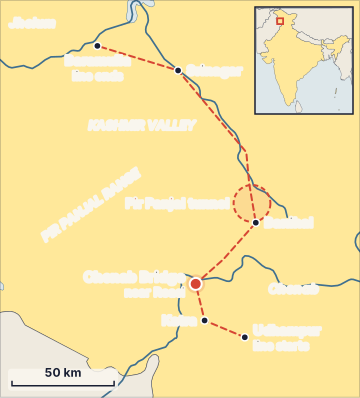
Why was it needed?
The Kashmir Valley is surrounded by high mountains. For decades, its main link to the rest of India was the Jammu-Srinagar National Highway, which often closes in winter because of snow, landslides and avalanches. When the road shuts, supplies of food, fuel and medicines are hit, and prices rise. A railway through tunnels and over bridges is far less affected by weather. It also helps tourism, trade (for example, apples and handicrafts going out of the Valley), and the quick movement of security forces.
Where did it come from?
The project was approved in the mid-1990s. It was declared a national project in 2002, which meant the central government would fund it fully and treat it as a priority. Because the terrain is so difficult, it was built in stages over more than two decades:
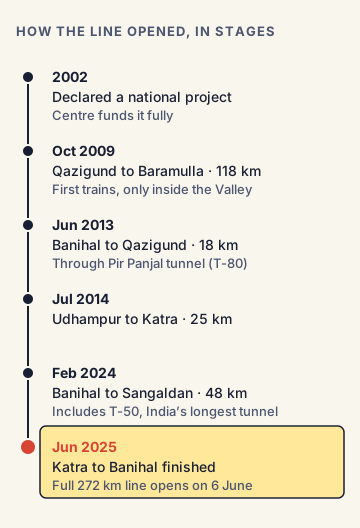
- Qazigund-Baramulla (118 km): opened in October 2009, running inside the Valley.
- Banihal-Qazigund (18 km): opened in June 2013, through the Pir Panjal tunnel.
- Udhampur-Katra (25 km): opened in July 2014.
- Banihal-Sangaldan (48 km): opened in February 2024, including tunnel T-50.
- Katra-Banihal (111 km, including Sangaldan-Reasi-Katra): the toughest part, completed last; the full line opened on 6 June 2025, with a Vande Bharat service between Katra and Srinagar.
What makes it so hard to build?
The line crosses the Pir Panjal range and the lower Himalayas. These mountains are young and still rising, so the rock is often weak and broken. The area lies in Seismic Zone V, India's highest earthquake risk zone. Engineers had to deal with deep river gorges, steep slopes, landslides and heavy snow. On the Katra-Banihal stretch, 97.42 km out of 111 km runs through tunnels or over bridges.
The key parts and facts
- Length: 272 km; tunnels: 36 (about 119 km in total); bridges: 943
- T-50 tunnel (Khari-Sumber): about 12.77 km, India's longest transportation tunnel, opened in February 2024
- T-80, Pir Panjal Railway Tunnel (Banihal-Qazigund): about 11.2 km, opened in June 2013; earlier India's longest
- Chenab Bridge (near Reasi): a steel arch bridge, 359 m above the riverbed, the world's highest railway bridge; about 35 m taller than the Eiffel Tower; total length 1,315 m; main arch span 467 m
- Anji Khad Bridge (Reasi district): India's first cable-stayed railway bridge, over the Anji river (a tributary of the Chenab); one 193-m tall pylon held up by 96 cables; total length about 725 m
- Chenab Bridge design: built to resist winds of about 260 kmph and strong earthquakes, with a design life of 120 years; its construction was overseen by Konkan Railway Corporation
- Trains: Vande Bharat trains on this route have heated windscreens, insulated toilets and anti-freezing systems for sub-zero winters
How does it benefit the region?
- All-weather link: trains run even when the highway is closed.
- Faster travel: the Katra-Srinagar Vande Bharat covers the journey in about three hours.
- Economy: cheaper transport of apples, dry fruits, handicrafts and other goods; easier arrival of supplies and tourists.
- Strategic value: faster movement of troops and equipment towards sensitive border areas.
- National integration: Kashmir is now physically joined to India's national rail network.
Commonly confused concepts
- USBRL vs Jammu-Baramulla line: The full railway from Jammu to Baramulla is often called the Jammu-Baramulla line. USBRL is the part from Udhampur onwards. The Jammu-Udhampur section was finished in 2005, before USBRL work.
- Chenab Bridge vs Anji Khad Bridge: Chenab is an arch bridge and the world's highest railway bridge. Anji Khad is a cable-stayed bridge, India's first for railways, and India's second-highest railway bridge.
- T-50 vs T-80: T-50 (about 12.77 km, Khari-Sumber) is now India's longest transport tunnel. T-80 (about 11.2 km, Banihal-Qazigund, Pir Panjal) held the record earlier.
- Pir Panjal rail tunnel vs Atal Tunnel: The Atal Tunnel (Rohtang, Himachal Pradesh) is a road tunnel, not a railway tunnel.
- Maximum permissible speed vs average speed: The maximum permissible speed is the highest speed allowed on a stretch. Actual average speed is lower because of curves, slopes and stops.
Issues, criticism and the way forward
- Delays and cost overruns: The project took more than 20 years and its cost rose many times because of tough geology, design changes and security issues.
- Geological risk: Weak rock, earthquakes and landslides need constant monitoring. Bridges like Anji have sensors to check their structural health.
- Environment: Tunnelling and slope-cutting in fragile mountains can disturb water springs and slopes.
- Speed limits: Running speeds were kept low at first for safety; they are raised only after tests and safety checks.
- Way forward: planned extensions, such as towards Uri and other parts of J&K, better freight use, and careful slope and structure monitoring.
Concepts to Know
- National project: A project fully funded and given priority by the central government because of its national importance.
- Seismic Zone V: The highest-risk earthquake zone on India's earthquake hazard map, where very strong earthquakes are possible.
- Broad gauge: The widest track gauge used by Indian Railways (1,676 mm between the rails). The USBRL is broad gauge, so it joins the national network directly.
- Gorge: A deep, narrow valley with steep sides, usually cut by a river.
- Pylon: A tall tower on a cable-stayed bridge from which the cables run down to hold the deck.
- USBRL: 272 km; cost about ₹43,780 crore; 36 tunnels (about 119 km); 943 bridges
- Declared a national project in 2002; fully opened on 6 June 2025
- Opening stages: Qazigund-Baramulla (Oct 2009), Banihal-Qazigund (June 2013), Udhampur-Katra (July 2014), Banihal-Sangaldan (Feb 2024), Katra-Banihal completed (June 2025)
- T-50: about 12.77 km, India's longest transport tunnel; T-80 (Pir Panjal): about 11.2 km
- Chenab Bridge: 359 m above riverbed, 1,315 m long, 467 m main arch span
- Anji Khad Bridge: India's first cable-stayed rail bridge; single 193 m pylon; 96 cables
● Tracked since April 30, 2026 · last seen October 03, 2026 · updates as the daily brief publishes