Types of Bridges
Arch, Cable-Stayed, Suspension and Beam
A bridge carries a road or railway across a river, valley or sea. Every bridge must safely carry its own weight plus the weight of vehicles, wind and earthquakes, and pass this load down into the ground. Engineers do this in different ways, which gives us different types of bridges: beam, truss, arch, cantilever, suspension and cable-stayed. Each type suits a certain distance, ground condition and cost.
Why does the type matter?
A short stream can be crossed with a simple slab. But a deep Himalayan gorge, where you cannot put pillars in the river, needs a design that can cover a very long gap in one jump. The longer the gap (called the span) and the harder the ground, the more clever the design has to be.
Two forces to understand first
Every bridge works with two basic forces:
- Compression: a squeezing force. Press a sponge between your hands: it is in compression. Stone and concrete are very strong in compression.
- Tension: a pulling or stretching force. A rope in a tug-of-war is in tension. Steel cables are very strong in tension.
A good bridge design sends each force to the material best at handling it.
The main types, step by step
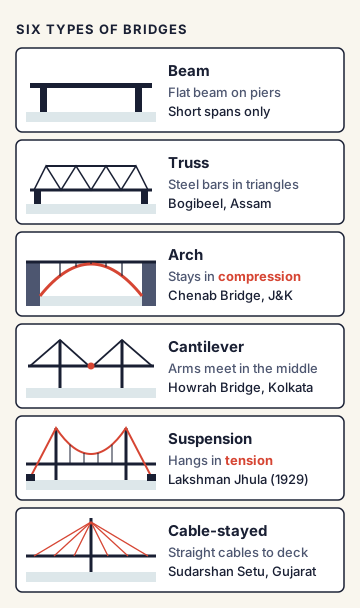
- Beam bridge: a flat beam resting on pillars (piers) at each end. Like a plank across a drain. The top of the beam is squeezed and the bottom is stretched. Simple and cheap, but only for short spans unless many piers are used.
- Truss bridge: a beam made of steel bars joined in triangles. Triangles do not change shape easily, so the bridge is strong but light. Each bar is either in tension or compression. Bogibeel Bridge in Assam (about 4.94 km, over the Brahmaputra) is India's longest rail-cum-road bridge and is a truss bridge.
- Arch bridge: a curved structure. The load pushes down and outward along the curve, so the arch stays in compression and passes the force into strong supports (called abutments) on both sides. Arches suit deep valleys with strong rock on both sides. The Chenab Bridge in J&K is a steel arch bridge and the world's highest railway bridge.
- Cantilever bridge: built from arms that stick out from piers, like a diving board, and meet in the middle. Howrah Bridge (Rabindra Setu) in Kolkata, opened in 1943 over the Hooghly, is India's best-known cantilever bridge.
- Suspension bridge: the deck hangs from vertical cables (hangers), which hang from two huge main cables. The main cables pass over tall towers and are tied into heavy anchors in the ground at each end. Everything is in tension. This type covers the longest spans. Examples: the Golden Gate Bridge (USA) and, in India, Lakshman Jhula in Rishikesh (a pedestrian bridge completed in 1929).
- Cable-stayed bridge: the deck is held up by straight cables running directly from tall towers (pylons) to the deck. There are no main cables and no big end anchors. Cables can be arranged like a fan or like the strings of a harp. It suits medium-to-long spans and is quicker to build than a suspension bridge. Indian examples: Vidyasagar Setu in Kolkata (1992, India's first cable-stayed bridge), Signature Bridge in Delhi (2018), Sudarshan Setu in Gujarat (2024, about 2.32 km, India's longest cable-stayed bridge), and Anji Khad Bridge in J&K (India's first cable-stayed railway bridge).
Special types worth knowing
- Vertical lift bridge: a section of the deck rises straight up to let ships pass. The New Pamban Bridge in Tamil Nadu (opened in April 2025, about 2.07 km) is India's first vertical lift sea bridge.
- Sea bridge: The Atal Setu (Mumbai Trans Harbour Link), opened in January 2024, is about 22 km long and is India's longest bridge and longest sea bridge.
Commonly confused concepts
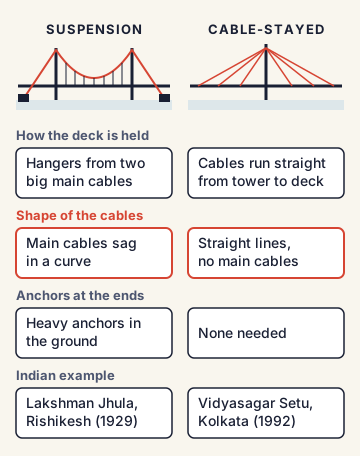
- Suspension vs cable-stayed: In a suspension bridge, the deck hangs from vertical hangers attached to big main cables that run between towers and are anchored at the ends. In a cable-stayed bridge, cables go straight from the tower to the deck, and there are no main cables or end anchorages. A quick way to tell: in a suspension bridge, the main cables sag in a curve; in a cable-stayed bridge, cables are straight lines.
- Arch vs suspension: An arch pushes (compression) and stands up from below. A suspension bridge pulls (tension) and hangs from above.
- Cantilever vs cable-stayed: Both can be built outward from towers, but a cantilever holds its arms with its own stiff structure, while a cable-stayed bridge uses cables to hold the deck.
- Highest vs longest bridge: "Highest" means height of the deck above the river or valley (Chenab). "Longest" means total length (Atal Setu for India).
Issues, criticism and the way forward
- Maintenance: Steel cables and joints rust and wear out; they need regular inspection. Old bridges that are not maintained can fail, as shown by bridge collapses in several places.
- Natural forces: Wind can make long, light bridges sway; earthquakes and floods can damage piers. Designs must include wind tunnel testing and earthquake-resistant features.
- Structural health monitoring: Modern bridges use sensors to measure movement, strain and vibration in real time, so problems are caught early.
- Way forward: Experts stress regular audits of old bridges, use of sensors, better materials, and choosing designs suited to local terrain.
Concepts to Know
- Span: The distance between two supports of a bridge. A longer span means fewer supports in the river or valley.
- Deck: The flat surface of the bridge on which vehicles or trains run.
- Pier: A pillar that supports the bridge from below between its two ends.
- Abutment: The strong support at each end of a bridge that holds it up and resists its push.
- Anchorage: A massive block in the ground that holds the ends of a suspension bridge's main cables.
- Arch: works mainly in compression; Chenab Bridge (359 m above riverbed) is the world's highest railway bridge
- Cable-stayed: cables run straight from pylons to the deck; Vidyasagar Setu (1992) was India's first; Sudarshan Setu (2024, about 2.32 km) is India's longest; Anji Khad is India's first cable-stayed rail bridge
- Cantilever: Howrah Bridge, Kolkata (opened 1943)
- Suspension: deck hangs from main cables; Lakshman Jhula, Rishikesh (1929)
- Truss: Bogibeel Bridge, Assam (about 4.94 km), India's longest rail-cum-road bridge
- New Pamban Bridge (April 2025): India's first vertical lift sea bridge; Atal Setu (January 2024, about 22 km): India's longest sea bridge
● Tracked since October 03, 2026 · last seen October 03, 2026 · updates as the daily brief publishes