Treaty-Making Power in India
Article 73 and Article 253
Treaty-making power is the power of a country to enter into binding agreements with other countries, such as trade deals, border agreements, tax treaties and climate agreements. In India, this power belongs to the Union executive: the Union government, acting in the name of the President, negotiates, signs and ratifies treaties. Parliament's approval is not required to sign or ratify a treaty. But if a treaty needs a change in Indian law to be carried out, only Parliament can make that law.
Why does it matter?
Treaties decide many things that affect ordinary people: the import tax on a phone, the tax a company pays on income earned abroad, the rights of a worker sent overseas, even the border of the country. So it matters who has the power to make them, and who checks that power. In India, the government acts fast and alone at the signing stage, and Parliament steps in mainly at the stage of turning the treaty into domestic law.
Where does the power come from in the Constitution?
The Constitution does not have one article that says "the government shall make treaties". The power comes from reading several provisions together:
- Article 73 (extent of executive power of the Union): The Union's executive power covers all matters on which Parliament can make laws. It also covers the rights and powers the Government of India can exercise under any treaty or agreement. Since Parliament can make laws on treaties, the Union executive can also make treaties.
- Article 246 and the Union List (List I of the Seventh Schedule): Several entries in the Union List give Parliament power over foreign matters:
- Entry 10: Foreign affairs; all matters which bring the Union into relation with any foreign country.
- Entry 13: Participation in international conferences, associations and other bodies, and implementing decisions made there.
- Entry 14: Entering into treaties and agreements with foreign countries and implementing of treaties, agreements and conventions with foreign countries.
- Entry 41: Trade and commerce with foreign countries.
- Article 253 (legislation for giving effect to international agreements): Parliament can make laws for the whole or any part of India to carry out any treaty, agreement or convention, or any decision taken at an international conference. It can do this even on subjects in the State List. This is an important exception to the normal division of powers between the Centre and the states.
- Article 51(c) (a Directive Principle): The State shall try to foster respect for international law and treaty obligations in the dealings of organised peoples with one another. This is a goal, not a rule that courts can enforce.
- Article 77: All executive action of the Government of India is taken in the name of the President. So treaties are signed on behalf of the President, but the decisions are made by the Union Cabinet.
How does India make a treaty, step by step?
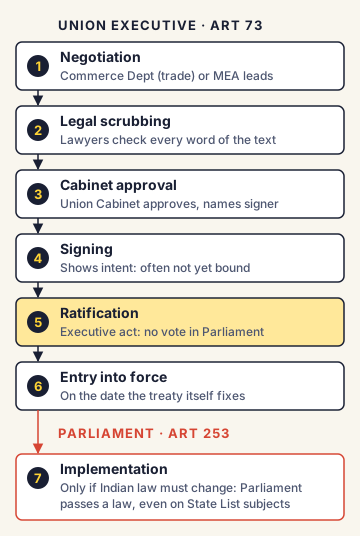
- Negotiation: The concerned ministry leads the talks. For trade deals, it is the Department of Commerce in the Ministry of Commerce and Industry. For border, defence or political treaties, the Ministry of External Affairs (MEA) leads.
- Legal drafting and "legal scrubbing": Once the main terms are agreed, lawyers from both sides turn them into a precise legal text and check every word, so that nothing is unclear or open to misuse. This is why there is a gap of weeks or months between "talks concluded" and "deal signed".
- Cabinet approval: The Union Cabinet approves the final text and authorises a minister or official to sign.
- Signing: The authorised person signs the treaty. Signing shows the country's intention to be bound, but in many treaties the country is not yet bound.
- Ratification: The government formally confirms that India agrees to be bound. In India, this is an executive act, done through an instrument of ratification approved by the government. Parliament does not vote on it.
- Entry into force: The treaty starts to apply on the date the treaty itself fixes, often after both sides have completed their own internal steps.
- Implementation: If the treaty needs changes in Indian law, such as new customs duty rates, a new tax rule or a new offence, Parliament must pass a law (or the government must use powers already given to it under an existing law). Customs duty cuts under trade agreements, for example, are usually notified by the government using powers under the Customs Act, 1962 and the Customs Tariff Act, 1975.
A simple way to picture it: the government is like a family member who signs a deal with a neighbour. They can sign alone. But if the deal requires changing the house rules that everyone follows, the whole family (Parliament) must agree to the new rule.
Is India "dualist" or "monist"?
- In a monist system, a treaty becomes part of the country's law the moment it is ratified. Courts can apply it directly.
- In a dualist system, a treaty does not automatically become law inside the country. A separate domestic law is needed.
- India follows the dualist approach, like the United Kingdom. A treaty that affects the rights of citizens or needs a change in existing law has no force inside India until Parliament acts. However, courts use treaties to interpret Indian laws and fill gaps (see the cases below).
Landmark cases
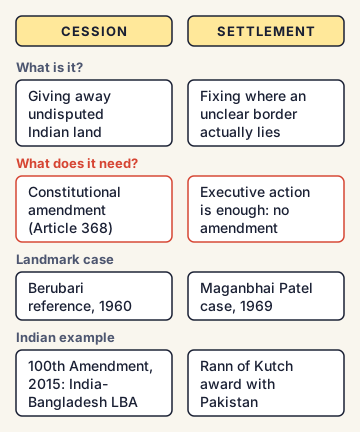
- In re Berubari Union (1960), the Berubari reference: The Nehru-Noon Agreement of 1958 with Pakistan proposed to give part of the Berubari Union (West Bengal) to Pakistan. The Supreme Court said that giving away Indian territory to another country cannot be done by an executive agreement or an ordinary law. It needs a constitutional amendment under Article 368. The government then passed the Constitution (Ninth Amendment) Act, 1960.
- Maganbhai Ishwarbhai Patel v. Union of India (1969): This case was about the award on the Rann of Kutch boundary with Pakistan. The Supreme Court said that settling a boundary dispute (deciding where an unclear border actually lies) is not giving away territory, so it does not need a constitutional amendment. The executive can do it. The Court also said that a law by Parliament is needed only when a treaty affects the rights of citizens or requires a change in existing law.
- Jolly George Varghese v. Bank of Cochin (1980): The question was whether a poor but honest debtor could be jailed for not repaying a debt. The Court referred to Article 11 of the International Covenant on Civil and Political Rights (ICCPR), which says no one shall be jailed merely for failing to fulfil a contract. It held that the treaty by itself could not override Indian law, but it read the Indian law (Section 51 of the Code of Civil Procedure) together with Article 21 in a way that matched the spirit of the treaty. This shows India's dualist approach.
- Vishaka v. State of Rajasthan (1997): There was no Indian law on sexual harassment of women at the workplace. The Supreme Court used the Convention on the Elimination of All Forms of Discrimination Against Women (CEDAW), which India had ratified, read with Articles 14, 15, 19 and 21, and laid down the Vishaka Guidelines. It said international conventions that are not in conflict with fundamental rights can be read into them to fill a gap in Indian law. Parliament later passed the Sexual Harassment of Women at Workplace (Prevention, Prohibition and Redressal) Act, 2013.
- Gramophone Company of India v. Birendra Bahadur Pandey (1984): The Court said rules of customary international law (rules all nations generally follow) are part of Indian law unless they conflict with an Act of Parliament. If there is a conflict, the Indian law wins.
India's position and Indian examples
- Trade agreements: India's trade deals, such as the India-UAE CEPA (2022), the India-Australia ECTA (2022), the India-EFTA TEPA (signed 2024) and the India-UK CETA (signed July 2025), were approved by the Union Cabinet and signed by the government. None needed a vote in Parliament to be signed or ratified.
- Laws passed to carry out treaties under Article 253: the Environment (Protection) Act, 1986 (after the 1972 Stockholm Conference), the Protection of Human Rights Act, 1993, and the Biological Diversity Act, 2002 (to carry out the Convention on Biological Diversity).
- Territory: The Constitution (100th Amendment) Act, 2015 was passed to carry out the India-Bangladesh Land Boundary Agreement, because it involved exchanging enclaves (pieces of territory). This followed the Berubari principle.
- Vienna Convention on the Law of Treaties (1969): This is the main international treaty about how treaties are made, read and ended. India is not a party to it, but India generally follows its rules in practice, many of which are also customary international law.
How do other countries do it? A useful comparison
- United States: Under Article II of the US Constitution, the President can make treaties only with the approval of two-thirds of the Senate. Trade deals are often approved through a separate process involving both houses of Congress. Many agreements are also made as executive agreements, which do not need Senate approval.
- United Kingdom: Like India, the government makes treaties. But a 2010 law requires most treaties to be laid before Parliament for 21 sitting days before ratification.
- European Union: Trade deals are negotiated by the European Commission, then approved by the Council of the EU and the European Parliament. Some deals also need approval by every member country.
Commonly confused concepts
- Signing vs ratification: Signing shows intent and ends negotiation. Ratification is the formal act by which a country agrees to be legally bound. A country can sign but never ratify.
- Treaty vs MoU vs joint statement: A treaty (or agreement) is legally binding under international law. A Memorandum of Understanding (MoU) is usually a statement of intent and is generally not legally binding. A joint statement is a political announcement of what leaders agreed to work towards. The India-US interim framework of February 2026 was a joint statement; the final trade agreement will be a binding text.
- Article 73 vs Article 253: Article 73 gives the executive the power to make treaties. Article 253 gives Parliament the power to make laws to carry them out, even on State List subjects.
- Cession of territory vs settlement of a boundary: Giving away undisputed Indian land (cession) needs a constitutional amendment (Berubari, 1960). Fixing where an unclear border lies (settlement) can be done by the executive (Maganbhai, 1969).
- Monist vs dualist: In a monist country, a ratified treaty is directly law. In a dualist country like India, a separate domestic law is needed if the treaty affects rights or existing laws.
Issues, criticism and the way forward
- Weak parliamentary scrutiny: Critics point out that Parliament has no formal role before India signs major treaties, even trade deals that affect farmers, workers and industries for decades. MPs often learn the details only after signing.
- No law on the treaty process: Parliament has made laws under Article 253 for specific treaties, but there is no general law that sets out how India must negotiate, consult and approve treaties. A consultation paper of the National Commission to Review the Working of the Constitution (NCRWC, 2001) discussed the need for parliamentary involvement in treaty-making.
- Impact on states: Article 253 lets the Centre make laws on State List subjects to carry out a treaty. Agriculture and fisheries are state subjects, yet trade deals that affect them are made by the Centre. Some states have asked to be consulted.
- Lack of transparency: Draft texts are usually not made public before signing, which limits input from farmers' groups, industry and experts.
- The other side of the debate: The government's position, and that of many experts, is that treaty talks need speed, secrecy and flexibility. Parliamentary votes on every treaty could slow deals and weaken India's bargaining position. Parliament can still debate treaties, question ministers, and refuse to pass any law a treaty needs.
- Way forward suggested by experts: place major treaties before Parliament before ratification (as in the UK); have a standing parliamentary committee to review trade deals; consult states on subjects that are in the State List; and publish impact studies before signing.
Concepts to Know
- Treaty: A written agreement between countries that is binding under international law. Trade agreements, tax treaties and border agreements are all treaties.
- Executive: The part of the government that runs the country day to day and carries out laws: the President, the Prime Minister, the Council of Ministers and the civil service.
- Union List, State List, Concurrent List: The three lists in the Seventh Schedule of the Constitution that divide law-making subjects between the Centre (Union List), the states (State List) and both (Concurrent List).
- Directive Principles of State Policy: Guidelines in Part IV of the Constitution that the government should follow while making laws and policies. Courts cannot force the government to follow them.
- Cession: Giving away a part of a country's territory to another country.
- Customary international law: Rules that countries follow because they have always done so and accept them as law, even if they are not written in a treaty.
- Legal scrubbing: The final careful check of a treaty's legal text by lawyers of both sides, to remove any errors or unclear wording before signing.
- Interim agreement: A smaller, first-stage deal that covers some items quickly, while talks on a full agreement continue.
- Article 73: Union executive power covers matters in Parliament's law-making power and rights under treaties
- Article 253: Parliament can make laws to carry out treaties, even on State List subjects
- Article 51(c): DPSP to foster respect for international law and treaty obligations
- Article 77: executive action taken in the President's name
- Union List entries: 10 (foreign affairs), 13 (international conferences), 14 (treaties and agreements), 41 (foreign trade)
- No parliamentary approval needed to sign or ratify; ratification is an executive act approved by the Union Cabinet
- Berubari (1960): cession of territory needs a constitutional amendment, leading to the 9th Amendment Act, 1960
- Maganbhai Ishwarbhai Patel (1969): settling a boundary dispute does not need an amendment
- Jolly George Varghese (1980): ICCPR Article 11; treaty used to interpret Indian law, not to override it
- Vishaka (1997): CEDAW used to frame guidelines; later the POSH Act, 2013
- Gramophone Co. (1984): customary international law is part of Indian law unless it conflicts with an Act of Parliament
- 100th Amendment Act, 2015: India-Bangladesh Land Boundary Agreement
- India is not a party to the Vienna Convention on the Law of Treaties, 1969
● Tracked since February 16, 2026 · last seen October 15, 2026 · updates as the daily brief publishes