Transitioning Away from Fossil Fuels (TAFF)
From Phase-Down to the Belém Roadmap
"Transitioning away from fossil fuels" means the world slowly moving its energy system off coal, oil and natural gas and onto clean sources like solar, wind, hydro and nuclear power. The phrase comes from a 2023 UN climate decision, the first time all countries together agreed that the fossil fuel era must end. It does not set a date or a target for any one country.
It is a shared direction of travel, and the big fight in climate talks is about how fast, who goes first, and who pays.
Why does it matter so much?
Burning fossil fuels releases carbon dioxide (CO₂), the main gas that traps heat and warms the planet. Fossil fuels cause roughly three-quarters of all greenhouse gas emissions in the world. So no climate goal, whether 1.5°C or 2°C, can be met without using much less of them. Think of it like a leaking bucket: you can keep mopping the floor (adaptation), but at some point you must close the tap.
Why was it so hard to agree?
For almost 30 years, UN climate decisions did not even name fossil fuels. The reasons are simple:
- Many countries earn most of their income from selling oil, gas or coal (for example, Gulf states and Russia).
- Developing countries like India still need cheap, reliable energy to lift people out of poverty, and coal is their main domestic fuel.
- Every decision at a COP (Conference of the Parties) needs consensus, so even a few countries can block strong words.
Where did it come from? The journey in the climate talks
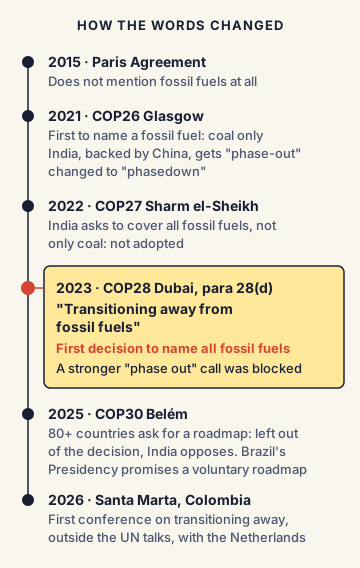
- Paris Agreement (2015): set the goal of keeping warming "well below 2°C" and trying for 1.5°C, but did not mention fossil fuels at all.
- Glasgow Climate Pact (COP26, 2021): the first COP decision to name a fossil fuel. It called for the "phasedown of unabated coal power" and the phase-out of inefficient fossil fuel subsidies. The draft said "phase-out" of coal; at the last minute India, supported by China, got it changed to "phasedown". India argued that developing countries still have development needs, and that singling out coal (India's fuel) while sparing oil and gas (rich countries' fuels) was unfair.
- COP27 (Sharm el-Sheikh, 2022): India pushed for a phasedown of all fossil fuels, not just coal. It did not make it into the final decision.
- COP28 (Dubai, 2023), the first Global Stocktake: paragraph 28(d) called on countries to contribute to "transitioning away from fossil fuels in energy systems, in a just, orderly and equitable manner", speeding up action this decade, to reach net zero by 2050 in line with the science. This package is often called the "UAE Consensus". A stronger call to "phase out" fossil fuels had wide support but was blocked by some oil-producing countries.
- COP30 (Belém, 2025): more than 80 countries asked for a formal roadmap to put paragraph 28(d) into practice. Oil producers and some large developing countries, including India, opposed putting it in the decision. The final "Global Mutirão" decision left it out. Brazil's COP30 Presidency then promised to prepare a voluntary roadmap outside the formal negotiations.
- Santa Marta, Colombia (April 2026): Colombia and the Netherlands hosted the First International Conference on Transitioning Away from Fossil Fuels, attended by over 50 countries. Its report was fed into Brazil's roadmap. A second conference is planned for 2027.
What else did paragraph 28 of the COP28 decision say?
Paragraph 28(d) is one part of a list of eight global efforts. Students should know the main ones:
- Triple the world's renewable energy capacity and double the yearly rate of energy-efficiency improvement by 2030.
- Speed up the phasedown of unabated coal power.
- Move towards net zero energy systems, using zero and low-carbon fuels well before or by around mid-century.
- Speed up zero and low-emission technologies, including renewables, nuclear, carbon capture (CCUS) and low-carbon hydrogen.
- Sharply cut non-CO₂ emissions, especially methane, by 2030.
- Phase out inefficient fossil fuel subsidies that do not tackle energy poverty or a just transition, as soon as possible.
The next paragraph (29) also accepted that "transitional fuels" (understood to mean natural gas) can help energy security during the shift. Critics saw this as a loophole.
How is the transition supposed to work?
There is no single global rulebook. It happens mainly through each country's own climate plan, called a Nationally Determined Contribution (NDC). Every five years countries submit new NDCs, and the Global Stocktake checks whether, added together, they are enough. The Belém roadmap tries to help by asking each country to look at three things:
- Demand: how to use less fossil energy, for example by moving cars, cooking and factories to electricity.
- Supply: how to plan the gradual decline of coal mines and oil and gas fields while building clean power, grids and storage.
- The economy: how regions and workers that depend on fossil fuels can find new jobs and income. This is the idea of a just transition.
Phase-out, phase-down and transition: what is the difference?
UPSC loves these words, so be exact:
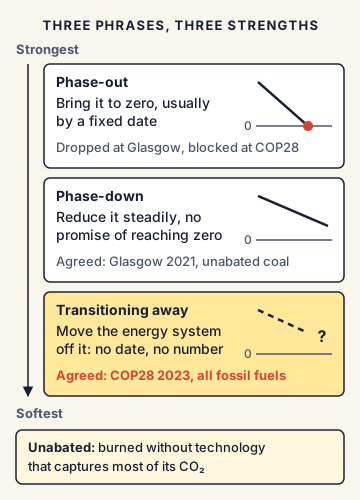
- Phase-out: bring something to zero, usually by a fixed date.
- Phase-down: reduce it steadily, without promising to reach zero.
- Transitioning away: move the energy system off it over time; no end date, no number. This is the softest of the three, and it is the phrase actually agreed at COP28.
- Unabated: fossil fuel burned without technology that captures most of its CO₂. "Unabated coal" means ordinary coal plants without carbon capture.
Other coalitions on fossil fuels (outside the formal UN decisions)
- Powering Past Coal Alliance (2017): launched by the UK and Canada at COP23; members pledge to end unabated coal power. India is not a member.
- Beyond Oil and Gas Alliance (BOGA, 2021): launched at COP26, led by Denmark and Costa Rica; members commit to stop new oil and gas licensing.
- Fossil Fuel Non-Proliferation Treaty initiative: first raised at the UN General Assembly by Vanuatu in September 2022, backed mainly by Pacific island nations. It is a proposal, not a treaty yet.
What does international law say?
In its advisory opinion of 23 July 2025, the International Court of Justice (ICJ) said, unanimously, that a country failing to act on emissions, including through fossil fuel production, new exploration licences or fossil fuel subsidies, may be committing an internationally wrongful act. The opinion is not binding, but it is expected to shape future climate cases.
India's position and Indian examples
India accepts that the world must move away from fossil fuels but stresses that the pace must be fair:
- Common but Differentiated Responsibilities (CBDR): rich countries polluted first and most, so they must cut faster and pay for the transition elsewhere.
- All fuels, not only coal: India opposes singling out coal while oil and gas, used more by rich countries, are spared.
- Development needs: coal still produces around 70% of India's electricity, and India's coal output crossed 1 billion tonnes in 2024-25. India's emissions per person are well below the world average.
- India's own targets: net zero by 2070 (announced at COP26, 2021); 50% of installed power capacity from non-fossil sources by 2030 (already reached in 2025); and, in its NDC for 2031 to 2035 submitted in April 2026, a 47% cut in emissions intensity of GDP from 2005 levels and 60% non-fossil installed capacity by 2035.
- India has generally preferred national, flexible targets over global top-down pledges. That is why it declined to join the COP30 roadmap push and, for now, the COP31 electrification pledge.
Commonly confused concepts
- Paragraph 28 (COP28) vs Glasgow Pact (COP26): Glasgow named only coal ("phasedown of unabated coal power"); COP28 was the first to name all fossil fuels ("transitioning away").
- Belém TAFF roadmap vs a COP decision: the roadmap is a voluntary document of the COP30 Presidency, not a negotiated, consensus decision of all countries.
- Installed capacity vs generation: India's 50% non-fossil target is about capacity (how much power the plants can make). Non-fossil sources still produce only about a quarter of the electricity India actually generates, because solar and wind do not run all the time.
- Global Stocktake vs NDC: the stocktake is a world-level review every five years; an NDC is one country's own plan.
Issues, criticism and the way forward
- No dates, no numbers: "transitioning away" has no end date and no binding target, so progress is hard to measure or enforce.
- Finance: developing countries say they cannot shut coal plants or oil fields without money for new grids, storage and worker support. Rich-country finance has been far below what is needed.
- Equity: critics argue the burden falls unfairly on poorer, coal-dependent countries while rich producers keep expanding oil and gas.
- Loopholes: "unabated", "transitional fuels" and carbon capture can be used to delay real cuts.
- Energy security: the 2022 energy crisis showed that cutting supply before clean alternatives are ready can push up prices.
- Way forward suggested by experts: national transition plans built into NDCs, just transition support for workers and coal regions, cheaper finance for developing countries, and reporting on progress in the 2028 Global Stocktake.
Concepts to Know
- Fossil fuels: Coal, oil and natural gas. They formed from plants and animals buried millions of years ago. Burning them gives energy but releases CO₂.
- Net zero: When a country removes from the air as much greenhouse gas as it releases, so its total addition is zero.
- Electrification: Replacing fuels burned directly (petrol in a car, gas in a stove) with electricity, ideally from clean sources.
- Just transition: Making the shift to clean energy fair for workers, families and regions that depend on fossil fuels, so they are not left jobless.
- Emissions intensity of GDP: The amount of greenhouse gas released to produce each unit of the economy's output. It can fall even when total emissions rise.
- Consensus: In COP talks, decisions are adopted only when no country formally objects. It is not a vote.
- Advisory opinion: Legal advice given by a court like the ICJ when asked by a UN body. It explains the law but does not bind countries.
- Glasgow Climate Pact (COP26, 2021): "phasedown of unabated coal power"; changed from "phase-out" after India's intervention
- COP28 (Dubai, 2023), first Global Stocktake, paragraph 28(d): "transitioning away from fossil fuels in energy systems, in a just, orderly and equitable manner", net zero by 2050
- COP28 also: triple renewable capacity and double energy-efficiency improvement by 2030
- COP30 (Belém, 2025): fossil fuel roadmap left out of the Global Mutirão decision; COP30 Presidency released a voluntary TAFF roadmap anchored in paragraph 28(d)
- First International Conference on Transitioning Away from Fossil Fuels: Santa Marta, Colombia, April 2026, co-hosted by Colombia and the Netherlands
- ICJ advisory opinion on climate change: 23 July 2025, unanimous, non-binding
- India: net zero by 2070; NDC 2035 targets of 47% emissions-intensity cut (from 2005) and 60% non-fossil installed capacity
● Tracked since November 04, 2026 · last seen November 04, 2026 · updates as the daily brief publishes