Transfer of High Court Judges (Article 222)
India has 25 High Courts. Article 222 of the Constitution allows the President to move a judge from one High Court to another, after consulting the Chief Justice of India. In practice, the President acts on the recommendation of the Supreme Court collegium, which is the CJI and the four senior-most judges of the Supreme Court. A transferred judge does not lose seniority or pay, and is entitled to an extra allowance to cover the cost of moving.
Why does the Constitution allow transfers?
Think of the judiciary as one national team, not 25 separate clubs. Sometimes a court needs an experienced judge. Sometimes a judge has become too close to local lawyers, families or politics in their home state. Sometimes a senior judge must be groomed to lead another court as its Chief Justice. A transfer power lets the system move judges where they are most needed and keep them free from local pressures.
The courts have said transfers must be made in the public interest, for better administration of justice, and never as a punishment.
What does Article 222 actually say?
It has two clauses:
- Article 222(1): The President may, after consultation with the Chief Justice of India, transfer a judge from one High Court to any other High Court.
- Article 222(2): A transferred judge, while serving in the new High Court, gets a compensatory allowance in addition to salary. Parliament fixes this allowance by law; until it does, the President fixes it by order.
The office of the judge in the old High Court ends automatically when the transfer happens. This is stated in Article 217(1), proviso (c), which says a judge's office is vacated when the President appoints them to the Supreme Court or transfers them to another High Court.
How did the provision change over time?
The original Article 222 of 1950 already had both clauses. The Seventh Amendment Act, 1956 removed clause (2), so for a few years transferred judges got no extra allowance. The Fifteenth Amendment Act, 1963 brought back a new clause (2), because Parliament accepted that a transfer puts an extra financial burden on the judge. In 2014, the Ninety-ninth Amendment changed clause (1) to make transfers happen on the recommendation of a new National Judicial Appointments Commission (NJAC).
But on 16 October 2015, the Supreme Court struck down the NJAC in the Supreme Court Advocates-on-Record Association v. Union of India case (often called the Fourth Judges Case). So the original wording, with consultation with the CJI, applies today.
What have the courts said about transfers?
Four judgments shaped the law:
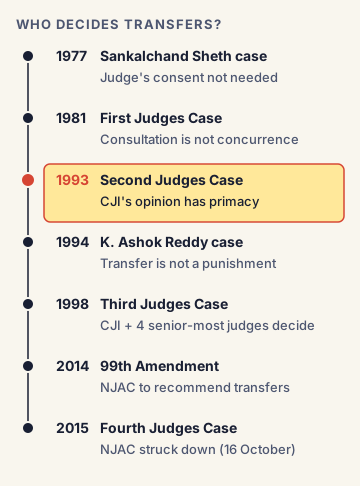
- Union of India v. Sankalchand Himatlal Sheth (1977): A Gujarat High Court judge, transferred to the Andhra Pradesh High Court in 1976, challenged his transfer. The majority of a five-judge bench held that the judge's consent is not needed for a transfer. But consultation with the CJI must be full and effective, and a transfer can only be made in the public interest.
- S.P. Gupta v. Union of India (1981), the First Judges Case: The Court said "consultation" with the CJI does not mean "concurrence" (agreement). This gave the government the upper hand.
- Supreme Court Advocates-on-Record Association v. Union of India (1993), the Second Judges Case: The Court reversed this. It held that the CJI's opinion has primacy, and a transfer can be made only on the CJI's proposal. It also said transfers are not open to challenge in court on their merits; a court can step in only if the CJI was not properly consulted.
- K. Ashok Reddy v. Government of India (1994): The Court confirmed that transfers under Article 222 are valid, are made in the public interest and are not a punishment. It said the participation of the CJI is itself a strong safeguard against misuse, so judicial review is very limited.
The Third Judges Case (1998), a Presidential Reference under Article 143, then fixed who exactly must be consulted.
How does a transfer happen today, step by step?
The steps come from the Third Judges Case and the Memorandum of Procedure (MoP), the agreed rulebook between the judiciary and the government:
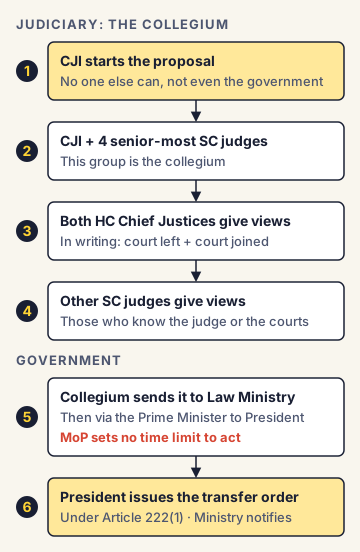
- The CJI starts the proposal. Nobody else, including the government, can start it.
- The CJI consults the four senior-most judges of the Supreme Court. Together they form the collegium.
- The collegium takes the views of the Chief Justice of the High Court the judge is leaving and the Chief Justice of the High Court the judge is joining. These views must be in writing.
- It also takes the views of one or more Supreme Court judges who know the judge or the courts concerned.
- The collegium's recommendation goes to the Union Law Ministry, which processes it and puts it up through the Prime Minister to the President.
- The President issues the transfer order, and the Law Ministry notifies it.
For transferring a Chief Justice of a High Court, the views of the Supreme Court judges familiar with that judge are taken. A long-standing practice is that the Chief Justice of a High Court is usually from outside that state. The MoP sets no time limit for the government to act on a transfer recommendation, as the Union Law Ministry told Parliament in 2024.
Indian examples
In March 2025, the collegium recommended sending Justice Yashwant Varma of the Delhi High Court back to his parent court, the Allahabad High Court, after cash was reportedly found at his official residence during a fire. The Law Ministry notified the transfer under Article 222(1) on 28 March 2025, while a separate in-house inquiry went on.
In 2019, the then Chief Justice of the Madras High Court, Justice Vijaya K. Tahilramani, resigned after the collegium declined her request to reconsider her transfer to the much smaller Meghalaya High Court. Such cases show why critics say transfers can feel like a penalty even when they are officially "in the public interest".
Commonly confused concepts
- Article 222 (transfer of judges) vs Article 139A (transfer of cases): Article 222 moves a judge between High Courts. Article 139A, added by the 42nd Amendment Act, 1976, lets the Supreme Court move cases from one High Court to another, or to itself.
- Transfer vs appointment (Article 217): Appointment brings a new person onto the bench; transfer moves an existing judge. Both are recommended by the collegium, but appointment to a High Court also involves the High Court collegium and the state government.
- Transfer vs removal: A transfer does not end a judge's career. Removal needs a special majority in both Houses of Parliament for "proved misbehaviour or incapacity" (Article 217(1)(b) read with Article 124(4)), under the process in the Judges (Inquiry) Act, 1968.
- Transfer vs repatriation: "Repatriation" is just a transfer that sends a judge back to their parent High Court, the court where they were first appointed.
- Consultation vs concurrence: "Consultation" means asking for an opinion; "concurrence" means getting agreement. The First Judges Case said the CJI's view was only consultative; the Second Judges Case made it decisive.
Issues, criticism and the way forward
- No written criteria: Transfers have depended on unwritten norms. This leads to charges of arbitrariness, and of transfers being used to favour or punish judges.
- Transfer as hidden punishment: Although the Supreme Court has said transfers are not punitive, many recent transfers were seen as moving judges out because of complaints. Critics say this just shifts a problem judge to another court, and that real complaints should go through the in-house procedure or impeachment.
- Government delays: Some recommendations stay pending with the Union government for long periods, while others are cleared quickly. Since the MoP has no deadline, this selective delay can weaken the collegium's decisions.
- Effect on the judge and the court: A sudden transfer disturbs the judge's family, and the receiving court's lawyers may protest, as the Allahabad High Court Bar did in 2025.
- Way forward: Experts suggest a published transfer policy with objective grounds; reasons recorded in collegium resolutions; a fixed time limit for the government to act; a step of warning and correction before using a transfer for conduct issues; and a clear route for the collegium to reconsider recommendations that the government has sent back or left pending.
Concepts to Know
- Collegium: The small group of the senior-most Supreme Court judges (CJI plus four) that recommends appointments and transfers of judges. It is not in the Constitution; it was created by the Judges Cases.
- Puisne judge: Any judge of a court other than the Chief Justice. Pronounced "pyoo-nee".
- Parent High Court: The High Court where a judge was first appointed.
- Memorandum of Procedure (MoP): The written procedure, agreed between the judiciary and the government, for how judges are appointed and transferred.
- Presidential Reference (Article 143): The President can ask the Supreme Court for its opinion on an important question of law. The Third Judges Case came about this way.
- In-house procedure: A system created by the judiciary itself to inquire into complaints against judges, short of impeachment by Parliament.
- Judicial review: The power of courts to examine whether an action of the government (or here, a transfer) follows the Constitution and the law.
- Article 222(1): President transfers a High Court judge after consultation with the CJI
- Article 222(2): transferred judge gets a compensatory allowance fixed by Parliament by law (or by Presidential order until then)
- Article 217(1) proviso (c): office in the old High Court is vacated on transfer
- Seventh Amendment, 1956: removed clause (2); Fifteenth Amendment, 1963: reinserted clause (2)
- Ninety-ninth Amendment, 2014 (NJAC) changed clause (1), but was struck down on 16 October 2015 (Fourth Judges Case)
- Sankalchand Sheth (1977): consent of the judge not needed; transfer only in public interest
- First Judges Case (1981): consultation is not concurrence; Second Judges Case (1993): CJI's opinion has primacy; Third Judges Case (1998): CJI plus four senior-most judges decide transfers
- K. Ashok Reddy (1994): transfers are not punitive; judicial review is very limited
- Article 139A (42nd Amendment, 1976) deals with transfer of cases, not judges
- The MoP prescribes no time limit for the government to act on transfer recommendations
● Tracked since November 11, 2026 · last seen November 11, 2026 · updates as the daily brief publishes