Trade Facilitation Agreement (TFA)
Making Goods Cross Borders Faster
The Trade Facilitation Agreement (TFA) is a World Trade Organization (WTO) agreement that makes it faster, cheaper and simpler for goods to cross borders. It does not cut tariffs (import taxes). Instead, it cuts the paperwork, delays and confusion at customs. It came into force on 22 February 2017 and binds all WTO members who have accepted it.
Why does it exist?
Imagine an exporter in Tiruppur who sends a container of shirts to Germany. Even if the tariff is zero, the shirts may sit at the port for days. Officials may ask for the same paper five times, rules may not be published anywhere, and each office may check the container again. Every extra day costs money in storage, interest and lost orders.
These hidden costs often hurt trade more than tariffs do. The TFA attacks these hidden costs. The WTO has estimated that full implementation of the TFA could cut global trade costs by an average of about 14.3%.
Where did it come from?
WTO members began discussing trade facilitation at the Singapore Ministerial Conference in 1996, as one of the four "Singapore issues". Formal negotiations started in 2004 as part of the Doha Round. The text was finally agreed at the WTO's Ninth Ministerial Conference in Bali, Indonesia, in December 2013, as part of the "Bali Package". It is the first multilateral agreement concluded since the WTO was set up in 1995.
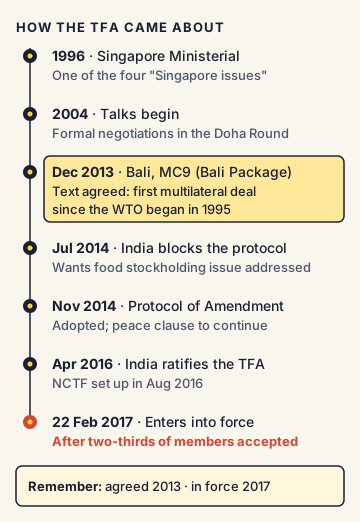
To add it to the WTO rulebook, members adopted a Protocol of Amendment in November 2014. The agreement entered into force on 22 February 2017, once two-thirds of WTO members had formally accepted it. India ratified it in April 2016.
What does it require?
The TFA has two parts. Section I lists the actual measures that customs and other border agencies must follow. Important ones include:
- Publishing information: Rules, forms, fees and procedures must be published and made available online, so traders know them in advance.
- Advance rulings: A trader can ask customs, before shipping, how a product will be classified and taxed, and get a binding written answer.
- Pre-arrival processing: Customs can process documents before the goods physically arrive, so clearance starts earlier.
- Risk management: Customs should not check every container. It should focus physical checks on high-risk shipments and let low-risk ones pass quickly.
- Post-clearance audit: Instead of holding goods at the border, customs can check records later at the trader's office.
- Authorised operators: Trusted, compliant traders get extra benefits such as fewer checks and faster release.
- Single Window: A trader submits all documents once, through one entry point, instead of visiting many different agencies.
- Border agency cooperation: Customs, health, plant quarantine and other agencies at the border must coordinate, and neighbouring countries are encouraged to coordinate too.
- Freedom of transit: Goods passing through a country to another country should not face unnecessary delays or charges.
- National Committee on Trade Facilitation: Each member must set up a national body to coordinate and implement the agreement.
How does the special treatment for developing countries work?
Section II is about flexibility. Developed countries had to apply the whole agreement from day one. Developing and least-developed countries could sort each measure into one of three groups:
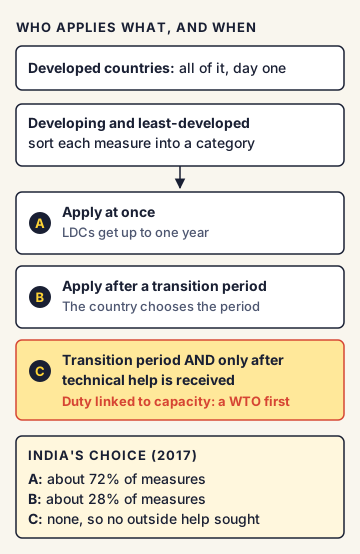
- Category A: Measures they will apply as soon as the agreement comes into force (or within one year for least-developed countries).
- Category B: Measures they will apply after a transition period that they choose.
- Category C: Measures they will apply after a transition period and only after receiving technical help and capacity-building support.
This was a first in WTO history: the obligation to implement was linked to a country's capacity to do so.
India's position and Indian examples
India notified its category choices by 22 February 2017. About 72% of the measures were placed in Category A and the rest in Category B; India placed nothing in Category C, meaning it did not ask for outside assistance. India set up the National Committee on Trade Facilitation (NCTF) in August 2016, under the Cabinet Secretary. It released the National Trade Facilitation Action Plan in July 2017 with 76 action points. On the ground, Indian customs has introduced:
- SWIFT (Single Window Interface for Facilitating Trade), launched in 2016, for one-time electronic filing of import documents.
- Authorised Economic Operator (AEO) programme, which gives trusted traders faster clearance.
- Faceless assessment, rolled out nationwide in 2020, where the officer who assesses the goods is not at the same port and does not meet the trader, reducing delays and chances of corruption.
- The online customs portal ICEGATE for electronic filing and payment.
Commonly confused concepts
- TFA vs FTA: The TFA is a WTO-wide agreement about customs procedures. An FTA is a deal between a few countries to cut tariffs. A country can have a zero tariff under an FTA and still lose business if its customs is slow; the TFA tackles that second problem.
- TFA vs Trade Facilitation in Services (TFS): India proposed a separate services facilitation agreement at the WTO in 2014-15. It did not become a WTO agreement. The TFA covers only goods.
- Trade facilitation vs trade liberalisation: Liberalisation means cutting tariffs and quotas. Facilitation means simplifying procedures without changing tariffs.
Issues, criticism and the way forward
- The 2014 deadlock: In July 2014, India refused to approve the TFA protocol until the WTO also addressed its concerns about public food stockholding (buying grain at the Minimum Support Price for the public distribution system). The deadlock ended in November 2014 when members agreed that the "peace clause" protecting such programmes from legal challenge would continue until a permanent solution is found. This showed how developing countries link facilitation to food security concerns.
- Uneven implementation: Many poorer countries still lack the computers, trained staff and laboratories needed for Category C measures.
- Many agencies, not just customs: Delays often come from other border agencies (food safety, plant quarantine, drug control). Customs reform alone is not enough.
- Way forward: Fully paperless trade, mutual recognition of each other's AEO programmes with major partners, and including trade facilitation chapters in FTAs (as India and the EU are doing).
Concepts to Know
- World Trade Organization (WTO): The global body, set up in 1995 and based in Geneva, that sets rules for trade between countries and settles trade disputes.
- Customs: The government department that checks goods entering or leaving a country and collects import duties on them.
- Tariff: A tax charged on imported goods. If a ₹100 shirt faces a 10% tariff, the importer pays ₹10 to the government.
- Doha Round: A round of WTO negotiations launched in Doha, Qatar, in 2001. Most of it remains unfinished.
- Ratify: When a country formally approves an international agreement so that it becomes legally binding on it.
- Concluded: Bali Ministerial Conference (MC9), December 2013
- Entered into force: 22 February 2017, after two-thirds of WTO members accepted it
- India ratified: April 2016
- India's notification: about 72% Category A, about 28% Category B, no Category C
- Three categories (A, B, C) for developing and least-developed members
- Every member must have a National Committee on Trade Facilitation; India's NCTF set up in August 2016 under the Cabinet Secretary
- India's National Trade Facilitation Action Plan (2017): 76 action points
- WTO estimate: average trade cost cut of about 14.3% on full implementation
● Tracked since April 24, 2026 · last seen November 02, 2026 · updates as the daily brief publishes