Tele-MANAS
India's National Tele Mental Health Programme
Tele-MANAS is India's free, round-the-clock mental health helpline. Anyone can call 14416 (or 1-800-891-4416) from any phone and talk to a trained counsellor in their own language, without giving their name. If needed, the caller is connected to a psychologist or psychiatrist. The full name is Tele Mental Health Assistance and Networking Across States, and it is the main part of the National Tele Mental Health Programme (NTMHP).
Why does it exist?
India has a very large number of people who need mental health care, but very few doctors and counsellors to help them.
- The National Mental Health Survey (2015-16), carried out by NIMHANS, found that about 10.6% of adults in India had a mental health problem at the time of the survey. About 15 crore people needed care.
- The treatment gap (the share of people who need care but do not get it) was very large, above 80% for several common disorders.
- Specialists are few and are mostly in big cities. A person in a village may have to travel hundreds of kilometres to see a psychiatrist.
- Stigma (shame and fear of being judged) stops many people from going to a clinic at all.
A phone call solves several of these problems at once. It is free, it reaches remote villages, it needs no travel, and nobody else needs to know. Think of it like a "108 ambulance" for the mind: one easy number that connects you to the right help.
Where did it come from?
The COVID-19 pandemic caused a sharp rise in stress, loneliness, job loss and grief. In the Union Budget 2022-23 (February 2022), the government announced a National Tele Mental Health Programme. Tele-MANAS was launched on World Mental Health Day, 10 October 2022, from NIMHANS (National Institute of Mental Health and Neuro-Sciences) in Bengaluru.
- NIMHANS, Bengaluru is the nodal centre, meaning it leads, trains and guides the whole network.
- IIIT Bangalore (International Institute of Information Technology) provides technology support.
- At launch, the network had 23 tele-mental health centres of excellence, which act as mentors for state cells.
- The Ministry of Health and Family Welfare runs it, with the National Health Systems Resource Centre (NHSRC) also supporting.
- Later, a Tele-MANAS mobile app and video consultation options were added, and a special cell was set up for the armed forces through an agreement with the Ministry of Defence.
How does it work, step by step?
Tele-MANAS has a two-tier structure.
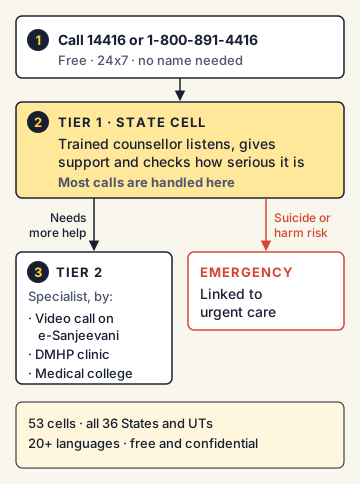
- Tier 1, the State Tele-MANAS cell: Your call first reaches a cell in your state. A trained counsellor listens, gives basic support and advice, and checks how serious the problem is. Most calls are handled at this level.
- Tier 2, specialist care: If you need more help, you are referred to a mental health specialist. This can be a video consultation through e-Sanjeevani (the government's online doctor service), or an in-person visit to a District Mental Health Programme (DMHP) clinic or a medical college.
- Emergencies: If a caller is at risk of suicide or harm, the team links them to urgent care.
As of October 2026, there are 53 operational cells covering all 36 States and UTs, and the service is offered in 20+ languages.
How does it fit into India's wider mental health system?
- National Mental Health Programme (NMHP), 1982: India's first national plan for mental health. It aimed to make basic mental health care available to everyone, especially the poor.
- District Mental Health Programme (DMHP), 1996: Started under the NMHP to take care down to the district level. It began in 4 districts using a model first tried in Bellary, Karnataka. As of 2026, it is sanctioned in 767 districts.
- National Mental Health Policy, 2014: India's first mental health policy. It focuses on prevention, rights and community care.
- Mental Healthcare Act, 2017: Makes access to mental healthcare a legal right for every person.
- Ayushman Arogya Mandirs (earlier called Health and Wellness Centres): Primary health centres where basic mental health screening and care are now offered. More than 1.83 lakh have integrated mental health services.
- Kiran helpline (2020): An earlier mental health helpline started by the Ministry of Social Justice and Empowerment in September 2020. Its merger with Tele-MANAS was announced in February 2024, and its calls were diverted to Tele-MANAS.
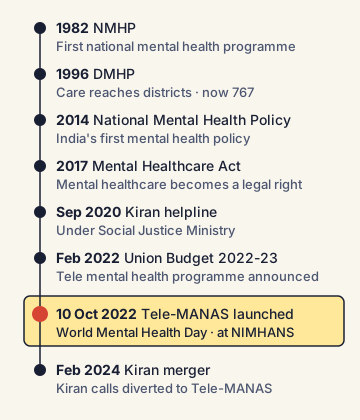
Tele-MANAS is the "front door" of this system: the easiest first step, which then guides the caller to the right level of care.
India and the global push for community care
WHO's long-standing advice is that mental health care should be given close to people's homes, in the community, not mainly in large psychiatric hospitals where patients may stay for years. This shift is called deinstitutionalisation. Tele-MANAS, DMHP clinics and Ayushman Arogya Mandirs are all parts of India's effort to bring care into the community. WHO warns, however, that this shift must come with proper follow-up care, rehabilitation and housing; simply closing hospitals is not enough.
Commonly confused concepts
- Tele-MANAS vs e-Sanjeevani: Tele-MANAS is a phone helpline for mental health only. e-Sanjeevani is the government's general online doctor consultation service for all illnesses. Tele-MANAS uses e-Sanjeevani for video consultations with specialists.
- Tele-MANAS vs Kiran: Both are mental health helplines. Kiran (2020) came under the Ministry of Social Justice and Empowerment. Tele-MANAS (2022) is under the Health Ministry and is now the main national helpline.
- NMHP vs DMHP: NMHP (1982) is the national programme. DMHP (1996) is the part of the NMHP that delivers care in districts.
- 14416 vs 112 vs 108: 14416 is the mental health helpline. 112 is the single emergency number for police, fire and ambulance. 108 is the ambulance service in many states.
- Counsellor vs psychologist vs psychiatrist: A counsellor gives listening support and guidance. A clinical psychologist diagnoses and treats through talk-based therapy. A psychiatrist is a medical doctor who can also prescribe medicines.
Issues, criticism and the way forward
- Follow-up is weak: A phone call is only the first step. Many callers need ongoing care, but local clinics and specialists are still scarce, especially in rural areas.
- Shortage of specialists: India has very few psychiatrists, psychologists and psychiatric social workers compared to its population.
- Awareness: Many people, especially in villages and among older adults, still do not know about 14416.
- Low spending: Mental health gets a very small share of India's health budget, and most state governments spend less than 1% of their health budgets on it.
- Quality and privacy: Counsellors need continuous training. Callers must trust that their information is kept private.
- Youth focus: With most callers aged 18 to 45 and many young people facing exam and job stress, experts suggest linking Tele-MANAS with schools, colleges and workplaces.
- Way forward: Experts suggest more trained staff at the district level, better links between the helpline and local clinics, more awareness drives, regular public reporting of outcomes, and higher budgets for community mental health.
Concepts to Know
- Mental health: A state in which a person can cope with normal stress, work well, and enjoy relationships. It is as important as physical health.
- Treatment gap: The share of people who need treatment but do not receive it.
- Stigma: A feeling of shame or social disapproval attached to something. Mental illness often carries stigma, which stops people from seeking help.
- Nodal centre: The main institution that leads, coordinates and trains all the others in a programme.
- Deinstitutionalisation: Moving mental health care out of large closed hospitals and into community settings near people's homes.
- Tele-health: Giving health advice or treatment from a distance, by phone or video.
- Full name: Tele Mental Health Assistance and Networking Across States
- Announced in Union Budget 2022-23; launched 10 October 2022 (World Mental Health Day)
- Helpline: 14416 or 1-800-891-4416; free, confidential, 24x7
- Nodal centre: NIMHANS, Bengaluru; technology support: IIIT Bangalore
- Two tiers: State cells with counsellors (Tier 1); specialists via e-Sanjeevani, DMHP and medical colleges (Tier 2)
- As of October 2026: 53 cells, all 36 States and UTs, 47,75,644 calls
- NMHP: 1982; DMHP: 1996 (now 767 districts); National Mental Health Policy: 2014
- National Mental Health Survey 2015-16: about 10.6% adults with a current mental disorder
● Tracked since October 11, 2026 · last seen October 11, 2026 · updates as the daily brief publishes