Mental Healthcare Act, 2017
Rights of Persons with Mental Illness
The Mental Healthcare Act, 2017 is India's main law on mental health. It gives every person a legal right to get mental healthcare from services run or funded by the government. It also protects the dignity and rights of people with mental illness, lets them decide in advance how they want to be treated, and says that a person who attempts suicide should be helped, not punished.
Why was it needed?
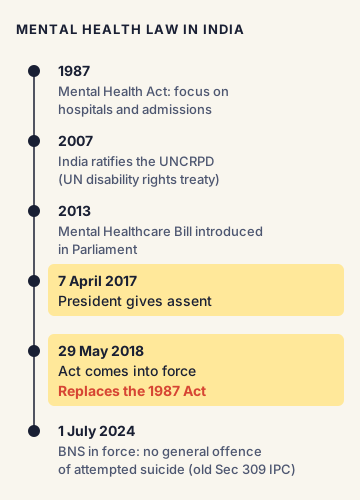
Before this law, the Mental Health Act, 1987 governed mental health in India. It focused mainly on running mental hospitals and on admitting patients, often against their will. It said little about patients' rights. Many people with mental illness were chained, kept in poor conditions or abandoned in hospitals for years. India had also signed the UN Convention on the Rights of Persons with Disabilities (UNCRPD) and ratified it in 2007. This treaty required India to change its laws to respect the rights and choices of people with mental illness.
Where did it come from?
The Mental Healthcare Bill was introduced in Parliament in 2013 and passed in 2017. The President gave assent on 7 April 2017. It came into force on 29 May 2018. It replaced the Mental Health Act, 1987. It shifted the focus from controlling patients to protecting their rights.
What does "mental illness" mean under this law?
The Act defines mental illness as a serious disorder of thinking, mood, perception, orientation or memory that greatly affects a person's judgement, behaviour, ability to recognise reality or ability to meet the ordinary demands of life. It also includes problems linked to alcohol and drug misuse. It does not include mental retardation (now called intellectual disability), which is a separate condition.
The Act also says a person cannot be called mentally ill just because of their political, economic or social status, their religious or cultural beliefs, or because they do not follow common moral or social values.
The key rights and provisions
- Right to access mental healthcare (Section 18): Every person has the right to mental health services that are affordable, of good quality, available in enough numbers and close to home. People below the poverty line, and homeless people, must get free treatment.
- Advance directive (Section 5): A person can write down in advance how they want to be treated, and how they do not want to be treated, if they later become mentally ill. It is like a "living instruction" for future care.
- Nominated representative (Section 14): A person can choose someone they trust to help make treatment decisions for them.
- Right to confidentiality: Information about a patient's mental health and treatment must be kept private.
- Right to dignity and equality: No cruel or degrading treatment. Patients must not be chained. They have the right to live in the community and not be left in hospitals.
- Mental health in insurance: Insurance companies must cover mental illness in the same way as physical illness.
- Limits on electroconvulsive therapy (ECT): ECT (treatment using controlled electric current to the brain) is banned without anaesthesia and muscle relaxants. ECT for children is banned except with special permission from the Board.
Decriminalising attempted suicide (Section 115)
Before this law, attempting suicide was a crime under Section 309 of the Indian Penal Code. Section 115 of the Act says that a person who attempts suicide shall be presumed to be under severe stress, unless proven otherwise, and shall not be tried or punished. The government must give such a person care, treatment and rehabilitation.
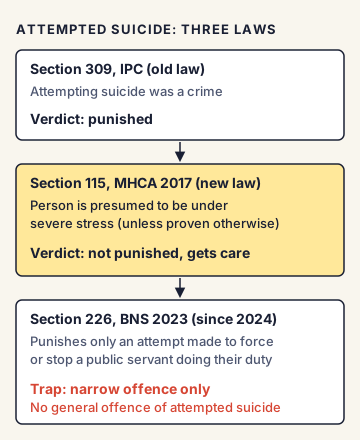
The new criminal code, the Bharatiya Nyaya Sanhita (BNS), 2023, in force since 1 July 2024, does not carry forward the general offence of Section 309. It has a narrower Section 226, which punishes attempting suicide in order to force or stop a public servant from doing their duty.
Who enforces the law?
The Act sets up new bodies:
- Central Mental Health Authority: At the national level. It registers mental health establishments run by the Centre and registers mental health professionals.
- State Mental Health Authority: In each state. It does the same for the state's establishments and professionals.
- Mental Health Review Boards: Quasi-judicial bodies (bodies that work somewhat like courts) at the district level. They review admissions against a person's will, protect patients' rights and hear complaints. They also check advance directives.
How do admissions work?
Most patients should be admitted as independent patients, meaning they choose admission themselves and can leave. Supported admission (admission without the person's full consent) is allowed only in limited cases, for example when a person is at serious risk of harming themselves or others. It is time-limited and must be reported to the Review Board. This protects people from being locked up for years.
Commonly confused concepts
- Mental Healthcare Act, 2017 vs Mental Health Act, 1987: The 1987 Act focused on hospitals and admissions. The 2017 Act focuses on rights, makes care a legal right and decriminalises attempted suicide.
- Mental Healthcare Act vs Rights of Persons with Disabilities (RPwD) Act, 2016: The RPwD Act covers 21 types of disabilities, including mental illness, and deals with rights such as reservation in jobs and education. The Mental Healthcare Act deals specifically with treatment and care for mental illness.
- Mental illness vs intellectual disability: Mental illness affects thinking, mood or behaviour and can often be treated. Intellectual disability means limited development of mental abilities from childhood. The 2017 Act excludes intellectual disability from "mental illness".
- Advance directive vs nominated representative: An advance directive is a written instruction about treatment. A nominated representative is a person chosen to support decisions.
- Section 115 MHCA vs Section 309 IPC vs Section 226 BNS: Section 309 IPC made attempted suicide a crime. Section 115 MHCA created a presumption of severe stress, so the person is not punished. Section 226 BNS punishes only an attempt made to pressure a public servant.
Issues, criticism and the way forward
- Weak implementation: Many states were slow to set up State Mental Health Authorities and Review Boards, and to frame rules. The Supreme Court has asked states to implement the Act properly.
- Not enough services: The right to care means little if there are not enough psychiatrists, psychologists and clinics. Rural areas suffer most.
- Low funding: Mental health gets a very small share of health budgets.
- Persons abandoned in hospitals: Many recovered patients still live in mental hospitals because families do not take them back. The Act's promise of community living needs halfway homes and support services.
- Debate on supported admission: Some experts say rules on admission without consent are too strict and make it hard to treat people in crisis. Others say strong safeguards are needed to prevent abuse.
- Way forward: Experts suggest full funding for the Act's bodies, more trained staff, more community-based services and halfway homes, awareness about advance directives, and linking helplines such as Tele-MANAS with local care.
Concepts to Know
- Ratify: When a country formally agrees to be bound by an international treaty it has signed.
- Decriminalise: To make an act no longer a crime under law.
- Quasi-judicial body: A body that is not a regular court but can hear cases and give decisions in a limited area.
- Presumption: Something the law assumes to be true unless someone proves otherwise.
- Electroconvulsive therapy (ECT): A medical treatment for some severe mental illnesses, in which a small controlled electric current is passed through the brain while the patient is under anaesthesia.
- Halfway home: A place where people recovering from mental illness live for a time before returning fully to normal life in society.
- Assent: 7 April 2017; in force: 29 May 2018; replaced the Mental Health Act, 1987
- Aligned with the UNCRPD (ratified by India in 2007)
- Section 5: advance directive; Section 14: nominated representative; Section 18: right to access mental healthcare
- Section 115: person attempting suicide presumed to be under severe stress, not to be tried or punished
- BNS, 2023 (in force 1 July 2024): no general offence of attempted suicide; Section 226 covers attempts to compel or restrain a public servant
- Bodies: Central Mental Health Authority, State Mental Health Authorities, Mental Health Review Boards
- ECT without anaesthesia and muscle relaxants banned; ECT for minors restricted
- Free treatment for people below the poverty line and homeless persons
● Tracked since February 21, 2026 · last seen October 11, 2026 · updates as the daily brief publishes