System of National Accounts (SNA)
The UN Rulebook for Measuring an Economy
The System of National Accounts (SNA) is the international rulebook that tells every country how to measure its economy. It defines what counts as production, income, consumption, investment and wealth, and how to record them. Because almost every country follows it, India's GDP can be compared with that of the US, China or Brazil. The latest version, the 2025 SNA, was adopted by the United Nations Statistical Commission in March 2025, and one of its biggest changes is that data is now treated as an asset.
Why does the SNA exist?
Imagine every family in a housing society keeping accounts in its own way. One counts rent as income, another forgets loans, a third counts the same money twice. Comparing them would be impossible. Countries faced the same problem. Without one rulebook, a country could make its economy look bigger simply by counting things differently. The SNA gives everyone the same definitions, so GDP, savings, investment and debt mean the same thing everywhere. International bodies such as the IMF and World Bank rely on these comparable numbers for lending, rankings and advice.
Where did it come from?
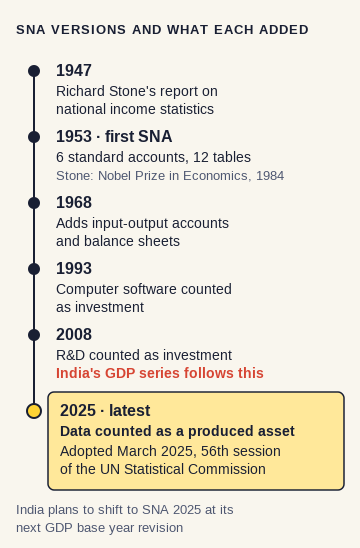
- After the Second World War, countries needed reliable numbers to rebuild their economies. In 1947, a League of Nations expert sub-committee led by British economist Richard Stone produced an early report on national income statistics.
- 1953 SNA: the first international standard, issued under the UN Statistical Commission. It had six standard accounts and 12 standard tables. Richard Stone later won the Nobel Prize in Economics (1984) for this work.
- 1968 SNA: added input-output accounts (tables showing how industries buy from and sell to each other) and balance sheets (records of what a country owns and owes).
- 1993 SNA: a major update that brought national accounts in line with other international statistical standards. It treated items like computer software as investment.
- 2008 SNA: updated for a changing world. For example, spending on research and development (R&D) began to be counted as investment, not as a cost that is used up.
- 2025 SNA: adopted at the 56th session of the UN Statistical Commission, held in New York on 4 to 7 March 2025.
Who makes it?
The SNA is prepared jointly by five international organisations working together as the Inter-Secretariat Working Group on National Accounts (ISWGNA):
- the United Nations (through its Statistics Division)
- the International Monetary Fund (IMF)
- the World Bank
- the Organisation for Economic Co-operation and Development (OECD)
- the European Commission (Eurostat, its statistics office)
The UN Statistical Commission, the top body of world statisticians, adopts each version as the official standard.
How does the SNA work?
The SNA is like a set of linked account books for the whole country.
- Sectors: The economy is split into groups such as companies, banks and insurers, government, households, and non-profit bodies serving households.
- Accounts in a sequence: For each sector, the accounts follow money step by step. First, what is produced (production account). Then, who earns the income from it (income accounts). Then, how income is spent or saved (use of income). Then, how savings are invested (capital account) and borrowed or lent (financial account).
- Balance sheets: At the end, the SNA records what each sector owns (assets) and owes (liabilities).
- Production boundary: The SNA sets a clear line on what counts as production. For example, rent that homeowners "pay themselves" by living in their own house (imputed rent) is counted. But a family member cooking and cleaning at home without pay is not counted in GDP.
What is an "asset" in the SNA, and why does it matter?
In national accounts, an asset is something that gives benefits to its owner over time. A produced fixed asset is something made by people and used again and again in production for more than one year, such as a factory machine, a building or software. Spending on such assets is counted as investment (gross fixed capital formation), which is part of GDP. Spending by a producer on things it uses up in production within the year, like raw materials or electricity, is intermediate consumption.
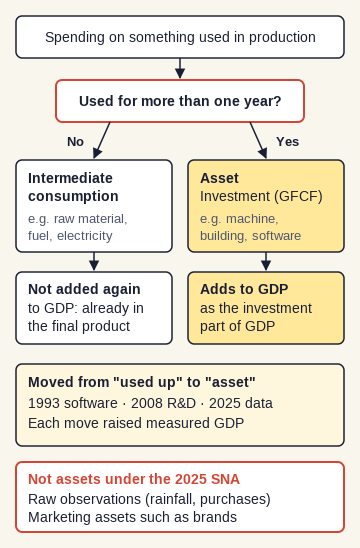
It is not added to GDP separately, because its value is already inside the final product. So when the rulebook moves an item from "used up" to "asset", the measured GDP usually goes up. This is exactly what happened when software (1993 SNA) and R&D (2008 SNA) were reclassified.
What is new in the 2025 SNA?
The update was built around a few big themes: globalisation, digitalisation, well-being and sustainability, and financial risks. The key changes UPSC could ask about are:
- Data as a produced asset: Data that is collected, organised and stored digitally, and used in production for more than one year, is now counted as an asset. A bank's customer database or a map company's road database are examples.
- Observations are not the asset: The raw facts of the world (for example, how much rain fell, or what people bought) are called observable phenomena. They are not counted as assets on their own. Only the data that someone produces by recording and organising them is the asset.
- How data is valued: Most data is made by companies for their own use and is never sold, so it has no market price. It is valued by the sum-of-costs method: adding up the costs of planning, collecting, recording, storing and organising it.
- Natural resource depletion: When oil, coal or forests are used up, the 2025 SNA records this as a cost of production. This lowers net measures such as Net Domestic Product (NDP) and net saving, but not GDP (which is "gross", that is, before such costs are subtracted).
- Crypto assets: Crypto assets that are nobody's debt (like Bitcoin) are recorded as a separate kind of non-produced, non-financial asset. Crypto assets backed by a matching liability are treated as financial assets.
- Not adopted: A proposal to count marketing assets (brands, trademarks, customer lists) as produced assets was not endorsed by the UN Statistical Commission.
India's position
India's GDP estimates follow the SNA 2008. This is true for the current series with base year 2022-23, as the guidance of the Ministry of Statistics and Programme Implementation (MoSPI) states. The earlier 2004-05 series followed the 1993 SNA, and the move to SNA 2008 came with the 2011-12 series. MoSPI says countries are expected to adopt the 2025 standard around 2029-30, and India plans to shift to SNA 2025 in its next base year revision.
A Sub-committee on SNA Update under the Advisory Committee on National Accounts Statistics (ACNAS), MoSPI's expert panel on GDP methods, is studying the changes. India is also a subscriber to the IMF's Special Data Dissemination Standard (SDDS), a set of rules for publishing economic data on time and openly.
Commonly confused concepts
- SNA vs SEEA: The System of Environmental-Economic Accounting (SEEA) is a companion UN standard that measures the environment (water, forests, minerals, ecosystems) and links it to the economy. Its Central Framework was adopted in 2012 and its Ecosystem Accounting in 2021. The SNA measures the economy itself. India's environment accounts (MoSPI's EnviStats) follow the SEEA.
- SNA vs BPM7: The IMF's Balance of Payments Manual, 7th edition (BPM7) covers only a country's dealings with the rest of the world (exports, imports, foreign investment). It was updated alongside the 2025 SNA so the two match.
- Data vs database vs software: Software (programs) and databases (the system that stores data) were already counted as assets under earlier versions. The 2025 SNA goes further and counts the data content itself.
- Data as an asset vs "digital economy" share: Counting data as an asset changes how investment and GDP are measured. Estimating the size of the digital economy is a separate exercise, usually done through satellite accounts (extra tables built around the main accounts).
- GDP vs NDP: GDP is before subtracting the wear and tear of assets (and, now, natural resource depletion). NDP is after subtracting them. A data asset also wears out (it gets outdated), so it adds to depreciation. So counting data as an asset raises NDP by less than it raises GDP, because NDP also subtracts this wear and tear.
Issues, criticism and the way forward
- Hard to measure: Most data is made in-house and never sold. Estimating its value from costs needs detailed company information on staff time and IT spending, which many countries, including India, do not yet collect.
- Risk to comparability: When some countries adopt the new rules earlier than others, GDP levels jump at different times. Users must take care when comparing countries or years.
- Government data: Governments hold huge datasets (land records, tax records, ID systems). Deciding which of these are assets and how to value them is still being researched, including by the IMF.
- Size of the change: Critics warn that each new item counted as investment can push up GDP on paper without any change in people's lives. Supporters reply that leaving out a major modern input like data would make GDP outdated.
- Way forward: Experts suggest new surveys of how firms spend on data, closer use of company filings and GST records, clear publication of the methods, and a back series so old and new numbers can be compared.
Concepts to Know
- Gross fixed capital formation (GFCF): The money spent on new long-lasting assets like machines, buildings, software and now data. It is the "investment" part of GDP.
- Intermediate consumption: Goods and services used up while producing something else, such as raw materials, fuel or electricity. It is not added to GDP separately.
- Sum-of-costs method: Valuing something that has no market price by adding up what it cost to make (wages, equipment use, other inputs).
- Depreciation (consumption of fixed capital): The fall in value of an asset because of wear and tear or because it becomes outdated.
- Satellite account: An extra set of tables attached to the national accounts to study one area in detail (for example tourism, health or the digital economy) without changing the main GDP number.
- UN Statistical Commission: The highest global body for official statistics, made up of the heads of national statistics offices; it adopts world statistical standards.
- Versions of the SNA: 1953, 1968, 1993, 2008, 2025
- 1953 SNA: six standard accounts and 12 standard tables; linked to Richard Stone (Nobel Prize, 1984)
- 2025 SNA adopted at the 56th session of the UN Statistical Commission, 4 to 7 March 2025, New York
- Prepared by the ISWGNA: UN, IMF, World Bank, OECD and European Commission (Eurostat)
- 2025 SNA: data counted as a produced asset, valued by sum of costs; raw observable phenomena not counted
- 2025 SNA: natural resource depletion recorded as a cost of production (lowers NDP, not GDP)
- Marketing assets were not accepted as produced assets
- India: current series (base 2022-23) follows SNA 2008; shift to SNA 2025 planned at the next base revision; countries expected to adopt it around 2029-30
● Tracked since February 28, 2026 · last seen November 23, 2026 · updates as the daily brief publishes