Speaker of the State Legislative Assembly
The Speaker is the person who runs the meetings of a state's Legislative Assembly (Vidhan Sabha). The Speaker keeps order, decides who speaks, puts questions to vote and protects the rights of the House. The Speaker is an ordinary MLA chosen by the other MLAs, but once chosen, the Speaker is expected to be fair to all sides. The office is set up by Articles 178 to 181 of the Constitution.
Why does a House need a Speaker?
Imagine a classroom debate with 200 students and no teacher. Everyone would speak at once, and nothing would be decided. An Assembly is similar. Someone must decide whose turn it is, which rule applies and when a vote is taken. The Speaker is like the umpire in a cricket match: not a player for either team, but the person whose decisions keep the game fair. The Speaker also speaks for the whole House when dealing with the Governor, the courts and the outside world.
Where did the office come from?
The idea comes from the Speaker of the British House of Commons, a post that is several centuries old. In India, provincial assemblies had their own presiding officers under British-era laws, and the Government of India Act, 1935 gave each provincial Legislative Assembly a Speaker and a Deputy Speaker. The Constitution kept this office for every state Assembly in Part VI, Chapter III (the state legislature).
Later, the 52nd Amendment Act, 1985 added the Tenth Schedule and made the Speaker the judge in defection cases. This gave the office a new and much-debated power.
How is the Speaker chosen? (Article 178)
Article 178 says every Legislative Assembly shall choose two of its members to be Speaker and Deputy Speaker, as soon as possible. The election is held under the Assembly's own rules of procedure.
- There is no fixed term written in the Constitution. The Speaker normally holds office for the life of the Assembly, which is five years unless it is dissolved earlier.
- When a new Assembly meets for the first time, a temporary presiding officer called the Speaker pro tem runs the oath-taking and the election of the new Speaker. By convention, this is usually a senior member.
- Under Article 180(1), if both the Speaker's and Deputy Speaker's offices are vacant, the Governor appoints a member of the Assembly to do the Speaker's work.
How does a Speaker leave office? (Article 179)
A Speaker vacates the office in three ways:
- If they stop being a member of the Assembly.
- If they resign, by writing to the Deputy Speaker.
- If they are removed by a resolution of the Assembly.
There is one special rule. When the Assembly is dissolved, the Speaker does not leave office at once. The Speaker continues until just before the first meeting of the new Assembly. So the House is never without a Speaker.
How is a Speaker removed?
Removal needs a resolution passed by "a majority of all the then members of the Assembly". At least 14 days' notice must be given before such a resolution is moved. This kind of majority is called an effective majority: a majority of the House's actual strength, after leaving out vacant seats.
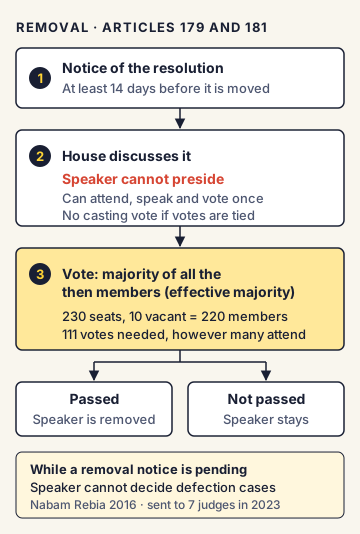
A simple example: the Madhya Pradesh Assembly has 230 seats. Suppose 10 seats are vacant. Then the "then members" are 220, and the resolution needs at least 111 votes. It does not matter how many members are present that day.
What happens while removal is being discussed? (Article 181)
The Speaker cannot preside while a resolution for their own removal is being considered. But the Speaker can attend, speak and take part in the proceedings. The Speaker can also vote in the first round like any member, but gets no casting vote if the votes are tied.
What are the Speaker's main powers?
- Running the House: The Speaker decides points of order, can adjourn or suspend a sitting if there is no quorum, and interprets the House's rules. Article 208 lets each House make its own rules of procedure.
- Casting vote (Article 189): Normally the Speaker does not vote. But if votes are tied, the Speaker casts a deciding vote. This is called a casting vote.
- Quorum (Article 189(3)): The minimum number of members needed for a sitting is ten members or one-tenth of the total members, whichever is greater.
- Money Bills (Article 199(3) and (4)): If there is a doubt whether a Bill is a Money Bill (a Bill only about taxes and spending), the Speaker's decision is final. The Speaker signs a certificate on every Money Bill.
- Resignations (Article 190(3)(b)): When an MLA resigns, the Speaker must accept it only if satisfied that the resignation is voluntary and genuine. This check was added by the 33rd Amendment Act, 1974.
- Defection cases (Tenth Schedule, Paragraph 6): The Speaker decides whether an MLA has become disqualified for defection.
- Protection of proceedings (Article 212): Courts cannot question the Assembly's proceedings only on the ground of an irregular procedure. An officer who regulates procedure, like the Speaker, is not under the courts' control for that work.
- Independence: The Speaker's salary is "charged" on the Consolidated Fund of the State (Article 202(3)(b)). This means it is paid without a vote of the Assembly every year, so the Speaker does not depend on the ruling side for their pay.
The Speaker as a judge in defection cases
This is the most debated part of the job. Under Paragraph 6 of the Tenth Schedule, the Speaker's decision on disqualification is called "final". When deciding these cases, the Speaker acts like a tribunal, which is a body that decides disputes like a court. The courts have shaped this power in several cases:
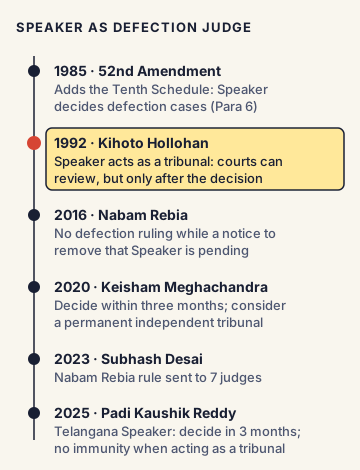
- Kihoto Hollohan v. Zachillhu (1992): A five-judge bench upheld the anti-defection law. It held that the Speaker acts as a tribunal, so the Speaker's decision can be reviewed by the High Courts and the Supreme Court on limited grounds, such as bias or breaking the rules of natural justice. Courts cannot step in before the Speaker decides.
- Nabam Rebia v. Deputy Speaker (2016): A five-judge bench held that a Speaker cannot decide disqualification petitions while a notice to remove that same Speaker is pending.
- Keisham Meghachandra Singh v. Speaker, Manipur Legislative Assembly (21 January 2020): The Supreme Court said that, except in extraordinary situations, a Speaker should decide a disqualification petition within three months. It also suggested that Parliament consider giving this job to a permanent independent tribunal, headed by a retired Supreme Court judge or a retired High Court Chief Justice.
- Subhash Desai v. Principal Secretary, Governor of Maharashtra (11 May 2023): A five-judge bench referred the Nabam Rebia rule to a larger seven-judge bench for reconsideration, because the rule can be misused: a member facing disqualification could simply file a removal notice against the Speaker to stop the case.
- Padi Kaushik Reddy v. State of Telangana (31 July 2025): The Supreme Court directed the Telangana Speaker to decide pending disqualification petitions within three months. It said that a Speaker acting as an adjudicating authority (a decision-maker in a dispute) is a tribunal and does not enjoy constitutional immunity from the courts in this role.
Commonly confused concepts
- Assembly Speaker vs Lok Sabha Speaker: The Lok Sabha Speaker comes from Articles 93 to 96 and runs the lower house of Parliament. The Assembly Speaker comes from Articles 178 to 181 and runs a state's lower house. The rules for election, removal (14 days' notice, effective majority) and presiding during removal are almost the same.
- Speaker vs Chairman of a Legislative Council: States with a second house (a Legislative Council, or Vidhan Parishad) have a Chairman and a Deputy Chairman, chosen under Articles 182 to 185. The Chairman is elected by Council members. Money Bill certification belongs only to the Assembly Speaker.
- Speaker vs Governor: The Governor is the constitutional head of the state and summons and prorogues the House. The Speaker runs the House once it is in session. The Governor does not decide defection cases; the Speaker does.
- Removal resolution vs no-confidence motion: A removal resolution targets the Speaker and needs an effective majority. A no-confidence motion targets the Council of Ministers (the government) and needs only a simple majority of members present and voting.
- Effective majority vs simple majority vs special majority: In a 230-seat House with 220 sitting members and 200 present: a simple majority is more than half of those present and voting (101 if all 200 vote); an effective majority is more than half of the 220 sitting members (111); a special majority under Article 368 needs a majority of the total membership plus two-thirds of those present and voting.
Issues, criticism and the way forward
- Neutrality: In the United Kingdom, the Speaker gives up party membership and is usually re-elected unopposed. In India, the Speaker usually stays a member of a party and often returns to party politics. Critics say this makes it hard to judge defection cases fairly, especially when the result affects whether the government survives.
- Delay: Many disqualification petitions have stayed undecided for years. Sometimes a member who defected finishes most of the Assembly's term before any decision. The Supreme Court has repeatedly set time limits, from three months in 2020 to the two months in this case, but there is no time limit written in the Tenth Schedule itself.
- Courts vs legislature: Some experts worry that frequent court directions intrude on the legislature's own space (separation of powers). Others argue that the courts step in only because the Speaker's power is being misused.
- Way forward: The Dinesh Goswami Committee on Electoral Reforms (1990) suggested that disqualification questions be decided by the President or Governor on the advice of the Election Commission. The Supreme Court in Keisham Meghachandra Singh (2020) suggested an independent permanent tribunal. Other suggestions include a fixed time limit written into the Tenth Schedule itself.
Concepts to Know
- Presiding officer: The person who runs the meetings of a House. In an Assembly, this is the Speaker (or the Deputy Speaker when the Speaker is absent).
- Speaker pro tem: A temporary Speaker who runs the first sitting of a newly elected House until the real Speaker is elected. "Pro tem" is Latin for "for the time being".
- Tribunal: A body that decides disputes like a court, but is not a regular court. When the Speaker decides defection cases, the Speaker acts as a tribunal.
- Judicial review: The power of courts to check whether a decision of the government or another authority follows the Constitution and the law.
- Natural justice: Basic rules of fairness: the person must get a fair hearing, and the judge must not be biased.
- Quorum: The minimum number of members who must be present for a meeting to go on.
- Dissolution: The end of an Assembly's life, after which fresh elections are held.
- Consolidated Fund of the State: The main account into which a state's revenue goes and from which its spending is made.
- Article 178: Assembly chooses a Speaker and Deputy Speaker from among its members
- Article 179: vacation, resignation (written to the Deputy Speaker) and removal; removal needs a majority of all the then members, with at least 14 days' notice; Speaker stays in office after dissolution until just before the new Assembly's first meeting
- Article 180(1): if both posts are vacant, the Governor appoints a member to perform the Speaker's duties
- Article 181: Speaker cannot preside during their own removal resolution; can speak and vote in the first instance, but no casting vote
- Article 189: casting vote in a tie; quorum is 10 members or one-tenth of the total, whichever is greater
- Article 199(3): Speaker's decision on whether a Bill is a Money Bill is final
- Article 190(3)(b): Speaker must be satisfied that a resignation is voluntary and genuine (33rd Amendment, 1974)
- Article 212: courts cannot question Assembly proceedings for irregular procedure
- Tenth Schedule Paragraph 6: Speaker decides defection cases
- Key cases: Kihoto Hollohan (1992), Nabam Rebia (2016), Keisham Meghachandra Singh (2020, three months), Subhash Desai (2023, referred to seven judges), Padi Kaushik Reddy (2025, three months for Telangana)
● Tracked since November 07, 2026 · last seen November 07, 2026 · updates as the daily brief publishes