Sovereign Green Bonds (SGrBs)
A Sovereign Green Bond (SGrB) is a bond sold by the Government of India in which the money raised can be used only for green projects, such as solar power, electric trains or metro rail. "Sovereign" means the issuer is the national government itself. Investors get the same safety as any other government bond, and the government promises to report where the money was spent.
Why does it exist?
The government borrows every year by selling bonds. A green bond lets it borrow specifically for climate-friendly spending. This does three things: it signals India's climate commitment to the world, it can attract investors who only buy green assets (such as some pension funds and global funds), and it may let the government borrow slightly more cheaply.
Where did it come from?
The Union Budget 2022-23 announced that the government would issue sovereign green bonds. The Sovereign Green Bonds Framework was released on 9 November 2022. The RBI, which manages government borrowing, held the first auction on 25 January 2023 for ₹8,000 crore, and a second ₹8,000 crore auction on 9 February 2023. So India raised about ₹16,000 crore in 2022-23, followed by about ₹20,000 crore in 2023-24.
How does it work, step by step?
- The Ministry of Finance decides how much to raise through green bonds in its borrowing calendar.
- The RBI auctions the bonds to banks, insurance companies, mutual funds and other investors.
- The money goes into the Consolidated Fund of India, the government's main account, like all borrowing.
- An equal amount is then allocated to eligible green projects in the Union Budget. Only spending done within 12 months before issuance can be counted, and proceeds should be allocated within 24 months of issuance.
- A Green Finance Working Committee (GFWC), chaired by the Chief Economic Adviser, selects eligible projects. It is expected to meet at least twice a year.
- The government publishes allocation and impact reports showing where the money went.
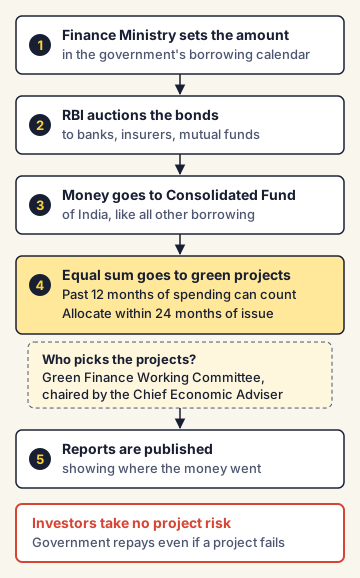
Investors do not take any project risk. Even if a project fails, the government still repays the bond, because it is backed by the government as a whole.
What can the money be used for, and what is excluded?
Eligible categories include renewable energy, energy efficiency, clean transportation (such as electric locomotives and metro rail), climate adaptation, sustainable water and waste management, pollution control, green buildings and sustainable management of living natural resources and land use. The framework excludes:
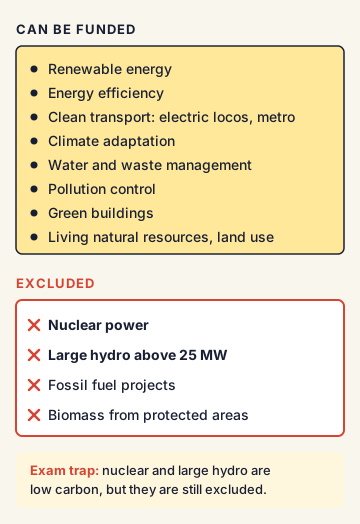
- nuclear power generation;
- large hydropower plants above 25 MW;
- fossil fuel projects;
- biomass projects using feedstock from protected areas;
- landfill projects and direct waste incineration, and sectors like alcohol, weapons, tobacco and gaming [Unverified].
How has the money been used?
In the 2022-23 allocation report, about 78% went to clean transportation, about 21% to renewable energy and about 1% to sustainable land use. Over FY23 to FY25, railways got the biggest share, with about ₹31,070 crore earmarked for energy-efficient electric locomotives and about ₹14,330 crore for metro rail. A parliamentary reply put the total SGrBs issued from FY23 to FY25 at about ₹57,697 crore.
What is the "greenium"?
A greenium (green + premium) is the small extra price, or lower interest rate, that investors accept for a green bond compared with a normal bond. In India's first auction, the 5-year green bond sold at about 5 to 6 basis points below the yield of a similar normal government bond. The coupon was 7.10% on the 5-year bond and 7.29% on the 10-year bond.
Later auctions often saw weak demand and a very small or no greenium, which made some auctions get cut or cancelled.
Opening to foreign investors
On 29 August 2024, the RBI introduced a scheme allowing eligible non-resident investors to buy and trade SGrBs through India's International Financial Services Centre (IFSC) at GIFT City, Gujarat. This was done to widen the pool of buyers.
What does the outside review say?
Before issuance, Norway-based CICERO gave the framework a "Medium Green" rating and a "Good" governance score. Such a check is called a Second Party Opinion: an independent expert reviews whether the bond framework is credible.
Commonly confused concepts
- Sovereign green bond vs corporate green bond: The sovereign bond is issued by the national government; a corporate green bond is issued by a company (regulated by SEBI's disclosure rules).
- Green bond vs normal government bond (G-sec): Both carry the same government guarantee. The only difference is that green bond money is tagged to green spending and reported on.
- Sovereign green bond vs Sovereign Gold Bond: Both are often written "SGB". A Sovereign Gold Bond is linked to the price of gold and was meant to reduce physical gold buying. It has nothing to do with the environment. Use "SGrB" for green bonds.
- Green bond vs blue bond vs social bond: Blue bonds fund ocean and water projects; social bonds fund social goals like health and housing; green bonds fund environmental projects.
- Greenium vs coupon: The coupon is the interest rate the bond pays. The greenium is the difference in yield between a green bond and a similar normal bond.
Issues, criticism and the way forward
- Small greenium: Indian investors, mostly domestic banks and insurers, are not willing to accept much lower returns, so the cost saving for the government is tiny.
- Additionality doubt: Critics ask whether green bonds fund new green projects or just relabel spending (like railway electrification) that would have happened anyway. The government's view is that tagging and reporting itself improves transparency and builds a green market.
- Exclusion of large hydro and nuclear: Some argue these are low-carbon sources and should qualify; others point to their environmental and safety concerns.
- Thin demand and liquidity: Green bonds are a small share of total borrowing and trade less often, making them less attractive.
- Way forward: Wider foreign participation through the IFSC route, a final national climate finance taxonomy, regular and detailed impact reports, and longer-tenure bonds to match long-life green assets.
Concepts to Know
- Bond: A loan given by investors to a government or company. The borrower pays fixed interest (the coupon) and returns the money on a fixed date (maturity).
- Yield: The actual return an investor earns on a bond, based on the price paid for it. When a bond's price goes up, its yield goes down.
- Basis point: One-hundredth of a percentage point. 5 basis points = 0.05%.
- Consolidated Fund of India: The main account of the central government (Article 266 of the Constitution). All taxes and loans go into it, and money comes out only with Parliament's approval.
- International Financial Services Centre (IFSC): A special zone, India's first at GIFT City in Gujarat, where financial deals can be done with foreign investors under special rules, similar to an offshore financial centre.
- Announced in Union Budget 2022-23; framework released 9 November 2022
- First auction 25 January 2023 (₹8,000 crore), second 9 February 2023 (₹8,000 crore); FY23 total about ₹16,000 crore
- First issue tenors: 5-year (7.10%) and 10-year (7.29%); greenium about 5–6 basis points
- FY24 issuance about ₹20,000 crore; FY23–FY25 total about ₹57,697 crore
- Green Finance Working Committee chaired by the Chief Economic Adviser
- Excluded: nuclear power, hydro above 25 MW, fossil fuels, biomass from protected areas
- Second Party Opinion: CICERO (Norway), "Medium Green"
- RBI scheme for SGrBs in IFSC: 29 August 2024
- FY23 allocation: about 78% clean transport, 21% renewable energy
● Tracked since March 27, 2026 · last seen October 28, 2026 · updates as the daily brief publishes