Green Finance and India's Climate Finance Taxonomy
Green finance means money (loans, investments, bonds, grants) that goes into activities that are good for the environment, such as solar and wind power, electric buses, energy-saving buildings or protecting farms from drought. Climate finance is the part of green finance that is aimed at climate change. To decide which activities truly count as "green", countries create a taxonomy: an official list with clear rules. India released a draft Climate Finance Taxonomy in May 2025.
Why does it exist?
Fighting climate change needs huge amounts of money. Building a solar park, a metro line or a green hydrogen plant costs a lot at the start, and the money comes back slowly over many years. Normal lenders often prefer safe, quick projects. Green finance is the effort to move money, on purpose, towards cleaner activities. Without it, the economy keeps investing in polluting options simply because they are familiar and cheaper today.
Two kinds of climate money
Students must know this split:
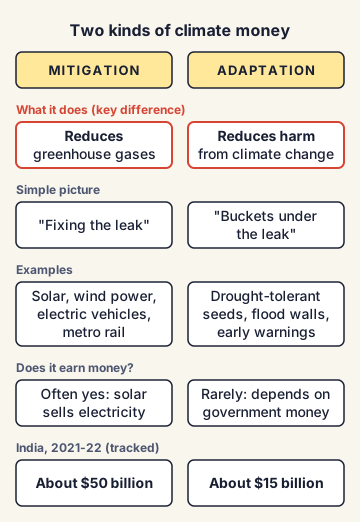
- Mitigation finance: money that reduces greenhouse gas emissions. Examples: solar and wind power, electric vehicles, energy-efficient appliances, metro rail.
- Adaptation finance: money that helps people cope with climate change that is already happening. Examples: drought-tolerant seeds, flood walls, early warning systems, heat action plans.
You can think of mitigation as "fixing the leak" and adaptation as "putting buckets under the leak". Both are needed. Mitigation projects often earn money (a solar plant sells electricity), so private investors like them. Adaptation projects often do not earn direct income, so they depend more on government money.
Where did it come from?
Green finance grew along with global climate agreements:
- 1992: The UN Framework Convention on Climate Change (UNFCCC) said rich countries should help poor countries with money and technology.
- 2007: The European Investment Bank issued the world's first green bond, called the "Climate Awareness Bond".
- 2009: At the Copenhagen climate summit, rich countries promised to mobilise $100 billion a year by 2020 for developing countries.
- 2015: The Paris Agreement. Its Article 2.1(c) asks countries to make all finance flows consistent with low-emission, climate-resilient development. Article 9 says developed countries shall provide finance to developing countries.
- 2024: At COP29 in Baku, countries agreed a New Collective Quantified Goal (NCQG): at least $300 billion a year by 2035 for developing countries, with developed countries taking the lead.
How does green finance reach a project?
Money can come through many channels:
- Bank loans: a bank lends to a solar developer or an electric-bus operator.
- Bonds: a company or the government borrows by selling green bonds, promising to use the money only for green projects.
- Equity: investors buy a share in a green company.
- Government budgets and subsidies: for example, subsidies for rooftop solar or electric vehicles.
- International sources: loans and grants from foreign governments, development banks like the World Bank, and climate funds. Each of these can be domestic (from inside India) or international, and public (government) or private.
How is India building the system?
India has put several pieces in place:
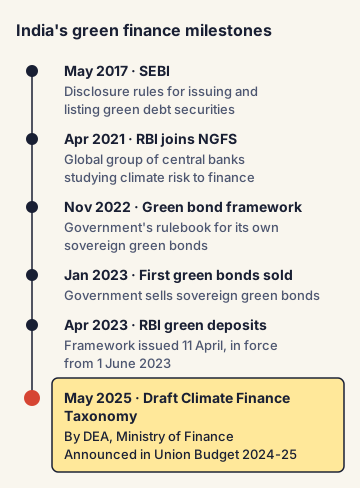
- SEBI (2017): On 30 May 2017, the market regulator SEBI issued disclosure rules for companies issuing and listing green debt securities, so investors know where the money goes.
- RBI joins NGFS (2021): The RBI became a member of the Network for Greening the Financial System (NGFS) on 23 April 2021. NGFS is a global group of central banks and regulators, launched in 2017, that studies climate risks to the financial system.
- Sovereign Green Bonds (2022-23): The government released its green bond framework in November 2022 and first sold green bonds in January 2023.
- Green Deposits (2023): The RBI's framework, issued on 11 April 2023 and in force from 1 June 2023, lets banks and deposit-taking NBFCs (non-bank lenders) take green deposits: fixed deposits whose money must be lent only to green activities. Fossil fuel, nuclear power, direct waste incineration, alcohol, weapons, tobacco, gaming and palm oil are excluded.
- Climate Finance Taxonomy (2025): Announced in the Union Budget 2024-25 and released as a draft by the Department of Economic Affairs (DEA), Ministry of Finance, in May 2025, with public comments until 25 June 2025.
What is a climate finance taxonomy, and how does it work?
A taxonomy is like a dictionary of green activities. For each sector, it says which activities count as climate-friendly and on what conditions. India's draft framework:
- aims to help India reach net zero by 2070 and keeps the Viksit Bharat 2047 goals in view;
- covers both climate-supportive activities (clearly green, like solar) and transition activities (activities that cut emissions in hard sectors like steel or cement, even if they are not fully green yet);
- plans sector-by-sector annexes with detailed lists;
- aims to prevent greenwashing and help channel more money into green technologies.
Think of it as a "green certificate standard". Once the rules are clear, a bank, investor or regulator can check if a project really deserves the "green" label.
India's position: how big is the need?
India's climate targets (its Nationally Determined Contribution, updated in 2022) include cutting the emissions intensity of GDP by 45% by 2030 from 2005 levels and getting about 50% of power capacity from non-fossil sources by 2030. India's long-term goal is net zero by 2070. Meeting these goals needs very large investment every year, much more than current flows. India's stand in climate talks is that developed countries must provide far more finance, in line with the principle of Common But Differentiated Responsibilities (CBDR).
What does the data show?
According to Climate Policy Initiative's tracking, India's mitigation finance was about $50 billion (₹3,712 billion) in 2021-22, and adaptation finance about $15 billion (₹1,092 billion) a year in 2021-22. By 2023-24, tracked mitigation finance had reached about $81.9 billion. Most of it is domestic, and private money is now larger than public money in mitigation.
Commonly confused concepts
- Green finance vs climate finance: Green finance is the wider idea and includes all environmental goals (such as clean water or biodiversity). Climate finance is only about climate change (mitigation and adaptation).
- Mitigation vs adaptation: Mitigation reduces emissions; adaptation reduces harm from climate change.
- Green bond vs green deposit: A green bond is a loan taken by the issuer from investors. A green deposit is money placed by a customer in a bank, which the bank then lends to green projects.
- Taxonomy vs green bond framework: A taxonomy is a national dictionary for all lenders and investors. A green bond framework is the rulebook of one issuer (for example, the government's own framework for its green bonds).
- Net zero vs carbon neutral vs zero emissions: Net zero means any emissions left are balanced by removals (like forests absorbing carbon). It does not mean zero emissions.
Issues, criticism and the way forward
- Too concentrated: Most money goes to proven areas like solar, wind and efficient appliances. Newer areas such as battery storage, green hydrogen, industrial decarbonisation and adaptation get far less.
- Adaptation gap: Adaptation projects rarely earn returns, so private investors avoid them. Farmers and poor households, who suffer most from climate change, get the least.
- Low international flows: India's green finance is mostly domestic. Developed countries' promises have not translated into large flows to India.
- Greenwashing: Without clear rules, some projects may be labelled green without real benefit. A final taxonomy and strong disclosure rules are the main fix.
- Information gap: Lenders do not have enough data on the risks and returns of new technologies, so they charge more or refuse loans. A shared knowledge hub, credit guarantees and blended finance (public money that takes the first loss to attract private money) are suggested solutions.
- Way forward: Finalise and update the taxonomy, prepare sector roadmaps, build a pipeline of investment-ready projects, and expand public guarantees for risky but important technologies.
Concepts to Know
- Greenhouse gases: Gases such as carbon dioxide and methane that trap heat in the atmosphere and warm the planet.
- Greenwashing: Falsely presenting a product, project or company as environment-friendly to attract money or customers.
- Emissions intensity: The amount of greenhouse gas released for every unit of GDP. If it falls, the economy is producing more with less pollution.
- Nationally Determined Contribution (NDC): The climate action plan each country submits under the Paris Agreement, listing its targets.
- Common But Differentiated Responsibilities (CBDR): The principle that all countries must act on climate change, but rich countries that polluted more in the past must do more and help poorer countries.
- Equity: Money invested in a company in return for a share of ownership, unlike a loan which must be repaid.
- First green bond in the world: European Investment Bank, 2007
- Paris Agreement: Article 2.1(c) (align finance flows), Article 9 (finance from developed countries)
- NCQG (COP29, Baku, 2024): at least $300 billion/year by 2035
- SEBI green debt securities disclosure circular: 30 May 2017
- RBI joined NGFS: 23 April 2021 (NGFS launched 2017)
- RBI green deposits framework: issued 11 April 2023, effective 1 June 2023
- Draft Climate Finance Taxonomy: DEA, Ministry of Finance, May 2025; announced in Union Budget 2024-25
- India's NDC (2022): 45% cut in emissions intensity by 2030 (from 2005); about 50% non-fossil power capacity by 2030; net zero by 2070
● Tracked since October 28, 2026 · last seen October 28, 2026 · updates as the daily brief publishes