Solid Rocket Motor
How Solid-Fuel Rocket Stages Work
A solid rocket motor is a rocket stage whose fuel is a solid, rubbery block packed inside a strong tube. When it is lit, the block burns from the inside, produces a huge amount of hot gas, and the gas rushes out of a nozzle at the back. That rush of gas pushes the rocket forward. A simple way to picture it: it works like a very large, very carefully engineered Diwali rocket.
Why do rockets use solid motors?
Solid motors give a very big push (thrust) from a fairly simple machine. They have no pumps, pipes or valves to carry fuel, so there are fewer moving parts that can break. The fuel can sit inside the motor for a long time and is ready almost instantly. This is why solid motors are used as first stages and strap-on boosters, which must lift a heavy rocket off the ground, and why most modern missiles use them.
Where did it come from?
Rockets powered by gunpowder were used in China centuries ago. In India, the Mysore rulers Hyder Ali and Tipu Sultan used iron-cased rockets against the British in the 18th century. Modern solid motors grew after the Second World War, when new rubbery fuels allowed very large motors to be cast in one piece. India's space programme started with small solid sounding rockets (rockets that go up and come down to study the upper atmosphere) from Thumba near Thiruvananthapuram in the 1960s.
India's first satellite launch vehicle, SLV-3, was an all-solid, four-stage rocket. It put the Rohini satellite (RS-1) into orbit on 18 July 1980, after a failed first flight in August 1979.
What is inside a solid motor?
It has a few main parts:
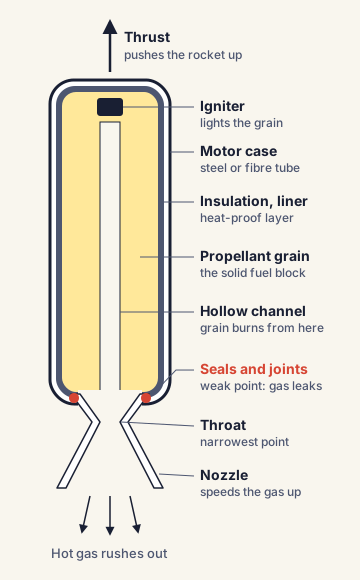
- Motor case: the strong outer tube that holds the fuel and the very high pressure. It is made of special steel, or of lighter fibre materials like Kevlar or carbon fibre wound with resin.
- Insulation and liner: heat-proof layers between the fuel and the case, so the case does not get burnt through.
- Propellant grain: the solid fuel block itself. "Grain" just means the cast block of propellant, of any size.
- Igniter: a small charge at the top that lights the grain.
- Nozzle: the bell-shaped exit at the back. It first narrows (the narrowest point is the throat) and then widens. This shape speeds the gas up to several times the speed of sound, which gives more push.
- Seals and joints: rubber O-rings and similar seals that stop hot gas leaking where the parts are joined, especially between the case and the nozzle.
What is the fuel made of?
Most large modern motors use a composite propellant, a mixture of three main things:
- Ammonium perchlorate (AP): the oxidiser, which supplies the oxygen for burning. There is no air in space, so the rocket must carry its own oxygen.
- Aluminium powder: a metal fuel that burns very hot and adds energy.
- HTPB (Hydroxyl-Terminated Polybutadiene): a liquid rubber that is mixed with the powders and then set (cured) into a solid. It acts as the binder (the glue holding everything together) and also burns as fuel.
In a typical mix, ammonium perchlorate is roughly 65 to 70% of the weight, aluminium roughly 15 to 20%, and the binder and other additives make up the rest. The mixture is poured into the case like thick cake batter and left to cure into a firm, rubber-like solid.
How does it work, step by step?
- The igniter fires and lights the inner surface of the grain.
- The grain burns, turning into very hot, high-pressure gas inside the case.
- The gas escapes through the nozzle at very high speed.
- By Newton's third law (every action has an equal and opposite reaction), the gas going backward pushes the rocket forward.
The grain usually has a hollow channel down the middle, often star-shaped. The shape of this channel decides how much surface is burning at each moment, and so how the thrust changes during the burn. Engineers choose the shape to get the thrust they want, for example high thrust at lift-off and lower thrust later.
How is a solid motor steered?
The rocket must be pointed in the right direction all the time. This is done by thrust vector control, which means changing the direction of the out-going gas:
- Flex nozzle: the nozzle sits on a flexible joint made of rubber and metal layers, so it can tilt slightly. The PSLV's third stage uses this, tilting about 2 degrees.
- Secondary injection: a liquid is sprayed into one side of the nozzle to bend the gas flow. The PSLV's first stage (S139) uses strontium perchlorate solution for this.
India's solid motors
India makes some of the world's largest solid motors:
- PSLV: first stage S139 (about 139 tonnes of propellant), six strap-ons of about 12 tonnes each (XL version), and the third stage PS3 (about 7.6 tonnes of HTPB propellant, Kevlar-polyamide fibre case, flex nozzle).
- LVM3 (India's heaviest rocket): two S200 strap-on boosters, each carrying about 205 tonnes of HTPB-based propellant.
- SSLV (Small Satellite Launch Vehicle): three solid stages, plus a small liquid Velocity Trimming Module at the top for final fine-tuning of speed.
- Missiles: India's long-range Agni missiles use solid motors because they can be stored ready to fire.
ISRO's Vikram Sarabhai Space Centre (VSSC) in Thiruvananthapuram designs these motors, and large motors are cast and tested at the Satish Dhawan Space Centre, Sriharikota.
What is a static test, and why is it so important?
A solid motor cannot be switched on, checked and then reused, because once lit it burns until the fuel is finished. So engineers cannot test the actual motor that will fly. Instead, they build identical motors and fire them while bolted to a test stand on the ground. Sensors record the thrust, the pressure inside the case, temperatures, vibrations and the nozzle's movement.
If these match the design, the design is "qualified". For each flight motor, quality comes from strict checks on raw materials and careful non-destructive testing, such as X-ray and ultrasound scans that look for hidden cracks, air pockets or gaps between the fuel and the case.
Commonly confused concepts
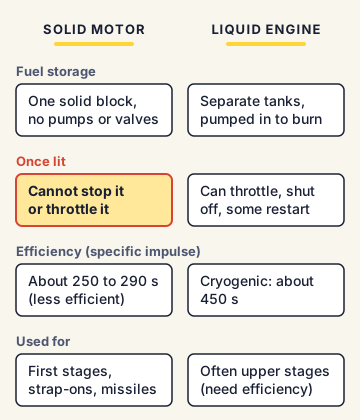
- Solid motor vs liquid engine: By convention, solid stages are called motors and liquid stages are called engines. A liquid engine keeps fuel and oxidiser in separate tanks and pumps them into a chamber. It can be throttled (made stronger or weaker), shut off and sometimes restarted. A solid motor, once lit, usually cannot be stopped or throttled.
- Efficiency vs thrust: Solid motors give big thrust but use fuel less efficiently than liquid engines. Rocket scientists measure fuel efficiency with specific impulse (how long a fixed amount of fuel can produce a fixed push). Solids are roughly in the 250 to 290 second range, while cryogenic engines (using liquid hydrogen and liquid oxygen) reach about 450 seconds. This is why upper stages, which need efficiency more than raw power, are often liquid or cryogenic.
- Composite vs double-base propellant: Composite propellant mixes a separate oxidiser (AP) and fuel in a rubber binder. Double-base propellant (nitroglycerine and nitrocellulose) has oxidiser and fuel in the same molecules and is used mainly in smaller rockets and missiles.
- Static test vs flight test: A static test fires the motor fixed to the ground. A flight test proves it in real flight, where vibration, speed and changing air pressure also act on it.
Issues, criticism and the way forward
- No second chance: Because a solid motor cannot be shut down, any defect (a crack in the grain, a weak bond with the case, or a leaking seal) can end a mission in seconds.
- Seals and joints are weak points: The most famous solid motor failure was the US Space Shuttle Challenger disaster on 28 January 1986, which killed seven astronauts. The Rogers Commission found that an O-ring seal in a joint of the right solid rocket booster failed, made worse by very cold weather, letting hot gas escape.
- Nozzles face extreme heat: The nozzle throat faces gas at thousands of degrees, so its material wears away (erodes) during the burn. Small design errors here can cause failure.
- Manufacturing quality: Large motors are cast in batches over many days. Experts stress that tight control of raw materials, mixing, casting and inspection matters as much as the design.
- Transparency: After failures, space agencies around the world usually publish failure reports. Experts have argued that publishing findings builds trust with commercial customers and the public.
- Way forward: Wider safety margins, backup seals, better scanning of finished motors and more ground testing before a return to flight. These are exactly the steps ISRO has said it took for the PS3 redesign.
Concepts to Know
- Thrust: The pushing force a rocket produces by throwing gas backward.
- Oxidiser: A chemical that supplies oxygen so the fuel can burn, needed because space has no air.
- Chamber pressure: The pressure of hot gas inside the motor case. A sudden fall means gas is escaping somewhere it should not, or the fuel is not burning as planned.
- Design margin: Extra strength built into a part beyond what it should need, like building a bridge to carry twice its expected load.
- Non-destructive testing (NDT): Checking a part for hidden flaws (for example with X-rays or ultrasound) without cutting or damaging it.
- Roll: The rotation of a rocket around its own long axis, like a spinning pencil. Too much roll means the rocket is losing control.
- Strap-on booster: An extra rocket fixed to the side of the main rocket to give more push at lift-off; it falls away once its fuel is used.
- Composite propellant: ammonium perchlorate (oxidiser) + aluminium powder (fuel) + HTPB (binder and fuel)
- SLV-3: India's first launch vehicle, all-solid, four stages; launched Rohini RS-1 on 18 July 1980 from Sriharikota
- PSLV PS1: S139 solid motor, steered by secondary injection (strontium perchlorate); PSLV-XL strap-ons about 12 tonnes each
- PSLV PS3: about 7.6 tonnes HTPB propellant, Kevlar-polyamide fibre case, flex nozzle (about 2 degrees tilt)
- LVM3: two S200 boosters, about 205 tonnes of propellant each
- SSLV: three solid stages plus a liquid Velocity Trimming Module
- Challenger disaster: 28 January 1986; O-ring seal failure in a solid booster joint; probed by the Rogers Commission
● Tracked since November 12, 2026 · last seen November 12, 2026 · updates as the daily brief publishes