Section 17A of the Prevention of Corruption Act, 1988
Prior Approval for Investigation
Section 17A of the Prevention of Corruption Act, 1988 says the police cannot even begin to look into certain corruption cases against a public servant without first getting approval from the government. It applies only when the alleged offence is linked to a recommendation made or a decision taken by that officer while doing official work. The idea is to protect honest officers from being harassed for genuine decisions, while still allowing real corruption to be punished.
Why does it exist?
Government officers take many decisions every day: giving contracts, approving files, granting licences. Some of these decisions later turn out badly or anger someone. If any such person could get the police to start a corruption probe just by filing a complaint, officers might become scared to take decisions at all. This fear is often called policy paralysis, and people describe the problem as the "three Cs" (CBI, CVC and CAG) haunting officers.
Section 17A was meant to act as a filter: a senior authority first checks whether a complaint about a decision deserves a probe.
Where did it come from?
The idea of a prior-approval filter is old, and courts struck it down twice before Section 17A was made:
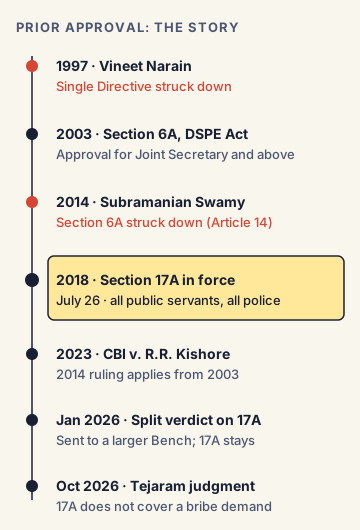
- The Single Directive: For years, a government instruction required the CBI to get approval before probing senior officers (Joint Secretary and above). In Vineet Narain v. Union of India (1997), the Supreme Court struck it down. It said an executive instruction cannot stop the police from doing their legal duty to investigate.
- Section 6A of the DSPE Act: In 2003, the Central Vigilance Commission Act, 2003 added Section 6A to the Delhi Special Police Establishment (DSPE) Act, 1946 (the law under which the CBI works). It brought back the approval requirement for officers of Joint Secretary rank and above, this time as a law. In Subramanian Swamy v. Director, CBI (2014), a five-judge Constitution Bench struck it down. It said dividing officers into senior and junior classes for this purpose violated Article 14 (equality before law). In CBI v. R.R. Kishore (2023), another Constitution Bench held that this ruling applies from 2003 itself, as if Section 6A never existed.
- Section 17A: Parliament then passed the Prevention of Corruption (Amendment) Act, 2018, in force from July 26, 2018. It added Section 17A, which covers all public servants (not just senior ones) and applies to all police agencies (not just the CBI).
What does Section 17A say?
No police officer can conduct any enquiry, inquiry or investigation into an offence under the Act by a public servant, where the offence is relatable to a recommendation or decision made in the discharge of official functions, without previous approval of:
- the Central Government, for a person employed (or employed at the time of the offence) in the affairs of the Union
- the State Government, for a person employed in the affairs of a state
- the authority competent to remove the person, for anyone else
The two provisos (exceptions and time limits)
- First proviso: No approval is needed when a person is arrested on the spot for accepting or attempting to accept an undue advantage (a bribe) for himself or someone else. This covers trap cases, where the ACB or CBI catches an officer red-handed with marked notes.
- Second proviso: The approving authority must give its decision within three months. It can extend this by one month, only after recording its reasons in writing.
How does it work in practice?
Suppose a complaint says an officer gave a road contract to a favoured company. Because this is about a decision taken officially, the police must first send the material to the competent authority. Only after approval can they start even a preliminary enquiry. Now suppose a complaint says a clerk asked for ₹5,000 to clear a file.
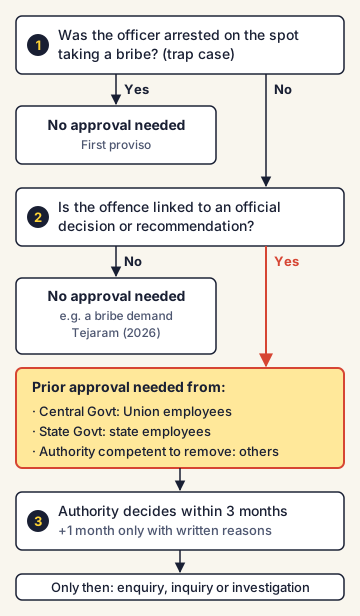
Asking for money is not a decision or recommendation, so no approval is needed. Police can register the case and investigate at once. This is exactly what the Supreme Court confirmed in the October 2026 Tejaram judgment.
What have the courts said about its scope?
- Tejaram v. State of Rajasthan (2026): A bribe demand is a pure criminal act unconnected with official duty, so Section 17A does not apply, and the lack of approval does not spoil the case.
- Earlier in 2026, in a case from Rajasthan (Anil Daima v. State of Rajasthan), another Bench (Justices J.B. Pardiwala and S.C. Sharma) also held that Section 17A cannot shield officers accused of demanding illegal gratification.
- Whether Section 17A applies to offences committed before July 26, 2018 has also been disputed in courts. In January 2024, a two-judge Bench gave a split view on this point in a case involving a former Andhra Pradesh Chief Minister.
Is Section 17A itself valid? The 2026 split verdict
The Centre for Public Interest Litigation (CPIL) challenged Section 17A. On January 13, 2026, a two-judge Bench gave a split verdict:
- Justice B.V. Nagarathna held Section 17A unconstitutional. She said it is "manifestly arbitrary" under Article 14, brings back what the Court struck down twice, and blocks even a preliminary enquiry, so police cannot test whether a complaint is true.
- Justice K.V. Viswanathan held it valid, but only if read down: the approval decision should be screened by an independent body, the Lokpal at the Centre or the Lokayukta in a state, whose view would bind the government.
Because the judges disagreed, the matter was sent to the Chief Justice of India to be placed before a larger Bench. Until that Bench decides, Section 17A remains in force.
Commonly confused concepts
- Section 17A vs Section 19 of the PC Act: Section 17A is about approval before investigation begins. Section 19 is about sanction before a court takes cognizance (formally takes up the case) to start the trial. An officer may need both, at two different stages.
- Section 17A vs Section 6A of the DSPE Act: Section 6A covered only Joint Secretary-level and senior officers and only the CBI, and was struck down in 2014. Section 17A covers all public servants and all police agencies, and is limited to decisions and recommendations.
- Trap case vs decision-based case: In a trap case (on-the-spot arrest for taking a bribe), no approval is needed. In a case about an official decision, approval is needed.
- Enquiry vs inquiry vs investigation: An enquiry is an informal preliminary check; an inquiry is a more formal fact-finding step; an investigation is the full police process of collecting evidence after a case is registered. Section 17A blocks all three without approval.
Issues, criticism and the way forward
- Conflict of interest: The government that must approve a probe may be the same body whose decision is being questioned, especially for senior officers or ministers' decisions. Critics say this gives the executive a veto over investigations.
- Delay and evidence loss: Even with a three-month limit, delays happen. Evidence and witnesses can disappear in the meantime.
- Equality concern: As Justice Nagarathna noted, ordinary citizens get no such filter before police probe them.
- The case for it: Supporters say honest officers need protection for genuine decisions that later go wrong, and that fear of probes slows down governance. The government defended the provision on this ground.
- Way forward: Suggestions include an independent screening body (the Lokpal or Lokayukta model in Justice Viswanathan's opinion), strict time limits with "deemed approval" if the authority stays silent, and clear guidelines separating bona fide decisions from corrupt ones.
Concepts to Know
- Public servant: Under the PC Act, a wide group of people paid by or working for the government or public bodies, including government employees, judges, and people holding public office.
- Undue advantage / illegal gratification: Any benefit other than lawful pay that a public servant takes for doing or not doing official work. In simple words, a bribe.
- Trap case: A planned operation where anti-corruption officers give the complainant marked currency notes and catch the officer red-handed while accepting them.
- Read down: When a court keeps a law alive but gives it a narrower meaning so that it fits the Constitution.
- Split verdict: When the judges on a Bench disagree, so there is no majority decision; the case then goes to a larger Bench.
- Lokpal and Lokayukta: Independent anti-corruption bodies created under the Lokpal and Lokayuktas Act, 2013: the Lokpal for the Centre and the Lokayukta for each state.
- Section 17A added by the Prevention of Corruption (Amendment) Act, 2018; in force from July 26, 2018
- Applies only when the offence relates to a recommendation made or decision taken in discharge of official functions
- Approving authority: Central Government, State Government, or the authority competent to remove the officer
- First proviso: no approval for on-the-spot arrest for accepting or attempting to accept an undue advantage
- Second proviso: decision within 3 months, extendable by 1 month with written reasons
- Vineet Narain (1997): Single Directive struck down
- Section 6A of DSPE Act (added 2003) struck down in Subramanian Swamy v. Director, CBI (2014); held retrospective in CBI v. R.R. Kishore (2023)
- January 13, 2026: split verdict on the validity of Section 17A (Nagarathna: unconstitutional; Viswanathan: valid if screened by Lokpal/Lokayukta); referred to a larger Bench
- Tejaram v. State of Rajasthan (2026 INSC 1147, October 16, 2026): Section 17A does not apply to a bribe demand
● Tracked since October 19, 2026 · last seen October 19, 2026 · updates as the daily brief publishes