Satellite Internet
How Low Earth Orbit Constellations Deliver Broadband
Satellite internet means getting internet from a satellite in the sky instead of from a cable or a mobile tower near your home. A small dish on your roof talks to a satellite. The satellite talks to a ground station, and the ground station is connected to the normal internet. Because the signal comes from space, it can reach a mountain village, a ship at sea or a border post where no cable or tower exists.
Why do we need it?
Laying optical fibre cable or building mobile towers is costly in hills, forests, deserts and islands. Very few customers live there, so companies often do not find it worth the money. A satellite covers a huge area at once. So it can fill the "last gaps" in coverage. It also works as a backup when cables are cut by floods, earthquakes or war.
What are the different orbits?
An orbit is the path a satellite follows around the Earth. The height of the orbit decides how the service works.
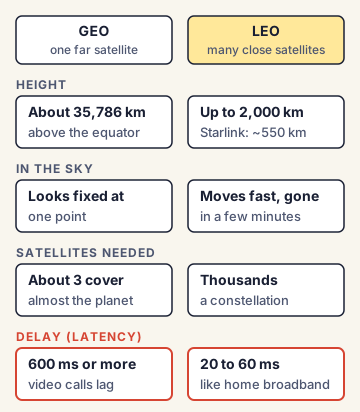
- Geostationary orbit (GEO): About 35,786 km above the equator. A satellite here goes round the Earth once in a day, the same speed as the Earth turns. So it seems to stay fixed at one point in the sky. Three such satellites can cover almost the whole planet. This is the old way of doing satellite internet and satellite TV (DTH).
- Medium Earth orbit (MEO): Between low and geostationary orbit. Navigation satellites such as GPS work here.
- Low Earth orbit (LEO): Generally up to about 2,000 km above the Earth. Starlink satellites mostly fly at around 500 to 550 km. A LEO satellite goes round the Earth in about 90 to 120 minutes.
Why does height matter? The delay problem
Radio signals travel at the speed of light, but even light needs time to cover long distances. From a GEO satellite, the signal has to travel up about 36,000 km and back down, twice for a full request and reply. So the delay, called latency, is usually 600 milliseconds or more. That is fine for TV, but video calls and online games feel laggy. A LEO satellite is about 65 times closer, so latency falls to roughly 20 to 60 milliseconds, close to normal broadband.
Why do LEO systems need thousands of satellites?
A LEO satellite is low, so it sees only a small patch of Earth. It also moves fast and crosses your sky in a few minutes. To give you a non-stop connection, another satellite must arrive before the first one leaves. That needs a constellation: a large group of satellites spread in many orbits that work together. As of mid-2026, Starlink had crossed 10,000 working satellites [counts vary by tracking source]. This is why such systems are called mega-constellations.
How does it work, step by step?
- Your user terminal (a flat dish with an electronic antenna) points at the sky and tracks the satellite passing overhead. It switches to the next satellite on its own.
- The satellite receives your signal and sends it down to a gateway, a ground station with large antennas.
- The gateway connects to the normal internet through fibre cables.
- Newer satellites can also pass data to each other using laser links in space, so they can serve areas far from any gateway, such as the open ocean.
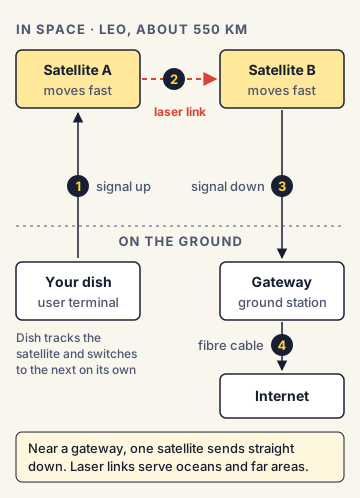
Think of it like a relay race. The baton (your data) is passed from your dish to the satellite, from satellite to satellite, and finally to a gateway on the ground.
Which radio frequencies does it use?
Satellites talk to the ground using radio waves called spectrum. Broadband satellites mostly use the Ku band (about 12 to 18 GHz) and the Ka band (about 26.5 to 40 GHz). Higher frequencies can carry more data, but heavy rain can weaken them. This weakening is called rain fade, and it matters a lot in a monsoon country like India.
Who are the main players?
- Starlink (SpaceX, USA): the largest LEO constellation.
- Eutelsat OneWeb (Europe): a LEO constellation at about 1,200 km. Bharti group is a major shareholder.
- Project Kuiper (Amazon, USA): a LEO constellation being built.
- Jio-SES (India and Luxembourg): uses SES satellites, including in MEO.
- India's own GSAT-N2 (GSAT-20): a GEO high-throughput satellite of NewSpace India Limited (NSIL). It was launched on a SpaceX Falcon 9 rocket on 19 November 2024 (Indian time), because at 4,700 kg it was too heavy for ISRO's own LVM3. It uses the Ka band, has 32 beams and a capacity of 48 Gbps.
How does India regulate it?
A foreign or Indian company needs several separate approvals before it can sell satellite internet in India:
- A GMPCS licence (or authorisation) from the Department of Telecommunications to provide the service.
- An authorisation from IN-SPACe to use its satellite system over India.
- Spectrum assignment from the DoT. Under the Telecommunications Act, 2023, satellite spectrum is given by an administrative process, not by auction.
- Security clearance for each gateway and for the network, linked to the DoT's satcom security rules of May 2025.
The May 2025 security rules say Indian traffic must not be routed through a gateway outside India, lawful interception (legal monitoring by agencies) must be possible from inside India, and Indian user data must not be copied or decrypted abroad. Operators must also make about 20% of their ground network in India within five years of starting commercial service, and move user terminals to India's own navigation system, NavIC, by 2029.
How is spectrum priced?
In May 2025, the Telecom Regulatory Authority of India (TRAI) recommended that satellite broadband spectrum be given for 5 years (extendable by 2 years), at a charge of 4% of Adjusted Gross Revenue (AGR), with a minimum of ₹3,500 per MHz per year. For LEO and MEO broadband, it also suggested an extra ₹500 per urban user per year, with rural users exempted. The DoT had proposed a higher charge earlier, and as of October 2026 the final pricing had not been notified.
Commonly confused concepts
- GEO vs LEO: GEO is one big satellite far away (about 35,786 km), fixed in the sky, with high delay. LEO is thousands of small satellites close by, always moving, with low delay.
- Geostationary vs geosynchronous: A geosynchronous satellite takes one day to go round the Earth. A geostationary one does this exactly over the equator, so it looks fixed. Every geostationary orbit is geosynchronous, but not the other way round.
- Satellite internet vs satellite phone: Satellite phones (like those of Iridium or BSNL's satellite phone service) give voice and small data to a handheld phone. Satellite broadband gives home-style internet through a dish.
- Gateway vs user terminal: The gateway is a big station owned by the operator. The user terminal is the small dish at the customer's place.
- Auction vs administrative allocation: In an auction, companies bid and the highest bidder wins. In administrative allocation, the government assigns spectrum at a fixed price set by rules.
Issues, criticism and the way forward
- Space debris: Thousands of satellites in LEO raise the risk of crashes. Each crash creates pieces that can hit other satellites. Scientists Donald Kessler and Burton Cour-Palais warned in 1978 that this could become a chain reaction, now called the Kessler syndrome.
- Astronomy: Bright satellites leave streaks in telescope images and disturb radio astronomy.
- Sovereignty and security: A foreign-owned network can be switched off or controlled from outside the country. That is why India insists on gateways, monitoring and data storage inside India.
- Fair competition: Mobile operators argue that satellite firms should pay similar charges, since they may compete for the same users. Satellite firms argue that spectrum shared in space cannot be auctioned like mobile spectrum.
- Cost: Dishes and monthly plans cost more than mobile data, which limits use by poor households.
- Way forward: Experts suggest clear and quick rules, debris-removal and "end of life" rules for satellites, use of satellite internet for schools, health centres and disaster relief in remote areas, and support for Indian satellite makers.
Concepts to Know
- Latency: The time taken for data to go from your device to the server and back. Lower latency means a faster, smoother feel. It is measured in milliseconds (ms); 1,000 ms = 1 second.
- Spectrum: The range of radio frequencies used to send signals through the air. It is limited, so governments decide who can use which part.
- GHz (gigahertz): A unit of frequency. 1 GHz means one billion waves per second.
- Throughput (Gbps): How much data a system can carry each second. Gbps means gigabits per second.
- Adjusted Gross Revenue (AGR): The part of a telecom company's income on which the government charges licence and spectrum fees.
- Data localisation: A rule that data about a country's users must be stored or processed inside that country.
- GEO altitude: about 35,786 km above the equator; LEO: generally up to about 2,000 km
- Starlink altitude: mostly about 500 to 550 km; more than 10,000 working satellites as of mid-2026
- Typical latency: GEO about 600 ms or more; LEO about 20 to 60 ms
- Broadband bands: Ku (about 12 to 18 GHz) and Ka (about 26.5 to 40 GHz)
- GSAT-N2 (GSAT-20): Ka band, 48 Gbps, 32 beams, 4,700 kg, launched on Falcon 9 in November 2024
- TRAI (May 2025): 4% of AGR, 5 years (plus 2), minimum ₹3,500 per MHz per year, ₹500 per urban user per year for LEO/MEO broadband
- DoT satcom security rules (May 2025): gateways in India, about 20% indigenisation within 5 years, NavIC by 2029
- Kessler syndrome: proposed in 1978 by Donald Kessler and Burton Cour-Palais
● Tracked since October 17, 2026 · last seen October 17, 2026 · updates as the daily brief publishes