Run-of-the-River Hydropower
How India Uses the Western Rivers
A run-of-the-river hydropower plant makes electricity from the natural flow of a river, without holding back large amounts of water in a big reservoir. A small dam or barrage turns some of the river's water into a tunnel or channel. The water drops through turbines to make power and then goes back into the river. Under the Indus Waters Treaty, this is the main kind of power plant India was allowed to build on the western rivers.
Why does this type of plant matter?
Rivers in the Himalaya fall steeply, so even a modest flow can drive turbines with great force. A run-of-the-river plant uses this drop instead of a huge lake. Because it stores little water, it cannot hold back a river for long. That is exactly why the 1960 treaty allowed only this type on the western rivers: Pakistan wanted to be sure India could not stop or suddenly release large volumes of water.
How does it work, step by step?
- A diversion structure (a small dam, weir or barrage) is built across the river.
- Behind it, a small pool forms. This is called pondage.
- An intake sends water into a head-race tunnel, often several kilometres long, through a mountain.
- The water drops down to a powerhouse, often underground, and spins the turbines.
- A tail-race tunnel returns the water to the river further downstream.
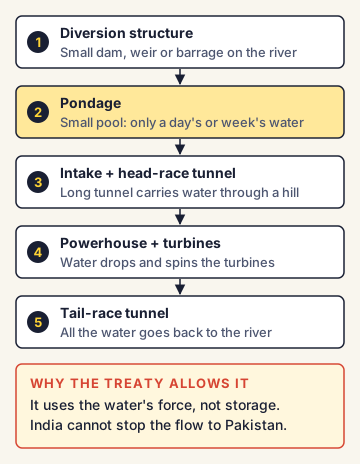
Think of it like a garden hose that takes water from a tap at the top of a slope. The water runs down, turns a small wheel, and flows back out. You use the water's force, but you do not keep the water.
Pondage vs storage
These two words are central to the treaty and to exam questions:
- Pondage is a small amount of live storage, just enough to adjust for changes in electricity demand during a day or a week. For example, a plant may hold some water at night and release more in the evening, when people switch on lights and fans.
- Storage means holding large volumes of water for months, for example from the monsoon to the dry season. A storage project has a big reservoir.
- Live storage is the part of a reservoir's water that can actually be released and used. Dead storage lies below the lowest outlet and cannot be drawn out normally.
What the treaty's Annexure D says
Annexure D defines a run-of-the-river plant as one that works without live storage as an integral part of the plant, except for pondage and surcharge storage. It sets design limits, for example:
- the maximum pondage allowed, by a set formula;
- no low-level outlets unless they are really needed;
- gated spillways, if needed, placed as high as possible;
- the intake for turbines placed at the highest level that works well for the plant.
These rules stop India from quickly lowering or raising the water level to control the flow into Pakistan. But they also cause problems. Himalayan rivers carry a lot of silt (fine sand and mud). Silt piles up behind a dam, and the best way to clear it is through low-level outlets, a process called drawdown flushing. The treaty's limits make this harder, so silt fills the pondage and reduces power output over time.
Hydropower projects in the Chenab basin
The Chenab flows from Himachal Pradesh into J&K, then into Pakistan. Its steep valleys in Kishtwar, Ramban and Reasi districts make it one of India's richest hydropower rivers.
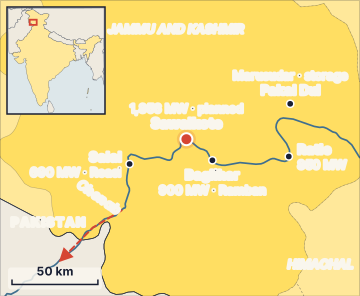
- Salal (690 MW): Reasi district; one of the oldest on the Chenab.
- Baglihar (900 MW): Ramban district; its design was examined by a Neutral Expert in 2007.
- Dul Hasti (390 MW): Kishtwar district.
- Ratle (850 MW): Kishtwar district; its design is part of a long India-Pakistan dispute.
- Pakal Dul (1,000 MW): on the Marusudar, a tributary of the Chenab; it will be J&K's first major storage project, with a 167-metre-high dam.
- Kiru (624 MW) and Kwar (540 MW): Kishtwar district.
- Sawalkote (1,856 MW, planned): Ramban district; a run-of-the-river project between Baglihar and Salal, with 1,406 MW in Stage I and 450 MW in Stage II. NHPC is the developer.
Pakal Dul, Kiru and Kwar are being built by Chenab Valley Power Projects Private Limited (CVPPL), a joint venture of NHPC (51%) and the J&K State Power Development Corporation (49%). The 330 MW Kishanganga project, near Bandipora in the Jhelum basin, was commissioned in 2018.
India's wider hydropower policy
In March 2019, the Union Cabinet declared large hydropower projects (above 25 MW) as renewable energy. Earlier, only small hydro (up to 25 MW) counted as renewable. The government also created a Hydropower Purchase Obligation (HPO), which requires power distribution companies to buy a share of their power from hydro plants. Hydropower is valued because it can start and stop quickly, which helps balance the grid when solar and wind output changes.
Commonly confused concepts
- Run-of-the-river vs storage project: Run-of-the-river uses the river's flow with only small pondage. A storage project holds large volumes in a reservoir for months. Pakal Dul is a storage project; Sawalkote and Baglihar are run-of-the-river.
- Pondage vs storage: Pondage covers daily or weekly changes in demand. Storage carries water across seasons.
- Run-of-the-river vs pumped storage: Pumped storage pumps water up to an upper reservoir when power is cheap and releases it later. It works like a battery, not like a normal river plant.
- Small hydro vs large hydro: In India, small hydro means projects up to 25 MW. Large hydro means projects above 25 MW, counted as renewable since 2019.
Issues, criticism and the way forward
- Silt: Treaty design limits make flushing hard, so pondage fills with silt and output drops.
- Fragile mountains: Long tunnels and blasting in young Himalayan mountains can cause landslides and damage springs. Disasters like the 2013 Kedarnath floods, the 2021 Chamoli flood in Uttarakhand, and the October 2023 glacial lake outburst in Sikkim that washed away the Teesta-III dam have raised concern about dams in the Himalaya.
- Dry river stretches: When several projects are built one after another on a river, long stretches can lose most of their water, harming fish and villages. Releasing an environmental flow (a minimum flow kept in the river) is the usual answer.
- Delays and costs: Big hydro projects often take more than ten years and go over budget, because of difficult geology, land issues and, on the western rivers, international objections.
- Way forward: Finish ongoing projects on time, use modern silt management, carry out strong environmental studies, and share benefits such as free power with local people.
Concepts to Know
- MW (megawatt): A unit of power capacity. One MW equals 1,000 kilowatts. A 1,000 MW plant running at full capacity can power several lakh homes.
- Turbine: A machine with blades that spin when water or steam pushes them. The spinning drives a generator that makes electricity.
- Barrage / weir: A low barrier across a river that raises the water level a little and controls the flow, without creating a big lake.
- Silt: Fine mud and sand carried by a river.
- Environmental flow: The minimum amount of water that must keep flowing in a river so that fish, plants and people downstream are not harmed.
- Joint venture: A company owned together by two or more partners who share costs and profits.
- Annexure D of the IWT: India may build run-of-the-river plants on western rivers, without live storage except pondage and surcharge storage
- Pondage = live storage only enough for daily and weekly load changes
- Sawalkote: 1,856 MW (Stage I 1,406 MW + Stage II 450 MW), Chenab, Ramban district, NHPC; fresh environmental clearance October 2025
- Ratle 850 MW; Pakal Dul 1,000 MW (Marusudar river, first major storage project in J&K); Kiru 624 MW; Kwar 540 MW
- CVPPL: NHPC 51%, JKSPDC 49%; builds Pakal Dul, Kiru, Kwar
- Salal 690 MW (Reasi); Baglihar 900 MW (Ramban); Kishanganga 330 MW (Bandipora, 2018)
- Large hydro (above 25 MW) declared renewable energy: March 2019
● Tracked since April 11, 2026 · last seen October 03, 2026 · updates as the daily brief publishes