Rohingya Crisis
The Rohingya are a mostly Muslim ethnic group who have lived for generations in Rakhine State (also called Arakan) in western Myanmar, next to Bangladesh. Myanmar does not recognise them as one of its official ethnic groups and denies most of them citizenship, which makes them one of the largest stateless groups in the world. Waves of violence, especially in 2017, have pushed over a million of them into Bangladesh, where they live in huge refugee camps.
Why does this crisis exist?
Myanmar is a mainly Buddhist country with more than a hundred ethnic groups. Many in Myanmar see the Rohingya as illegal migrants from Bangladesh and call them "Bengalis", even though many families have lived in Rakhine for generations. Without citizenship, the Rohingya cannot move freely, study at higher levels, own land easily or vote. This legal exclusion, mixed with religious and ethnic tension, has led to repeated violence.
Where did it come from?
- Muslims have lived in Arakan for centuries. Many more people moved between Bengal and Arakan during British rule (Burma was governed as part of British India until 1937).
- After Burma's independence in 1948, some Rohingya were treated as citizens. After the 1962 military takeover, their rights were slowly cut down.
- The 1982 Citizenship Law created three classes of citizens: full, associate and naturalised. Full citizenship mainly went to the "national races" recognised by the state. The Rohingya are not among the 135 recognised ethnic groups, so most of them became stateless.
- Large outflows to Bangladesh happened in 1978 and 1991–92. Violence in Rakhine flared again in 2012 and 2016.
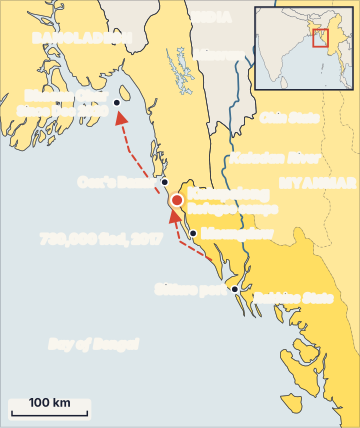
- On August 25, 2017, the armed group ARSA (Arakan Rohingya Salvation Army) attacked police posts. Myanmar's army responded with "clearance operations": villages were burnt and there were mass killings and sexual violence. At least 730,000 Rohingya fled to Bangladesh within months. The UN human rights chief called it "a textbook example of ethnic cleansing".
- In 2018, a UN Independent International Fact-Finding Mission found signs of genocidal intent and recommended that top generals, including army chief Min Aung Hlaing, be investigated.
- On February 1, 2021, the army seized power in a coup. Since 2024, the Arakan Army, a Rakhine Buddhist armed group fighting the military, has taken most of Rakhine, including Maungdaw and the whole border with Bangladesh (December 2024). Rohingya have been caught between both sides, and new refugees keep arriving.
The refugee situation in Bangladesh
- About 1.1 to 1.2 million Rohingya refugees live in Bangladesh, mostly in camps in Cox's Bazar district, including Kutupalong, one of the world's largest refugee camps. Around 150,000 arrived since 2024 alone.
- Since December 2020, Bangladesh has moved some refugees to Bhasan Char, a silt island in the Bay of Bengal. Rights groups raised concerns about flooding, cyclones and consent.
- Bangladesh and Myanmar signed repatriation agreements in 2017, but almost no refugees have returned, because conditions in Rakhine are not safe and citizenship is not guaranteed.
- Cuts in international aid since 2025 have reduced food rations and services in the camps.
The search for justice (three tracks)
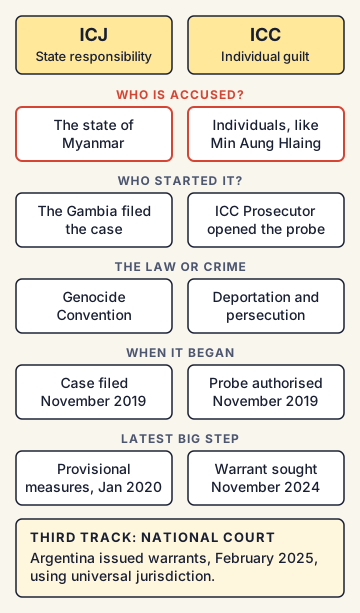
- ICJ (state responsibility): The Gambia v. Myanmar, filed November 2019 under the Genocide Convention. Provisional measures were ordered in January 2020; final judgment due November 19, 2026.
- ICC (individual guilt): Myanmar is not a member of the ICC, but Bangladesh is. Since the crime of deportation ended on Bangladeshi soil, the ICC authorised an investigation in November 2019. In November 2024, the ICC Prosecutor asked for an arrest warrant for Min Aung Hlaing for crimes against humanity of deportation and persecution.
- National courts (universal jurisdiction): In February 2025, a court in Argentina issued arrest warrants for Min Aung Hlaing and other officials, using the principle that the gravest crimes can be tried anywhere.
India's position and Indian examples
- India is not a party to the 1951 UN Refugee Convention or its 1967 Protocol, and has no national refugee law. Rohingya who entered without papers are treated as illegal foreigners under India's immigration laws (now the Immigration and Foreigners Act, 2025).
- Government estimates in 2017 put the number of Rohingya in India at about 40,000, spread across Jammu, Delhi, Hyderabad, Haryana and other places. Some hold UNHCR refugee cards.
- In Mohammad Salimullah v. Union of India (April 2021), the Supreme Court refused to stop the deportation of Rohingya detained in Jammu, but said deportation must follow the procedure prescribed by law. Whether India is bound by non-refoulement remains debated.
- The government has cited security concerns, including possible links of some individuals with terror groups.
- India sent relief to Bangladesh for the refugees under Operation Insaniyat (September 2017) and has funded housing in Rakhine under a Rakhine State Development Programme. India's stated position is that the refugees should return to Myanmar in a safe, sustainable and speedy way.
- India's stakes include its "Act East" links with Myanmar (such as the Kaladan Multi-modal Transit Transport Project, which runs through Rakhine's Sittwe port), stability on its north-east border, and ties with Bangladesh.
Commonly confused concepts
- Refugee vs illegal migrant vs stateless person: A refugee has fled their country because of a well-founded fear of persecution. An illegal migrant has entered without valid papers, for any reason. A stateless person is not recognised as a citizen by any country. The Rohingya are mostly stateless, and in India are legally treated as illegal migrants.
- ARSA vs Arakan Army: ARSA is a small Rohingya militant group whose 2017 attacks triggered the crackdown. The Arakan Army is a large ethnic Rakhine (Buddhist) armed group fighting Myanmar's military, and now controls most of Rakhine.
- Rakhine State vs Chin State: Rakhine is on Myanmar's west coast, bordering Bangladesh; Chin State borders Mizoram in India.
- ICJ case vs ICC case: The ICJ case is against the state of Myanmar; the ICC case targets individuals like Min Aung Hlaing.
Issues, criticism and the way forward
- Root cause unresolved: Without changes to the 1982 Citizenship Law, return and safety are hard to guarantee.
- Burden on Bangladesh: Hosting over a million refugees strains land, forests, jobs and security in Cox's Bazar.
- Camp security and trafficking: Armed groups, drug trade (especially yaba pills) and human trafficking, including dangerous boat journeys across the Andaman Sea, are major concerns.
- Funding gaps: Falling international aid has cut rations and schooling in the camps.
- Accountability gaps: Myanmar's military rejects the courts, and arrest warrants are hard to enforce.
- Regional responsibility: ASEAN's Five-Point Consensus (2021) on Myanmar has had limited results.
- Way forward: Experts suggest safe and voluntary return with citizenship rights, more aid and education in the camps, regional burden-sharing, and support for justice through the ICJ, the ICC and national courts.
Concepts to Know
- Stateless person: Someone no country recognises as its citizen, so they lack the basic rights citizenship brings.
- Non-refoulement: The rule that a country should not send a person back to a place where they face serious danger, such as persecution or torture.
- Repatriation: Sending refugees back to their home country, which should be safe, voluntary and dignified.
- Universal jurisdiction: The idea that some crimes are so serious that any country's courts can try them, wherever they took place.
- UNHCR: The UN Refugee Agency, which protects and helps refugees around the world.
- Rohingya: mostly Muslim, from Rakhine (Arakan) State, Myanmar; not among Myanmar's 135 recognised ethnic groups
- 1982 Citizenship Law: three categories of citizens (full, associate, naturalised); left most Rohingya stateless
- August 25, 2017: ARSA attacks followed by military clearance operations; at least 730,000 fled to Bangladesh
- 2018: UN Fact-Finding Mission found genocidal intent
- About 1.1 to 1.2 million Rohingya refugees in Bangladesh, mostly in Cox's Bazar; relocation to Bhasan Char since December 2020
- ICC investigation authorised November 2019; arrest warrant sought for Min Aung Hlaing November 2024
- Argentina court arrest warrants: February 2025
- India: not party to the 1951 Refugee Convention; about 40,000 Rohingya (2017 estimate); Mohammad Salimullah v. Union of India (2021); Operation Insaniyat (2017)
● Tracked since November 03, 2026 · last seen November 03, 2026 · updates as the daily brief publishes