International Court of Justice (ICJ)
The International Court of Justice (ICJ) is the main court of the United Nations. It settles legal disputes between countries (not between individuals) and gives legal advice, called advisory opinions, to UN bodies. It sits at the Peace Palace in The Hague, Netherlands. It is often called the "World Court".
Why does it exist?
Countries often disagree: over borders, sea areas, treaties or the treatment of their citizens. Without a court, such fights can turn into wars. The ICJ gives countries a peaceful way to settle disputes using international law. Think of it like a civil court for nations: two parties bring a dispute, judges hear both sides, and a binding decision is given.
Where did it come from?
- Its predecessor was the Permanent Court of International Justice (PCIJ), set up under the League of Nations in 1922.
- After the Second World War, the UN Charter (1945) created the ICJ as one of the six principal organs of the UN. Its rules are in the Statute of the ICJ, which is attached to the UN Charter.
- The court held its first sitting in April 1946.
- It is the only one of the six principal UN organs not based in New York.
- Every UN member country is automatically a party to the ICJ Statute.
Who are the judges?
- The court has 15 judges, each elected for a nine-year term. They can be re-elected.
- Judges are elected by the UN General Assembly and the UN Security Council voting separately. A candidate needs an absolute majority in both bodies. In the Security Council vote, there is no veto: permanent and non-permanent members count the same.
- Elections are staggered: one-third of the judges (five) are elected every three years, so the court is never fully new.
- No two judges can be from the same country. Together, they are meant to represent the main legal systems of the world.
- If a country in a case has no judge of its own nationality on the bench, it can appoint a temporary judge ad hoc for that case.
- The judges elect a President and a Vice-President for three years. Judge Iwasawa Yuji of Japan was elected President on March 3, 2025, after Nawaf Salam resigned to become Prime Minister of Lebanon.
- The official languages are English and French.
How does it decide cases? (Its two jobs)
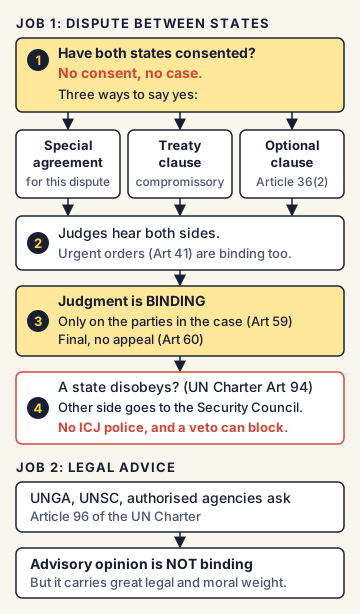
- Contentious cases (disputes between states): The court can hear a case only if the countries involved have consented. Consent can come in three ways:
- a special agreement where both countries agree to send a dispute to the court;
- a compromissory clause in a treaty: a line saying disputes under this treaty can go to the ICJ (for example, Article IX of the Genocide Convention);
- an optional clause declaration under Article 36(2) of the Statute, where a country accepts the court's jurisdiction in advance. About 74 to 75 countries have made such declarations. India's declaration carries many reservations (exceptions), including for disputes with Commonwealth countries.
- Advisory opinions: The UN General Assembly, the Security Council and authorised UN agencies can ask the court for legal advice (Article 96 of the UN Charter). These opinions are not binding, but carry great legal and moral weight. Example: the advisory opinion on states' obligations on climate change (July 2025).
Is its judgment binding?
- A judgment binds only the parties in that case (Article 59 of the Statute). It is final and cannot be appealed (Article 60).
- Provisional measures are urgent orders the court can give while a case is going on, to protect rights from harm (Article 41). Since the LaGrand case (2001), they are binding.
- Under Article 94 of the UN Charter, each UN member promises to obey ICJ decisions in cases it is party to. If a country does not, the other side can go to the Security Council, which may act. The ICJ has no police of its own, so enforcement depends on the Security Council, where the five permanent members hold a veto.
India's position and Indian examples
- Indian judges at the ICJ: Sir B.N. Rau (1952–1953); Nagendra Singh (1973–1988), who was President of the ICJ from 1985 to 1988, the only Indian to hold that post; R.S. Pathak (1989–1991); and Dalveer Bhandari (since 2012, re-elected in 2017).
- India's cases: India has been a party in six cases, four of them with Pakistan.
- Right of Passage over Indian Territory (Portugal v. India): judgment 1960; the court did not find India in breach.
- Appeal Relating to the Jurisdiction of the ICAO Council (India v. Pakistan): judgment 1972.
- Trial of Pakistani Prisoners of War (Pakistan v. India): filed 1973, later withdrawn.
- Aerial Incident of 10 August 1999 (Pakistan v. India): in 2000 the court said it had no jurisdiction.
- Marshall Islands v. India (nuclear disarmament): in 2016 the court upheld India's objection on jurisdiction.
- Jadhav case (India v. Pakistan): on July 17, 2019, the court held, by 15 votes to 1, that Pakistan violated the Vienna Convention on Consular Relations by denying consular access to Kulbhushan Jadhav, and ordered an effective review of his conviction.
- India generally prefers to settle disputes with neighbours bilaterally (directly between the two countries), which is why its optional clause declaration excludes many kinds of disputes.
Commonly confused concepts
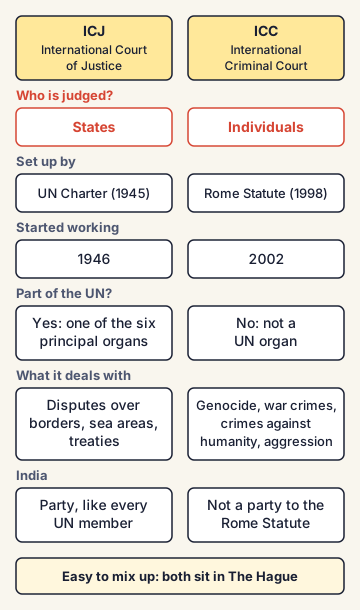
- ICJ vs ICC: The ICJ (1945–46, UN organ) judges states. The International Criminal Court (ICC), set up by the Rome Statute (1998) and working since 2002, tries individuals for genocide, war crimes, crimes against humanity and aggression. The ICC is not a UN organ. Both are in The Hague. India is not a party to the Rome Statute.
- ICJ vs Permanent Court of Arbitration (PCA): The PCA (1899) is not a court with fixed judges; it helps set up arbitration panels chosen by the parties. It also sits in the Peace Palace. The Indus Waters Treaty "Court of Arbitration" proceedings, for example, have been run with the PCA's support.
- ICJ vs PCIJ: The PCIJ (1922) was the League of Nations' court; the ICJ replaced it under the UN.
- Judgment vs advisory opinion: A judgment in a contentious case is binding on the parties; an advisory opinion is not binding.
- ITLOS: The International Tribunal for the Law of the Sea (Hamburg) is a separate court set up under UNCLOS for sea disputes.
Issues, criticism and the way forward
- Consent-based jurisdiction: Countries can stay out of the court's reach by not accepting its jurisdiction or by adding reservations. Most permanent members of the Security Council do not accept compulsory jurisdiction.
- Weak enforcement: Compliance depends on the Security Council, where a veto can block action. Some states have ignored provisional measures.
- Slow pace: Big cases can take many years; The Gambia v. Myanmar has taken seven years to reach a final judgment.
- Representation: Critics point out that the court's composition has long favoured the permanent members and Western legal traditions; there are calls for more diverse benches.
- Growing role: On the positive side, states increasingly use the ICJ for big questions, such as genocide, climate change and decolonisation (for example, the 2019 Chagos advisory opinion). Experts suggest wider acceptance of compulsory jurisdiction and stronger follow-up of judgments.
Concepts to Know
- Jurisdiction: The legal power of a court to hear and decide a case.
- Contentious case: A case where two or more states have a dispute and ask the court for a binding decision.
- Provisional measures: Temporary orders given before the final judgment, to stop harm while the case is going on, like a "stay order" in Indian courts.
- Reservation: A statement a country makes when joining a treaty or accepting a court's jurisdiction, saying some parts will not apply to it.
- Merits: The main questions of a case (did the country break the law or not), as opposed to preliminary questions like jurisdiction.
- Established by the UN Charter (1945); first sitting April 1946; successor to the PCIJ (1922)
- Seat: Peace Palace, The Hague; official languages English and French
- 15 judges; 9-year terms; elected by absolute majority in both UNGA and UNSC; one-third elected every 3 years
- Binding judgment: Article 59 (parties only); no appeal: Article 60; provisional measures: Article 41; compliance: Article 94 of the UN Charter
- Advisory opinions: Article 96 of the UN Charter; not binding
- Indian President of ICJ: Nagendra Singh (1985–88); current Indian judge: Dalveer Bhandari (since 2012)
- President (as of November 2026): Iwasawa Yuji (Japan), elected March 3, 2025
- Jadhav case judgment: July 17, 2019 (15–1)
● Tracked since November 03, 2026 · last seen November 03, 2026 · updates as the daily brief publishes