Refugee Policy in India
A refugee is a person who has run away from their own country because they fear serious harm there, for example because of their religion or race, and who cannot safely go back. Many countries have a special refugee law that gives such people a legal status and rights. India has no national refugee law. Instead, it deals with each refugee group separately, using its general laws on foreigners, government orders and court judgments. Even so, India has given shelter to millions of people over the years.
Why does refugee protection matter?
A person fleeing danger often cannot carry a passport or get a visa. Under normal immigration law, such a person is simply an "illegal" foreigner who can be jailed and sent back. Refugee protection exists so that a person is not punished for running to safety, and is not pushed back to the place where they may be killed or tortured. Without it, people fleeing war or persecution would have nowhere to go.
The global framework: the 1951 Refugee Convention
After the Second World War, millions of people in Europe were homeless and stateless. In response, the United Nations adopted the Convention Relating to the Status of Refugees in 1951. Its key points:
- It defines a refugee as a person outside their country who has a "well-founded fear of persecution" because of one of five grounds: race, religion, nationality, membership of a particular social group, or political opinion.
- Article 33 contains the principle of non-refoulement. This means a country must not send a refugee back to a place where their life or freedom is at risk.
- Article 33(2) has a narrow exception: a refugee who is a danger to the security of the country, or who has been convicted of a particularly serious crime, can lose this protection.
The 1951 Convention only covered events that happened before 1 January 1951, and countries could limit it to Europe. The 1967 Protocol removed these time and place limits, so the Convention now applies to refugees anywhere in the world. Around 145 countries are parties to the Convention and around 146 to the Protocol.
India's position on the Convention
India has not signed either the 1951 Convention or the 1967 Protocol. The reasons usually given are:
- The Convention was written with Europe's post-war problems in mind, and it looks only at individual persecution. South Asia faces sudden mass arrivals of lakhs of people, which the Convention was not designed for.
- India's borders are long and porous (easy to cross), and the region has many security and terrorism concerns. India wants to keep the freedom to decide who stays.
- India is a developing country with limited resources, and it worries about the costs of the Convention's obligations.
Even so, India takes part in global refugee work. It was elected to the Executive Committee of UNHCR (the United Nations High Commissioner for Refugees, the UN refugee agency) in 1995. UNHCR runs an office in New Delhi. It registers refugees from countries such as Afghanistan and Myanmar who come to it directly. As of 31 December 2024, about 47,630 refugees and asylum-seekers were registered with UNHCR India.
Large groups such as Tibetans and Sri Lankan Tamils are registered with the Government of India instead, and are counted separately.
How does India actually handle refugees?
Since there is no refugee law, India uses a mix of tools:
- The foreigners law. Every refugee is legally a "foreigner". Their entry and stay fall under the Immigration and Foreigners Act, 2025 (which replaced the Foreigners Act, 1946 and the Passport (Entry into India) Act, 1920).
- Exemption orders. The central government can exempt whole groups from passport and visa rules. This is how Tibetans, Sri Lankan Tamils and persecuted minorities from neighbouring countries are protected.
- Long Term Visas (LTVs). In December 2011, the MHA issued a Standard Operating Procedure (SOP) for foreigners who claim to be refugees. A person applies through the Foreigners Regional Registration Office (FRRO). After security checks, the MHA can grant a Long Term Visa. LTV holders can work in the private sector and study.
- State-level welfare. States run camps and give help. For example, Tamil Nadu runs over 100 camps for Sri Lankan Tamil refugees.
Think of it like a school without a written rulebook for new students. The principal decides each case one by one. This gives flexibility, but students do not know their rights in advance.
Major refugee groups in India
India's practice differs from group to group:
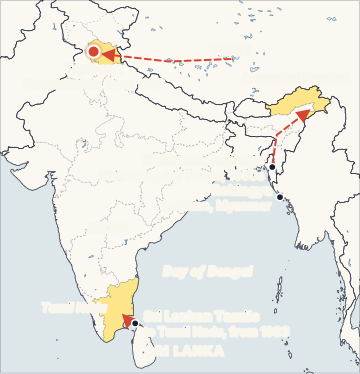
- Tibetans: They began arriving in 1959, when the Dalai Lama fled to India. The Central Tibetan Administration (the Tibetan government-in-exile) is based in Dharamshala, Himachal Pradesh. The MHA issued the Tibetan Rehabilitation Policy, 2014 to give uniform facilities, such as land on lease and access to government schemes, in all states. Around 80,000 or more Tibetans live in India.
- Sri Lankan Tamils: They came in waves from 1983, during Sri Lanka's civil war. About 58,000 to 61,000 live in camps in Tamil Nadu, and over 30,000 more live outside the camps.
- Chakmas and Hajongs: Buddhist and Hindu groups who came from the Chittagong Hill Tracts of present-day Bangladesh in the 1960s, many of whom settled in Arunachal Pradesh.
- Afghans and Rohingya (from Myanmar): mostly registered with UNHCR. The Rohingya are a Muslim minority from Myanmar's Rakhine state. India treats them as illegal migrants and has raised security concerns about them.
- Minorities from Afghanistan, Bangladesh and Pakistan: Given LTVs, exemption from penal action, and a fast track to citizenship under the CAA.
What do Indian courts say?
The Constitution protects some rights of all persons, not just citizens:
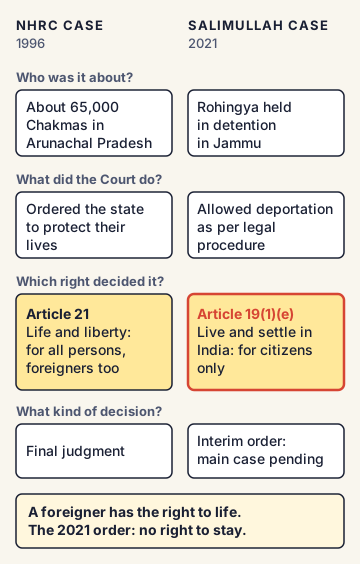
- Article 14 (equality before the law) and Article 21 (protection of life and personal liberty) apply to foreigners too.
- In National Human Rights Commission v. State of Arunachal Pradesh (1996), the Supreme Court ordered the state to protect the lives of about 65,000 Chakmas who faced threats and forced eviction. It held that Article 21 protects foreigners as well.
- Some High Courts, such as the Gujarat High Court in Ktaer Abbas Habib Al Qutaifi v. Union of India (1998), read the principle of non-refoulement into Article 21, as long as the refugee is not a threat to India's security.
- But in Mohammad Salimullah v. Union of India (2021), an interim order in the Rohingya case, the Supreme Court allowed deportation of detained Rohingya as per legal procedure. It said the right not to be deported is linked to the right to live and settle anywhere in India under Article 19(1)(e), which only citizens have. It also noted India is not a party to the 1951 Convention. The main case is still pending.
Commonly confused concepts
- Refugee vs illegal migrant: A refugee flees persecution or danger. An illegal migrant, under Indian law, is any foreigner who enters without valid papers or stays after their papers expire, whatever the reason. Indian law does not separate the two; government orders do.
- Refugee vs asylum-seeker: An asylum-seeker is a person who has asked for protection but whose claim has not yet been decided. Once the claim is accepted, they are a refugee.
- Refugee vs internally displaced person (IDP): An IDP has fled their home but is still inside their own country. A refugee has crossed an international border.
- Refugee vs economic migrant: An economic migrant moves mainly for better jobs or income, not because of a threat to life.
- Refugee vs stateless person: A stateless person is not a citizen of any country. A refugee may still have a nationality but cannot safely use its protection.
- Exemption order vs citizenship: An exemption only protects a person from punishment for not having a passport or visa. Citizenship is a full legal membership of the nation with voting rights. One does not lead to the other automatically.
Issues, criticism and the way forward
- No uniform law: Critics say treating each group differently creates unequal treatment and uncertainty. The government's view is that case-by-case policy lets it respond to security needs and keep good relations with neighbours.
- Religion-based selection: Some experts argue that protecting only certain communities from certain countries leaves out others who also face persecution, such as Rohingya, Ahmadiyyas or Hazaras. The government's position is that the six communities face religious persecution in Muslim-majority neighbouring states and India has a historical duty towards them.
- Security concerns: The state points to the risk of infiltration, trafficking and terrorism across porous borders, especially in the North-East and border states.
- Life in camps: Sri Lankan Tamils and others have lived in camps for decades with limited mobility, work and education options. Many children born in India remain without a clear status.
- Way forward suggested by experts: A national refugee law has been suggested many times, including through a private member's bill (the Asylum Bill, 2015). Suggestions include a fair process to decide refugee claims, clear rights to work and study, a legal guarantee of non-refoulement with a security exception, and a balance between humanitarian duty and national security.
Concepts to Know
- Persecution: Serious and repeated harm, such as violence, jailing or threats, done to a person because of who they are, like their religion or race.
- Non-refoulement: A French-origin word meaning "not pushing back". A country must not return a person to a place where they face serious danger. Many experts treat it as part of customary international law, which means it binds all countries, even those that have not signed the Convention.
- Customary international law: Rules that become binding because almost all countries follow them for a long time and believe they must, even without a written treaty.
- UNHCR: The United Nations High Commissioner for Refugees, the UN agency that protects refugees. It was set up in 1950 and is based in Geneva.
- FRRO (Foreigners Regional Registration Office): A government office under the Bureau of Immigration where foreigners register and get their visas extended.
- Long Term Visa (LTV): A visa given for a long period and renewable, allowing a foreigner to live in India, work in the private sector and study.
- Interim order: A temporary court order given while a case is still being heard, not the final decision.
- 1951 Refugee Convention: five grounds (race, religion, nationality, particular social group, political opinion); Article 33 = non-refoulement
- 1967 Protocol: removed the pre-1951 time limit and the Europe-only option
- India: not a party to the 1951 Convention or the 1967 Protocol; no national refugee law
- India elected to the UNHCR Executive Committee in 1995
- MHA SOP for foreigners claiming refugee status: December 2011; LTV route through the FRRO
- Tibetans: arrivals from 1959; Central Tibetan Administration at Dharamshala; Tibetan Rehabilitation Policy, 2014
- Sri Lankan Tamils: about 58,000 to 61,000 in over 100 camps in Tamil Nadu
- UNHCR India registered refugees and asylum-seekers: about 47,630 (as of 31 December 2024)
- NHRC v. State of Arunachal Pradesh (1996): Article 21 protects foreigners (Chakma case)
- Mohammad Salimullah v. Union of India (2021): interim order allowing deportation of Rohingya under legal procedure; right to reside and settle under Article 19(1)(e) is for citizens only
● Tracked since November 06, 2026 · last seen November 06, 2026 · updates as the daily brief publishes