Red Mud (Bauxite Residue)
Waste from Aluminium That Holds Critical Minerals
Red mud is the reddish-brown, sticky waste left over when alumina (aluminium oxide) is taken out of bauxite ore. Its proper name is bauxite residue. For every tonne of alumina made, about 1 to 1.5 tonnes of red mud are left behind. It is strongly alkaline (like a strong soap or washing soda solution), so it is hard to store safely.
But it also holds small amounts of valuable metals such as titanium and gallium, and rare earth elements such as scandium. This is why India now sees it as a possible source of critical minerals.
How is red mud made?
Aluminium is made in two big steps:
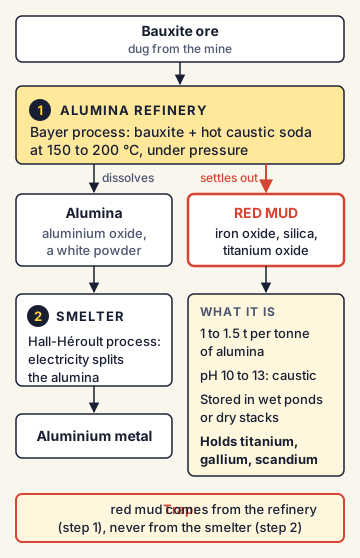
- Bauxite to alumina (the Bayer process): Crushed bauxite is mixed with hot caustic soda (sodium hydroxide) at about 150 to 200 °C under pressure. The aluminium part dissolves. The parts that do not dissolve, mainly iron oxides, silica and titanium oxide, settle down as a red sludge. This sludge is red mud.
- Alumina to aluminium (the Hall-Héroult process): The pure alumina is broken down using electricity in a smelter to get aluminium metal.
So red mud comes from the refinery (the first step), not from the smelter. A simple way to picture it: think of making tea. The tea you drink is the alumina. The wet leaves left in the strainer are the red mud, except here the "strainer" also holds a lot of strong caustic liquid.
Where did it come from?
The Austrian chemist Carl Josef Bayer developed this process in 1887-88. The smelting step, the Hall-Héroult process, was invented in 1886. Together, these two processes made aluminium cheap enough for daily use. Almost all alumina in the world is still made by the Bayer process, so red mud is produced wherever aluminium is made.
What is red mud made of?
Its make-up depends on the bauxite used. Typical ranges, by weight:
- Iron oxide: 5 to 60%. This is what gives red mud its red colour.
- Alumina (aluminium oxide) left over: 5 to 30%
- Silica: 3 to 50%
- Titanium oxide: up to 15%
- Calcium oxide: 2 to 14%
- Sodium oxide (from the caustic soda): 1 to 10%
It also carries trace amounts (very small quantities) of gallium and vanadium, and of rare earth elements such as scandium. Its pH is usually 10 to 13, and often above 12. (On the pH scale, 7 is neutral like pure water. Higher numbers mean more alkaline. Each step up is ten times stronger.)
Why is it a problem?
The world makes a huge amount of it, and very little is used.
- In 2023, the world produced over 142 million tonnes of alumina and about 170 million tonnes of red mud.
- More than 4 billion tonnes of red mud are already stored around the world, mostly in large ponds or dams.
- Only a few per cent of the red mud made each year is put to any use. The rest is stored.
Stored red mud can harm the land, water and air around it. Its alkaline liquid can leak into soil and groundwater. When it dries, fine red dust can blow over nearby villages. And if a storage dam breaks, the result can be a disaster.
The Ajka disaster: why safe storage matters
On 4 October 2010, a wall of a red mud reservoir at an alumina plant near Ajka in Hungary broke. About one million cubic metres of red mud flooded nearby villages such as Kolontár and Devecser. About ten people died and hundreds were injured. The sludge reached the Danube river on 7 October 2010. This accident made the world pay attention to how red mud is stored.
How should red mud be stored?
There are two main methods:
- Wet storage: The red mud slurry (a watery mix) is pumped into large ponds held back by earth walls. This is cheap, but the ponds hold a lot of caustic water and the walls can fail.
- Dry stacking: The slurry is first squeezed in machines called filter presses to remove most of the water. The thicker, drier cake is then piled up in stacks. This uses less land, recovers caustic soda for reuse, and greatly reduces the risk of a dam break.
India's rules
In India, red mud is managed under the Hazardous and Other Wastes (Management and Transboundary Movement) Rules, 2016, made under the Environment (Protection) Act, 1986. The Central Pollution Control Board (CPCB) issued guidelines for handling and managing red mud from alumina plants, circulated to states through a letter dated 16 August 2024. These guidelines treat red mud as a "high-volume, low-effect" waste, like fly ash and phosphogypsum.
This label means it is made in huge amounts and is less harmful, tonne for tonne, than most hazardous wastes. It does not mean it is harmless: it still needs careful handling. Their main points:
- Plants should cut the amount of red mud they make, for example by using better-quality ore and washing the mud better.
- Plants should install filter presses and move to dry stacking.
- Plants must send quarterly (every three months) monitoring reports to their State Pollution Control Board.
Where is red mud made in India?
Red mud is made where bauxite is refined, so it is concentrated in the bauxite states.
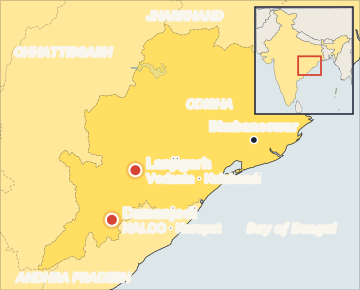
- Odisha has about 41% of India's bauxite resources, followed by Chhattisgarh (20%), Andhra Pradesh (12%), Gujarat (8%), Jharkhand (6%) and Maharashtra (5%), according to the Indian Bureau of Mines.
- Odisha also produced about 76% of India's bauxite in 2020-21.
- Major alumina refineries include NALCO's refinery at Damanjodi (Koraput district, Odisha), which uses bauxite from the Panchpatmali mines, and Vedanta's refinery at Lanjigarh (Kalahandi district, Odisha).
- Estimates of how much red mud India makes each year vary between sources, from about 5 million to 10 million tonnes [Unverified: no single official figure].
Red mud as a source of critical minerals
The same red mud that is a storage headache can also be a "secondary resource", meaning a source of minerals other than a fresh mine. It contains:
- Titanium (used in aircraft, paints and medical implants)
- Gallium (used in computer chips and LEDs)
- Scandium (added to aluminium to make very light, strong alloys for aircraft, and used in some fuel cells)
- Vanadium, and rare earth elements other than scandium
Titanium, gallium, vanadium and rare earth elements (a group of 17 elements that includes scandium) are all on India's list of 30 critical minerals. Indian red mud is reported to contain about 45 to 70 parts per million of scandium. "Parts per million" means grams per tonne, so this is about 45 to 70 grams of scandium in every tonne of red mud.
Because the amounts are tiny, getting them out is costly. So far, commercial extraction of rare earths from red mud in India is close to zero; the work is at the research and pilot stage.
What is India doing?
- NALCO and CSIR-NML: On 6 January 2026, NALCO and the CSIR-National Metallurgical Laboratory signed an agreement for India's first pilot project to recover scandium from red mud. The plan is a 10-tonne-per-day pilot plant at Damanjodi, Odisha. The process aims to recover alumina, iron, titanium oxide and scandium oxide, and to produce a rare earth concentrate.
- JNARDDC: The Jawaharlal Nehru Aluminium Research Development and Design Centre in Nagpur is an autonomous body under the Ministry of Mines, set up in 1989 with support from the United Nations Development Programme (UNDP). It has developed a process to recover rare earth elements from red mud.
- National Critical Mineral Mission (NCMM): The Mission (approved 29 January 2025) supports recovering critical minerals from waste. About ₹100 crore has been set aside for pilot projects that recover critical minerals from overburden, mine tailings, fly ash and red mud, run through recognised Centres of Excellence.
- Bulk uses: Some red mud is already used in cement making, bricks, tiles and road building. In 2013, Vedanta set up a red mud powder unit at its Lanjigarh refinery, which it described as the first of its kind in the alumina industry.
Commonly confused concepts
- Red mud vs fly ash: Red mud comes from refining bauxite into alumina. Fly ash is the fine ash left after burning coal in thermal power plants. Both are high-volume industrial wastes, and both are now seen as possible sources of critical minerals, but they come from different industries.
- Red mud vs mine tailings: Tailings are the waste left at a mine after the useful mineral is separated from the ore. Red mud is not mine waste; it is made at the refinery, after chemical treatment with caustic soda.
- Alumina refinery vs aluminium smelter: The refinery turns bauxite into alumina (Bayer process) and makes red mud. The smelter turns alumina into aluminium using electricity (Hall-Héroult process). A common trap: red mud does not come from the smelter.
- Is red mud "toxic"? Its main danger is its strong alkalinity, not high levels of poisonous heavy metals. After Ajka, experts said its immediate poisoning effect from heavy metals was fairly low, but the caustic burns and long-term effects on land and water were serious. In the European Union's waste list, red mud normally has a non-hazardous code. It counts as hazardous there only if it contains hazardous substances. India manages it under its Hazardous and Other Wastes Rules, 2016.
- Scandium and rare earths: Scandium is counted as one of the 17 rare earth elements, along with yttrium and the 15 lanthanides, even though it is a much lighter element. A common trap: titanium, gallium and vanadium are critical minerals, but they are not rare earth elements.
Issues, criticism and the way forward
- Low concentration, high cost: Valuable metals are present only in grams per tonne. Extracting them needs large plants, a lot of acid or energy, and creates new waste of its own.
- Lab to market gap: Indian research bodies have shown that recovery is possible, but there is still no commercial-scale plant. Pilot plants like the one planned at Damanjodi are meant to test whether it can pay for itself.
- Sodium limits bulk use: The leftover sodium makes red mud hard to use in large amounts in cement and bricks without first treating it.
- Safety of old ponds: Large amounts of red mud already lie in wet ponds. Moving to dry stacking and checking old dam walls is essential to avoid an Ajka-type accident.
- Way forward: Experts suggest combining both goals: first pull out the valuable metals (iron, alumina, titanium, scandium and other rare earths), then use the cleaner leftover in cement, bricks or roads, so that almost nothing is wasted. This "zero waste" approach would both reduce pollution and cut India's import dependence for critical minerals.
Concepts to Know
- Bauxite: The main ore (rock) from which aluminium is obtained. It is rich in aluminium hydroxide minerals.
- Alumina: Aluminium oxide, a white powder made from bauxite. It is the raw material that smelters turn into aluminium metal.
- Caustic soda: The common name for sodium hydroxide, a strong alkali used to dissolve the aluminium part of bauxite.
- Alkaline: The opposite of acidic. Strong alkalis, like strong acids, can burn skin and damage soil and water.
- Slurry: A thick, watery mixture of solid particles and liquid, which can be pumped through pipes.
- Filter press: A machine that squeezes a slurry between cloth filters to push out the water, leaving a dry cake.
- Secondary resource: A source of minerals that is not a fresh mine, such as industrial waste, mine waste or scrap.
- Pilot plant: A small test plant built to check if a process works before building a full-size factory.
- Rare earth elements (REE): A group of 17 metals (15 lanthanides plus scandium and yttrium) used in strong magnets, electronics and defence equipment.
- Red mud = bauxite residue, the waste from the Bayer process (bauxite to alumina)
- About 1 to 1.5 tonnes of red mud per tonne of alumina (global average about 1.23 tonnes, International Aluminium Institute)
- pH usually 10 to 13; red colour from iron oxide (5 to 60% by weight)
- Bayer process: Carl Josef Bayer, 1887-88; Hall-Héroult smelting process: 1886
- World: about 170 million tonnes of red mud in 2023; more than 4 billion tonnes stored; only a few per cent used each year
- Ajka disaster, Hungary: 4 October 2010, about one million cubic metres released, about ten deaths
- CPCB red mud guidelines under the Hazardous and Other Wastes Rules, 2016: circulated by letter dated 16 August 2024; filter presses, dry stacking, quarterly reports to State Pollution Control Boards
- Odisha: about 41% of India's bauxite resources and about 76% of bauxite production (2020-21)
- Indian red mud: about 45 to 70 parts per million of scandium
- NALCO and CSIR-NML scandium pilot: agreement on 6 January 2026; 10 tonnes per day; Damanjodi, Odisha
- JNARDDC, Nagpur: set up 1989 by the Ministry of Mines with UNDP support
- NCMM: about ₹100 crore for pilot projects on recovering critical minerals from overburden, tailings, fly ash and red mud
● Tracked since November 21, 2026 · last seen November 21, 2026 · updates as the daily brief publishes