Real Effective Exchange Rate (REER)
The Real Effective Exchange Rate, or REER, tells us how strong or weak the rupee really is against the currencies of all of India's main trading partners together, after adjusting for differences in price rise (inflation). It is shown as an index number, with a chosen base year set at 100. When the REER goes up, the rupee has become stronger in real terms, and Indian goods become costlier for the world. When it goes down, the rupee has become weaker in real terms, and Indian goods become cheaper for foreigners.
Why do we need it?
The rupee-dollar rate shown on the news is only one number against one currency. But India trades with dozens of countries: China, the United Arab Emirates (UAE), the euro area, the US and many more. The rupee can fall against the dollar and rise against the yen on the same day. Also, if prices in India rise faster than prices abroad, Indian goods become costlier even if the exchange rate does not change.
A single dollar rate misses both of these. REER captures both, so it is the best single measure of whether Indian exports are price-competitive.
Building it step by step: from nominal rate to REER
It helps to see the three levels:
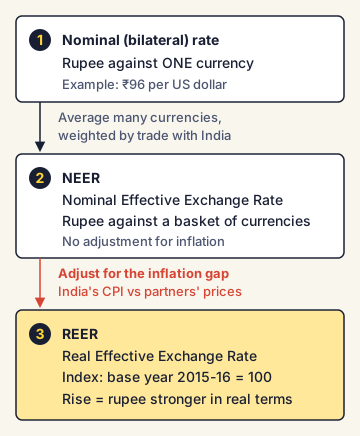
- Nominal (bilateral) exchange rate: the price of the rupee in one other currency, for example ₹96 per dollar.
- Nominal Effective Exchange Rate (NEER): an average of the rupee's exchange rates against many currencies at once. Each currency gets a weight based on how much India trades with that country. A big trading partner counts more. NEER does not adjust for inflation.
- Real Effective Exchange Rate (REER): the NEER adjusted for the difference between price rise in India and price rise in the partner countries.
A simple example: suppose the rupee-dollar rate does not move for a year. But prices in India rise by 6% and prices in the US rise by 2%. Indian goods are now about 4% costlier for Americans than before, even though the exchange rate is unchanged. In real terms, the rupee has become stronger (appreciated) by about 4%. REER picks this up; the plain exchange rate does not.
How does the RBI calculate it?
The RBI calculates NEER as a weighted geometric average of the rupee's exchange rates against the basket currencies. (A geometric average multiplies the numbers and takes a root, instead of adding them; it handles percentage changes better.) For REER, it then adjusts each currency by the ratio of Indian prices to that country's prices, using the Consumer Price Index (CPI). Key facts:
- Base year: 2015-16 = 100. The RBI moved the base from 2004-05 to 2015-16 in a revision published in January 2021. It chose 2015-16 as a "normal" year for India's economy and external sector.
- 40-currency basket: the main index. It was widened from 36 to 40 currencies in the 2021 revision (8 added, including the currencies of Nepal, Oman, Iraq and Chile; 4 dropped, including those of Pakistan and Sweden). It covers about 88% of India's trade, up from about 84%.
- 6-currency basket: a smaller index using the US dollar, the euro, the Chinese yuan, the British pound, the Japanese yen and the Hong Kong dollar.
- Weights: For the 40-currency basket, the RBI publishes indices with trade-based weights (exports plus imports) and with export-based weights. Trade weights change over time, using an average of the previous three years. In the 2021 revision, the biggest trade weights for 2020-21 were China (about 12.0%), the euro area (about 11.6%), the US (about 11.6%) and the UAE (about 7.8%).
- Direction: In the RBI's indices, a rise means the rupee has appreciated (become stronger) and a fall means it has depreciated.
- The RBI publishes the indices monthly in its Bulletin and in its Handbook of Statistics on the Indian Economy.
How do we read the number?
The base year value of 100 is treated as a reference point of "fair value", based on the idea of purchasing power parity (explained in Concepts to Know).
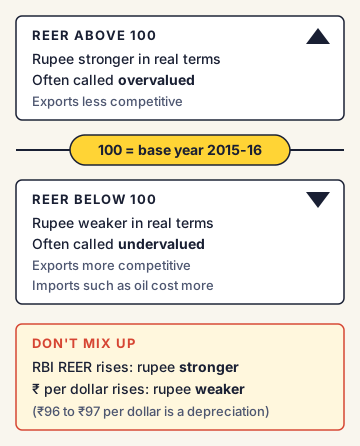
- REER above 100: the rupee is stronger in real terms than in the base year. It is often called overvalued. Exports become less competitive.
- REER below 100: the rupee is weaker in real terms than in the base year. It is often called undervalued. Exports become more competitive, but imports such as oil become costlier.
India's experience
For long periods, India's 40-currency REER stayed above 100, because India's inflation was higher than its partners' while the rupee fell only slowly. Exporters often complained that this made their goods costly abroad. Since late 2024 the picture changed. As reported, the 40-currency REER fell from about 108 in November 2024 to about 89 in May 2026, and was about 91 in June 2026 [Unverified].
In July 2026, RBI Governor Sanjay Malhotra said the rupee could reasonably be seen as undervalued in both nominal and real effective terms. The RBI does not target any REER level; it uses REER as one of many signals while managing volatility.
Commonly confused concepts
- NEER vs REER: NEER is an average of exchange rates only. REER is NEER adjusted for inflation differences. A country with high inflation can see its NEER fall while its REER rises.
- Depreciation vs devaluation: Depreciation is a fall in a currency's value caused by market forces (as in India's managed float). Devaluation is a deliberate cut in value by the government or central bank under a fixed rate system, as India did in 1966 and July 1991.
- REER vs Purchasing Power Parity (PPP) rate: PPP compares what the same basket of goods costs in two countries. REER is an index that tracks real changes against a base year. REER uses the PPP idea but does not give a "correct" exchange rate by itself.
- Bilateral rate vs effective rate: ₹96 per dollar is a bilateral rate. NEER and REER are "effective" rates because they cover many currencies at once.
- Index direction: In the RBI's REER, a higher number means a stronger rupee. In the ₹-per-dollar rate, a higher number means a weaker rupee. Students often mix these up.
Issues, criticism and the way forward
- The base year is a choice, not a law of nature. Calling 100 "fair value" assumes the base year was balanced. Change the base year and the same rupee can look over- or undervalued.
- Choice of price index matters. The RBI uses CPI. Some economists prefer wholesale or producer prices, or labour costs, for measuring export competitiveness. Each gives a different answer.
- Goods-heavy weights. The weights come from merchandise trade. India's services exports, such as software, are very large, so the index may not fully reflect India's real competitiveness.
- Productivity growth (the Balassa-Samuelson effect). In fast-growing economies, productivity rises quickly, and their currencies tend to rise in real terms over time without becoming truly "overvalued". So a REER above 100 in a growing country like India is not always a problem.
- Non-price factors. Quality, logistics, delivery time and technology also decide whether exports sell. REER captures only prices.
- Way forward: Experts suggest reading REER together with other signals: the current account deficit, forex reserves, capital flows and export growth, rather than as a single target.
Concepts to Know
- Appreciation and depreciation: When the rupee appreciates, one rupee buys more foreign currency (for example, ₹95 per dollar instead of ₹96). When it depreciates, one rupee buys less (₹97 per dollar).
- Purchasing Power Parity (PPP): The idea that, in the long run, the same basket of goods should cost the same everywhere once prices are converted into one currency. If a pen costs ₹96 in India and $1 in the US, the PPP rate is ₹96 per dollar.
- Index number: A number that shows change compared with a starting point (the base year) set at 100. A value of 110 means 10% higher than the base year.
- Consumer Price Index (CPI): A number that tracks how the prices of things households buy (food, fuel, clothes, rent) change over time.
- Weight: The importance given to each item in an average. If India trades much more with China than with Chile, the yuan gets a bigger weight than the Chilean peso.
- Export competitiveness: How easily a country's goods can sell abroad on price. A weaker real exchange rate makes exports cheaper for foreign buyers.
- REER = NEER adjusted for inflation differences between India and its trading partners
- RBI base year: 2015-16 = 100 (revised from 2004-05; revision published January 2021)
- 40-currency basket (widened from 36 in 2021), covering about 88% of India's trade; trade-based and export-based weights
- 6-currency basket: US dollar, euro, Chinese yuan, British pound, Japanese yen, Hong Kong dollar
- RBI REER uses CPI; NEER is a weighted geometric average
- Rise in RBI's REER = rupee appreciation; above 100 = overvalued, below 100 = undervalued (relative to base year)
- Biggest trade weights for 2020-21: China (~12.0%), euro area (~11.6%), US (~11.6%), UAE (~7.8%)
● Tracked since April 24, 2026 · last seen October 10, 2026 · updates as the daily brief publishes