Currency Hedging and the Forward Premium
Currency hedging means protecting yourself against a sudden change in the exchange rate. A business or investor who will need or receive dollars in the future can fix the exchange rate today through a contract, so a later fall or rise in the rupee does not hurt them. The extra price paid to buy dollars in the future, compared with today's price, is called the forward premium. For the rupee, this premium is mostly decided by the gap between Indian and US interest rates.
Why does hedging exist?
Think of an Indian company that imports machinery and must pay $1 million after six months. Suppose $1 costs ₹95 today. If the rupee falls to ₹100 in six months, the same bill will cost ₹50 lakh more. The company cannot run its business on such guesswork. So it signs a contract with a bank today to buy dollars after six months at a fixed rate.
This is like booking a train ticket in advance: you may pay a little extra, but you are sure of the price and your seat. Exporters, importers, companies with foreign loans and foreign investors all use hedging for the same reason.
What is a spot rate and a forward rate?
- The spot rate is the exchange rate for buying or selling a currency now (settled within two working days).
- The forward rate is the rate fixed today for a deal that will be settled on a future date, say after three months or one year.
- If the forward rate is higher than the spot rate (more rupees per dollar in the future), the dollar is at a forward premium. If it is lower, the dollar is at a forward discount.
Why is there a forward premium? (Covered interest parity)
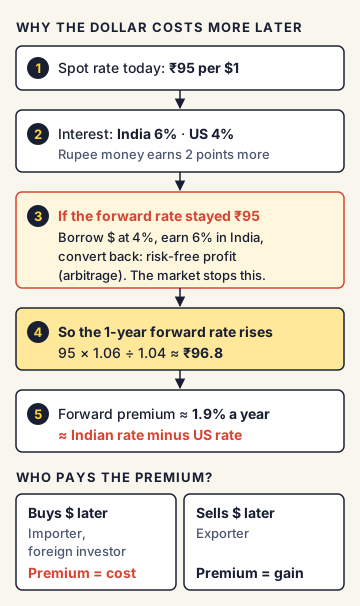
The forward premium is not a guess about where the rupee will go. It comes from a simple rule called covered interest parity. Money in rupees earns a higher interest rate in India than money in dollars earns in the US. If a bank sold dollars forward at today's spot rate, anyone could borrow dollars cheaply, convert them to rupees, earn the higher Indian interest, and convert back at no risk.
That would be free money. To stop this, the forward rate adjusts so that the interest advantage is cancelled out. The rough formula is:
Forward rate ≈ Spot rate × (1 + Indian interest rate) ÷ (1 + US interest rate)
A simple example: if the spot rate is ₹95 per dollar, the one-year Indian rate is 6% and the US rate is 4%, the one-year forward rate is about 95 × 1.06 ÷ 1.04, which is roughly ₹96.8. The forward premium is about 1.9% a year, close to the 2-percentage-point interest gap. So, roughly: annual forward premium ≈ Indian interest rate minus US interest rate.
What is the "hedging cost"?
For someone who will buy dollars in the future (an importer, or a foreign investor who will take money out of India), the forward premium is a cost. They agree to pay more rupees per dollar later than they would pay today. For an exporter who will sell dollars later, the premium is a gain, since they receive more rupees per dollar.
Why does hedging cost matter for foreign investors?
A foreign investor buys an Indian government bond paying, say, 6.5% a year. If the rupee falls 7% in that year, the investor's dollar return turns negative. To avoid this, the investor can hedge by selling rupees forward. But by covered interest parity, the hedge costs roughly the interest gap between India and the US. So a fully hedged investor earns roughly the US interest rate, no more.
The extra return from India comes only if the investor stays unhedged and takes the currency risk. When the rupee is falling and hedging is expensive, the investor has no attractive option, and many choose to leave. When markets are stressed, the actual hedging cost can go even higher than the interest gap, because many people want to buy dollars forward at once.
What tools are used to hedge?
- Forward contracts: Private contracts with a bank to buy or sell currency at a fixed rate on a future date. These are traded "over the counter" (OTC), meaning directly between two parties, not on an exchange.
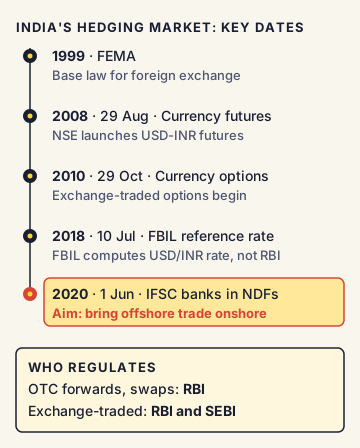
- Currency futures: Standard contracts traded on stock exchanges. In India, the National Stock Exchange (NSE) launched USD-INR futures on 29 August 2008.
- Currency options: Give the buyer the right, but not the duty, to buy or sell currency at a fixed rate. Exchange-traded currency options started in India on 29 October 2010.
- Currency swaps: Two parties exchange amounts in two currencies and swap them back later at an agreed rate. The RBI also uses buy/sell swaps to manage dollar and rupee liquidity.
- Non-Deliverable Forwards (NDF): Rupee forward contracts traded outside India, mainly in Singapore, Dubai and London. No rupees actually change hands; only the profit or loss is paid in dollars. From 1 June 2020, the RBI allowed Indian banks with branches in the International Financial Services Centre (IFSC) to deal in the NDF market, to reduce the gap between onshore and offshore prices.
Who regulates hedging in India?
The Foreign Exchange Management Act (FEMA), 1999 is the base law. The RBI regulates over-the-counter currency derivatives and banks dealing in foreign exchange. Exchange-traded currency derivatives are regulated jointly by the RBI and SEBI. The daily USD/INR reference rate, used to settle many contracts, has been computed by Financial Benchmarks India Pvt Ltd (FBIL) since 10 July 2018; earlier, the RBI published it.
To limit risk to banks, the RBI also asks banks to keep extra capital and provisions for loans to companies that leave their foreign currency exposure unhedged (the Unhedged Foreign Currency Exposure, or UFCE, framework).
Commonly confused concepts
- Forward premium vs forward discount: Premium means the dollar costs more in the future than today (usual for the rupee, because Indian rates are higher). Discount means it costs less.
- Hedging vs speculation: A hedger already has a real risk (an import bill, a foreign loan, an investment) and uses a contract to remove it. A speculator takes a new risk only to make a profit from price moves.
- Covered interest parity vs purchasing power parity (PPP): Covered interest parity links forward rates to interest rate gaps. PPP links exchange rates to the price of the same goods in two countries over the long run.
- Deliverable forward vs NDF: In a deliverable forward, the actual currencies are exchanged. In an NDF, only the difference is settled in dollars, usually offshore.
- Spot rate vs reference rate: The spot rate changes every moment in the market. The FBIL reference rate is a single benchmark published once each business day.
Issues, criticism and the way forward
- Small firms rarely hedge: Many Micro, Small and Medium Enterprises (MSMEs) do not hedge because they find contracts complex or costly, so a sudden rupee fall hits them hard.
- High cost in stressed times: When the rupee is under pressure and everyone wants dollars forward, hedging costs jump. This can push foreign investors out and add to the rupee's fall.
- Onshore vs offshore markets: A large share of rupee trading happens in offshore NDF markets, which can move the rupee before Indian markets open. Allowing IFSC banks into NDFs was one step to bring this business onshore.
- RBI's forward interventions: The RBI also sells dollars in the forward market to support the rupee. This saves reserves today but creates future dollar obligations, which markets watch closely.
- Way forward: Experts suggest deeper and simpler hedging markets, easier access for small firms, more trade invoiced in rupees (rupee internationalisation), and steady, predictable policy so that currency risk itself falls.
Concepts to Know
- Exchange rate: The price of one currency in terms of another, for example ₹95 for one US dollar.
- Derivative: A contract whose value depends on something else, like an exchange rate. Forwards, futures, options and swaps are derivatives.
- Rupee depreciation: When the rupee loses value, so more rupees are needed to buy one dollar.
- Over the counter (OTC): A deal made directly between two parties, like a company and its bank, rather than on a public exchange.
- Arbitrage: Making a risk-free profit by buying in one place and selling in another where the price is higher. Covered interest parity holds because arbitrage removes such free profits.
- Basis point: One-hundredth of a percentage point; 25 basis points = 0.25%.
- Forward rate ≈ Spot × (1 + domestic rate) ÷ (1 + foreign rate); annual forward premium ≈ interest rate differential
- Rupee usually trades at a forward premium against the dollar because Indian interest rates are higher than US rates
- A fully hedged foreign investor earns roughly the foreign (US) interest rate, as per covered interest parity
- NSE currency futures (USD-INR): launched 29 August 2008; exchange-traded currency options: 29 October 2010
- Banks with IFSC Banking Units allowed in the rupee NDF market from 1 June 2020
- FBIL computes the USD/INR reference rate since 10 July 2018
- Legal base: FEMA, 1999; OTC currency derivatives regulated by the RBI; exchange-traded currency derivatives by the RBI and SEBI
● Tracked since October 08, 2026 · last seen October 08, 2026 · updates as the daily brief publishes