Railway Multitracking
Doubling, Tripling and Quadrupling of Lines
Railway multitracking means laying extra tracks next to an existing railway line, so that more trains can run on the same route. Going from one track to two is called doubling. Adding a third or fourth line is called tripling or quadrupling. Multitracking does not create a new route; it increases the capacity of a route that already exists. It is the main way Indian Railways deals with crowded lines.
Why is it needed?
Think of a single-lane road with traffic in both directions. One vehicle must stop and wait in a side space every time another comes from the front. A single railway line works the same way. Trains going in opposite directions can pass each other only at stations that have a side track, called a crossing loop.
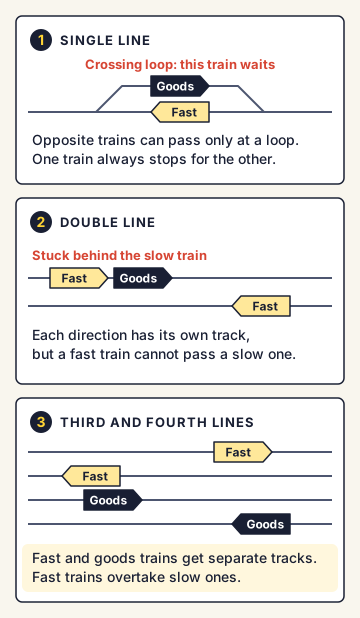
So one train always waits for the other. On a double line, each direction gets its own track, and this waiting ends. But on a double line, a fast passenger train still gets stuck behind a slow goods train. A third and fourth line solve this: slow freight and fast passenger trains can run on separate tracks, and fast trains can overtake slow ones.
What is "line capacity"?
Line capacity is the number of trains a section of track can safely handle in a day. Railway planners consider about 70-80% use of capacity to be healthy. The extra room is needed for track maintenance, delays and emergencies. When a section runs at more than 100%, trains wait at signals, run late and move slowly.
On many sections of India's busiest routes, utilisation is above 100%, and in places 150%. The National Rail Plan warned that without multitracking, about half the network would run at over 150% of capacity by 2031.
Where did the problem come from?
India's main trunk lines were built in the 19th and early 20th centuries, linking the big port cities and the capital. After Independence, traffic grew many times, but new tracks were added slowly. Freight and passenger trains came to share the same crowded lines. As a result, the average speed of goods trains on the existing network fell to about 25 km per hour.
Slow, unreliable freight pushed many businesses to use trucks, and the railways' share of India's freight fell over the decades. The government's answer has two parts: build separate freight-only lines (Dedicated Freight Corridors) and add more tracks to existing busy lines (multitracking).
What is the High Density Network?
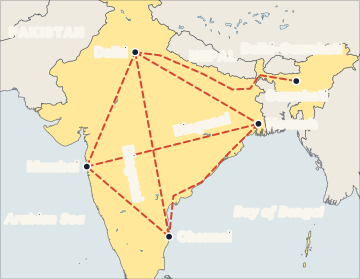
The Golden Quadrilateral is the set of rail lines linking the four metros, Delhi, Mumbai, Chennai and Kolkata (Howrah). Its two diagonals link Delhi to Chennai and Mumbai to Howrah. Together with Delhi-Guwahati, these make up seven High Density Network (HDN) routes. They cover about 16% of the route length but carry about 41% of the traffic. Because they are the most crowded, they get first priority for third and fourth lines.
How does a multitracking project work?
The steps are broadly these:
- The railway zone identifies a congested section and prepares a Detailed Project Report (DPR) with traffic studies and costs.
- The project is checked through the PM Gati Shakti National Master Plan (a digital, map-based planning platform) and its Network Planning Group, so that rail, road and port plans fit together.
- Large projects are approved by the Cabinet Committee on Economic Affairs (CCEA).
- Land next to the existing track is acquired where the railway does not already own it, and new tracks, bridges, signals and electrification are built alongside.
Because multitracking mostly uses land next to an existing line, it is usually quicker and cheaper per km than building a brand-new line.
Other ways to raise capacity
Multitracking is not the only tool. Students should know the others:
- Automatic Block Signalling (ABS): Under the older absolute block system, only one train is allowed between two stations at a time. Under ABS, the stretch between stations is divided into smaller blocks with their own signals, so several trains can follow each other safely on the same track. This raises capacity without new track.
- Electrification: Electric trains accelerate faster than diesel ones, so more trains fit into the same time. By March 2026, Indian Railways had electrified over 99% of its broad gauge network.
- Bypasses and flyovers (rail-over-rail): These remove points where one line crosses another and trains must wait.
- Dedicated Freight Corridors: These shift goods trains off passenger lines altogether.
India's position and examples
Indian Railways has one of the world's largest networks, with a route length of about 69,000 km (as of 2026). During 2022 to 2026, it sanctioned 237 projects covering about 9,703 km, of which 180 were doubling or multitracking projects. The Cabinet regularly approves batches of multitracking projects. One example is the September 2026 approval of eight projects covering about 1,196 km.
The railways also aim to raise freight loading to about 3,000 million tonnes a year by 2030. Freight earns more than 65% of the railways' revenue, so freeing up capacity matters for its finances too.
Commonly confused concepts
- Route km vs track km: Route km is the length of the route between two places. Track km counts every track. A 100 km route with four lines has 400 track km.
- Multitracking vs new line: Multitracking adds tracks to an existing route. A new line connects places that had no rail link before.
- Multitracking vs gauge conversion: Gauge conversion changes the width between rails (for example, metre gauge to broad gauge). It does not add tracks.
- Multitracking vs Dedicated Freight Corridor: A DFC is a separate, freight-only railway with its own design and higher axle load, run by its own company. Third and fourth lines are added to the normal network and can carry mixed traffic.
- Golden Quadrilateral (rail) vs Golden Quadrilateral (road): The road version is the National Highways project linking the four metros (under the National Highways Development Project). The rail version is the set of railway trunk lines linking the same cities.
Issues, criticism and the way forward
- Land acquisition: Near big cities, the land next to the track is often crowded with homes and shops. Acquiring it is slow and costly and causes displacement.
- Cost and returns: Multitracking costs lakhs of crores. Its returns depend on attracting freight back from roads, which needs better speed, reliability and door-to-door service, not just more track.
- Construction disruption: Work next to running lines needs "blocks" (time when trains are stopped), which can cause delays during construction.
- Overlap with DFCs: Some experts ask whether adding lines parallel to new DFCs is the best use of money. The railways' view is that traffic on these corridors is growing so fast that both are needed.
- Way forward: Experts and the National Rail Plan suggest combining multitracking with automatic signalling, the Kavach safety system, faster trains and better terminals, so that capacity actually turns into more and faster trains.
Concepts to Know
- Crossing loop: A short side track at a station where one train waits so that another train can pass on a single line.
- Line capacity utilisation: The number of trains actually run on a section, shown as a percentage of the number it is designed to handle.
- Detailed Project Report (DPR): A full report on a project's design, cost, benefits and timeline, prepared before the government approves it.
- Cabinet Committee on Economic Affairs (CCEA): A committee of Union ministers, headed by the Prime Minister, that approves major economic projects.
- Modal share: The share of total goods (or passengers) carried by one mode of transport, such as rail, road or waterways.
- Doubling = 2 lines; tripling = 3 lines; quadrupling = 4 lines on the same route
- Healthy line capacity use: about 70-80%; many HDN sections run above 100%, some near 150%
- Seven HDN routes: Delhi-Howrah, Howrah-Chennai, Chennai-Mumbai, Mumbai-Delhi, Delhi-Chennai, Mumbai-Howrah, Delhi-Guwahati
- HDN: about 16% of route length, about 41% of traffic
- Average speed of goods trains on the existing network: about 25 km per hour
- 2022-2026: 237 projects sanctioned covering about 9,703 km, including 180 doubling projects
- Freight loading target: about 3,000 million tonnes per year by 2030
- Automatic Block Signalling allows more than one train between two stations; the absolute block system allows only one
● Tracked since February 24, 2026 · last seen November 07, 2026 · updates as the daily brief publishes