Public Grievance Redressal in India
CPGRAMS and Time-Bound Redressal
A public grievance is a complaint by a citizen that a government office did not do what it should have done. Examples are a pension that was not paid, a ration card that was not issued, or wages for public work that never arrived. Grievance redressal is the system that receives such complaints, looks into them and fixes the problem within a fixed time.
In India, the main central system for this is an online portal called CPGRAMS, and many schemes and states have their own time-bound complaint systems.
Why does it exist?
In a democracy, people should not have to bribe someone or know a powerful person to get what the law already promises them. Without a complaint system, a poor worker whose wages are stuck has only two choices: keep visiting the office, or go to court. Courts are slow and costly. A good grievance system works like a customer care desk for the government.
It gives every citizen a simple, cheap and quick way to be heard. It also helps the government itself: if thousands of people complain about the same thing, it shows where a scheme is failing.
Where did it come from?
India built its grievance system step by step.
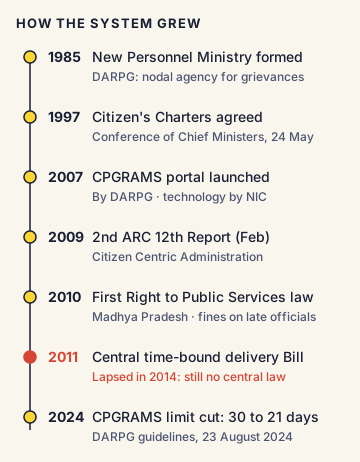
- 1985: The Ministry of Personnel, Public Grievances and Pensions was formed. Under it, the Department of Administrative Reforms and Public Grievances (DARPG) is the nodal (lead) agency for public grievance policy across all central ministries.
- 1997: At a Conference of Chief Ministers held on 24 May 1997, the Centre and the states agreed to bring out Citizen's Charters. A Citizen's Charter is a public promise by an office: which services it gives, in how many days, and where to complain if it fails.
- 2007: The Centralised Public Grievance Redress and Monitoring System (CPGRAMS) was set up as an online portal by DARPG, with the technology built by the National Informatics Centre (NIC).
- 2009: The Second Administrative Reforms Commission (2nd ARC), chaired by M. Veerappa Moily, submitted its 12th Report, "Citizen Centric Administration: The Heart of Governance" in February 2009. It stressed strong grievance redressal as a pillar of good governance.
- 2010 onwards: States began passing Right to Public Services laws. Madhya Pradesh was the first, with its Lok Sewaon ke Pradan ki Guarantee Adhiniyam, 2010. Under these laws, an official who fails to deliver a listed service on time can be fined.
- 2011: The Right of Citizens for Time Bound Delivery of Goods and Services and Redressal of their Grievances Bill, 2011 was introduced in the Lok Sabha on 20 December 2011. It would have made time-bound service a legal right across the country. It lapsed when the 15th Lok Sabha was dissolved in 2014. So there is still no central law giving every citizen a right to time-bound grievance redressal.
- 2024: DARPG's comprehensive guidelines of 23 August 2024 cut the maximum time to settle a CPGRAMS complaint from 30 days to 21 days.
What is the Sevottam model?
Sevottam joins two Hindi words, seva (service) and uttam (excellent): service excellence. It is a framework from DARPG for improving public service delivery, built on the 2nd ARC's ideas. It has three parts:
- Citizen's Charter: tell people what service they will get and how fast.
- Grievance Redress Mechanism: a clear way to complain and get the problem fixed.
- Service Delivery Capability: improve the office's own ability to deliver well.
Offices that meet the standard can be certified against the Indian Standard IS 15700:2005, issued by the Bureau of Indian Standards.
How does CPGRAMS work, step by step?
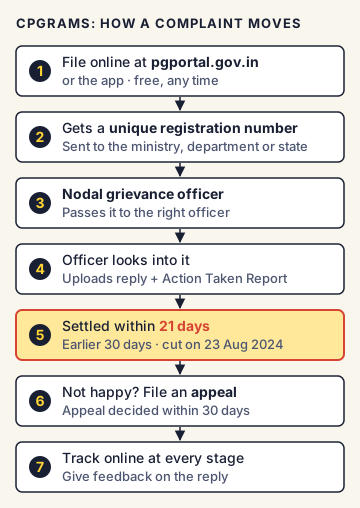
- A citizen files a complaint online at the pgportal.gov.in website or the mobile app, free of cost, any time of day.
- The complaint gets a unique registration number and is sent to the concerned ministry, department or state.
- Each ministry has a nodal grievance officer who passes it to the right officer.
- The officer looks into it and uploads a reply and an Action Taken Report.
- The complaint should be settled within 21 days. If more time is needed, an interim reply with reasons must be given.
- If the citizen is not happy with the reply, they can file an appeal, which should be decided within 30 days.
- Citizens can track their complaint online at every stage and give feedback.
What does CPGRAMS not handle?
Some matters are kept out because other systems deal with them:
- RTI matters (Right to Information requests have their own law and appeal system)
- Matters pending in a court (called sub judice matters)
- Religious matters
India's position and Indian examples
- CPGRAMS links all central ministries and departments and is also connected with state portals. It is one of the largest online grievance platforms run by any government.
- As of 2025, central ministries were settling more than 1 lakh complaints every month, with an average disposal time of about 15 to 16 days.
- Many welfare laws carry their own grievance systems. The National Food Security Act, 2013 requires a District Grievance Redressal Officer and a State Food Commission. The rural job law has its own three-level system, now detailed in the VB-G RAM G Grievance Redressal Rules, 2026, with a 15-day resolution limit.
- Many states run their own Right to Public Services commissions and helplines.
Commonly confused concepts
- Grievance redressal vs Right to Information (RTI): RTI is a right to get information from the government (Right to Information Act, 2005; reply within 30 days). Grievance redressal is about getting a problem fixed. Asking "why was my pension stopped?" can be an RTI request; asking "please restart my pension" is a grievance.
- Grievance redressal vs Lokpal: The Lokpal (Lokpal and Lokayuktas Act, 2013) investigates corruption by public servants. A grievance system deals with service failures, even where no corruption is involved.
- Grievance redressal vs Social audit: A grievance is one person's complaint about their own problem. A social audit is a public check of a whole scheme by the community, usually in a Gram Sabha meeting.
- Citizen's Charter vs Right to Public Services law: A Citizen's Charter is a voluntary promise; nobody is punished if it is broken. A Right to Public Services law makes timely service a legal right, with fines on officials who fail.
- CPGRAMS vs CPENGRAMS: CPGRAMS is for all public grievances. CPENGRAMS is a separate portal for pensioners' complaints.
Issues, criticism and the way forward
- "Disposed" is not always "solved": Experts point out that offices sometimes close a complaint with a standard reply without fixing the problem. Measuring citizen satisfaction, not only the speed of disposal, is a common suggestion.
- Digital divide: Online portals help those who can use phones and the internet. Poor rural workers, older people and those who cannot read may find them hard. That is why offline modes (in person, post, phone) matter, as the 2026 rural job rules allow.
- No penalty in many systems: Unlike state Right to Public Services laws, most central grievance systems do not fine officials for delay. Suggestions include linking delays to accountability.
- No central law: Since the 2011 bill lapsed, citizens do not have a national legal right to time-bound redressal. Some experts and petitioners have argued for a central law.
- Way forward: The 2nd ARC and later reviews recommended using complaint data to fix the root causes of problems, training grievance officers, publishing results openly, and using independent appeal bodies.
Concepts to Know
- Notification (of rules): When the government publishes rules in the official Gazette of India, they become legally active. Before that, they are only drafts.
- Nodal officer: The one officer in an office who is in charge of a task and coordinates it with others, like a team captain.
- Action Taken Report (ATR): A short report saying what an office did about a complaint.
- Sub judice: A Latin phrase meaning "under judgment". A matter is sub judice when a court is still hearing it, so other bodies avoid acting on it.
- Second Administrative Reforms Commission (2nd ARC): A commission set up by the Union government in 2005 to suggest how to improve public administration. It gave 15 reports.
- DARPG: central agency for public grievances (Ministry of Personnel, Public Grievances and Pensions)
- Citizen's Charters: agreed at Conference of Chief Ministers, 24 May 1997
- CPGRAMS: launched 2007 by DARPG, built by NIC; portal pgportal.gov.in
- CPGRAMS timeline: 21 days for redressal (since DARPG guidelines of 23 August 2024; earlier 30 days); appeals within 30 days
- Not handled by CPGRAMS: RTI matters, sub judice matters, religious matters
- 2nd ARC 12th Report "Citizen Centric Administration: The Heart of Governance", February 2009 (Chair: M. Veerappa Moily)
- Sevottam: Citizen's Charter + Grievance Redress + Service Delivery Capability; IS 15700:2005
- First state Right to Public Services law: Madhya Pradesh, 2010
- Right of Citizens for Time Bound Delivery of Goods and Services and Redressal of their Grievances Bill, 2011: lapsed in 2014
● Tracked since November 02, 2026 · last seen November 03, 2026 · updates as the daily brief publishes