Project 18A
India's Next-Generation Stealth Destroyers
Project 18A, also called the Next-Generation Destroyer (NGD) programme or Project 18, is the Indian Navy's plan to build a new class of large, stealthy, guided-missile destroyers in India. A destroyer is a big, fast, heavily armed warship that protects a fleet from air, surface and underwater attacks. Project 18A ships are planned to be much bigger and carry far more missiles than any Indian destroyer so far.
They are meant to replace older ships and become the main fighting ships of the Navy for the coming decades.
Why does India need bigger destroyers?
Wars at sea have changed. Today a warship can be attacked by swarms of cheap drones, by sea-skimming missiles that fly just above the waves, by submarines, and even by anti-ship ballistic missiles that fall from high in the sky at great speed. To defend itself and the ships around it, a destroyer needs more missiles, stronger radars and more electric power.
All of these need space. A bigger ship can simply carry more of everything and stay at sea longer. India also wants to protect its trade routes across the Indian Ocean, where China's navy is now very active with its own large destroyers.
Where did it come from? India's destroyer journey
India's destroyer story moved from buying ships abroad to building them at home, one "Project" at a time:
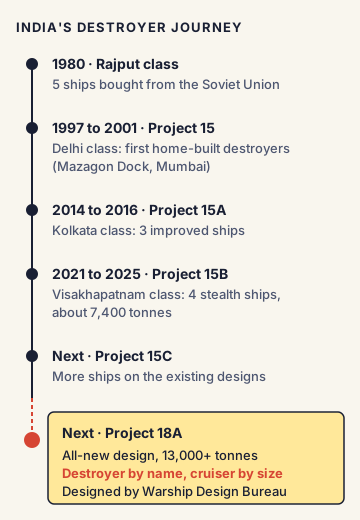
- Rajput class (Soviet Kashin class): 5 ships built in the Soviet Union. The first, INS Rajput, joined on 4 May 1980 and was retired on 21 May 2021 after 41 years.
- Project 15, Delhi class: India's first home-built destroyers, made by Mazagon Dock in Mumbai. INS Delhi (1997), INS Mysore (1999) and INS Mumbai (2001).
- Project 15A, Kolkata class: 3 improved ships. INS Kolkata (2014), INS Kochi (2015) and INS Chennai (2016).
- Project 15B, Visakhapatnam class: 4 stealth destroyers of about 7,400 tonnes, with about 75% Indian content. INS Visakhapatnam (21 November 2021), INS Mormugao (18 December 2022), INS Imphal (26 December 2023) and INS Surat (15 January 2025).
- Project 15C and Project 18A: The next steps. Project 15C is a planned follow-on to the Kolkata and Visakhapatnam designs. Project 18A is a brand-new, much larger design.
So Project 18A is not just "one more destroyer". It is the first time India plans to design a warship of cruiser size on its own.
Who designs and builds it?
The ship is designed by the Navy's own Warship Design Bureau. This in-house design team began as a small design cell in the 1960s, became the Directorate of Naval Design in 1970, and has designed most Indian warships since, including INS Vikrant, India's home-built aircraft carrier. Construction is expected to involve India's major public sector warship yards, Mazagon Dock Shipbuilders Ltd (MDL, Mumbai) and Garden Reach Shipbuilders & Engineers (GRSE, Kolkata). Reports suggest about 75% of the ship will be Indian-made.
What will the ship carry? Reported features
As of November 2026, these are reported plans, not final figures:
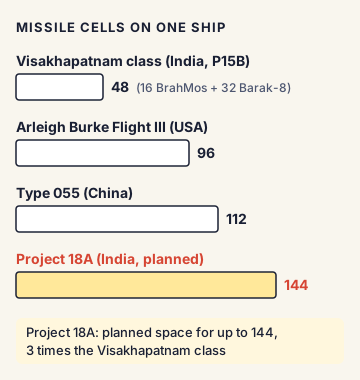
- Size: more than 13,000 tonnes displacement (some reports give 11,000 to 13,000 tonnes).
- Missiles: up to 144 vertical launch system (VLS) cells. These are vertical tubes set into the deck, from which missiles are fired straight up. Reported weapons include BrahMos-NG cruise missiles (to hit ships and land targets), Barak-8 extended-range air-defence missiles, and a future long-range land-attack cruise missile.
- Close defence: rapid-fire 30 mm close-in guns, a 127 mm main gun, and at least one high-energy laser weapon to shoot down drones and incoming missiles.
- Anti-submarine weapons: Varunastra heavy torpedoes, anti-submarine rockets and a towed sonar.
- Sensors: long-range radars reported to track targets up to about 500 km away.
- Power and range: Integrated Electric Propulsion, a range of about 4,500 nautical miles at 18 knots, and the ability to stay at sea for 45 days or more.
- Number of ships: reports speak of an initial batch of about four to six ships.
To see the jump: a Visakhapatnam-class destroyer carries 16 BrahMos and 32 Barak-8 missiles. Project 18A plans space for up to 144 missiles. For comparison, China's Type 055 destroyer (about 12,000 to 13,000 tonnes) has 112 cells, and the US Arleigh Burke Flight III destroyer has 96.
What is Integrated Electric Propulsion?
In an older warship, the engines are connected to the propellers through a long shaft and gearbox, and separate generators make electricity for the radars and weapons. In Integrated Electric Propulsion (IEP), the engines only make electricity. That electricity then runs electric motors that turn the propellers, and also powers everything else on board. This is like a common "power bank" for the whole ship.
It saves fuel, makes the ship quieter (harder for submarines to hear), and leaves spare power for future energy-hungry weapons like lasers.
How does the stealth work?
Stealth does not make a ship invisible. It makes the ship look much smaller on enemy radar, so it is harder to find and target. Planned stealth features include:
- Shaped hull and superstructure: flat, sloping surfaces that bounce radar waves away instead of back to the enemy.
- Enclosed mast: sensors are housed inside a closed, X-shaped mast instead of being hung on an open frame.
- Radar-absorbent materials: special coatings that soak up radar energy.
- Infrared suppression: cooling the hot engine exhaust so heat-seeking missiles cannot easily lock on.
How will it be bought? The steps
Under the Defence Acquisition Procedure, the DAC first gives an Acceptance of Necessity (AoN), which is an in-principle "yes, we need this". After that come the request for proposal, design finalisation, cost negotiation, approval by the Cabinet Committee on Security for big contracts, and finally the contract. Ships are usually delivered 5 to 10 years after the contract. So an in-principle approval is the start of a long road, not the end.
Commonly confused concepts
- Project 18A vs Project 15C: Project 15C is a next batch of destroyers based on the existing Kolkata and Visakhapatnam designs. Project 18A is an all-new, much larger design.
- Project 18A vs Project 17A/17B: Project 17A (Nilgiri class) and Project 17B are frigates, which are smaller multi-role ships. Project 15 and 18 are destroyer programmes.
- Destroyer vs cruiser: Both are large surface combatants. Ships above about 10,000 tonnes are usually called cruisers internationally. Project 18A would be a destroyer by name but cruiser by size.
- AoN vs contract: AoN is only an in-principle approval of need. No money is committed to a shipyard until a contract is signed.
- Project 18A vs Project 75I: Project 75I is India's programme for conventional submarines, not surface ships.
Issues, criticism and the way forward
- Delays: Indian warship projects often run late. Project 15A was planned for around 2010 but its first ship joined only in 2014. A long gap can leave the Navy short of ships.
- Cost: At about ₹75,000 to 80,000 crore, this is one of the Navy's costliest projects. It competes for money with submarines, aircraft carriers and aircraft within a limited defence budget.
- Shipyard capacity: Indian yards must handle many big orders at once. Building a 13,000-tonne ship will need upgrades to docks and skills.
- Technology risk: New systems such as IEP, laser weapons and very long-range radars are being tried for the first time in Indian destroyers. If any one is late, the whole ship can be delayed.
- Big ship vs many ships: Some experts argue that a few very large ships are a big loss if one is sunk. Others argue that large ships are the only way to carry enough missiles against modern threats.
- Way forward: Experts suggest fixing the design early, standardising systems across ship classes, building at more than one yard, and supporting Indian firms that make engines, radars and weapons.
Concepts to Know
- Displacement: The weight of water a ship pushes aside when it floats, which equals the ship's own weight. It is the standard way to measure how big a warship is.
- Guided missile: A missile that can steer itself towards its target after launch, using radar, GPS or heat sensors.
- Cruise missile: A missile that flies like a small unmanned plane, low and steady, all the way to its target. BrahMos is a supersonic cruise missile (faster than sound).
- Ballistic missile: A missile that is pushed high into the sky by a rocket and then falls towards its target at very high speed, like a thrown ball.
- Close-in weapon system (CIWS): A very fast-firing gun or missile system that is the ship's last line of defence against a missile that has come very close.
- Directed-energy weapon (laser weapon): A weapon that uses a powerful beam of light energy to burn and destroy targets such as drones, instead of firing bullets or missiles.
- Sonar: A system that uses sound waves under water to find submarines. A towed sonar is dragged behind the ship on a long cable, away from the ship's own noise.
- Nautical mile and knot: A nautical mile is about 1.85 km. One knot is a speed of one nautical mile per hour, so 18 knots is about 33 km per hour.
- Project 18A = Next-Generation Destroyer (NGD) programme; successor to Project 15B
- Reported cost: over ₹75,000 crore to about ₹80,000 crore; in-principle approval reported from the Defence Acquisition Council (chaired by the Defence Minister)
- Reported displacement: more than 13,000 tonnes (Visakhapatnam class: about 7,400 tonnes)
- Up to 144 VLS cells reported; about 75% indigenous content reported
- Designed by the Warship Design Bureau; MDL and GRSE expected as builders
- Integrated Electric Propulsion; range about 4,500 nautical miles at 18 knots; endurance 45+ days
- Destroyer lineage: Rajput class (from 1980) → Project 15 Delhi class (1997–2001) → Project 15A Kolkata class (2014–2016) → Project 15B Visakhapatnam class (2021–2025) → Project 15C and Project 18A
- INS Surat, the last Project 15B ship, was commissioned on 15 January 2025 along with INS Nilgiri (frigate) and INS Vaghsheer (submarine)
● Tracked since November 03, 2026 · last seen November 03, 2026 · updates as the daily brief publishes