Prime Minister Dhan-Dhaanya Krishi Yojana (PMDDKY)
The Prime Minister Dhan-Dhaanya Krishi Yojana (PMDDKY) is a central government programme to lift farming in 100 districts where agriculture is doing poorly. "Dhan-Dhaanya" means "wealth and grain", so the name means a district rich in both. The scheme does not create a fresh pool of money. Instead, it makes 36 existing schemes of 11 departments focus their efforts together on these districts.
The goal is to raise crop yields, help farmers grow a wider mix of crops, build storage and irrigation, and make farm loans easier to get.
Why does it exist?
India's farm performance is very uneven. In some districts, a hectare of land gives two or three times more grain than in others. Some districts grow only one crop a year, and many farmers there cannot get bank loans. Earlier, dozens of schemes, such as those for irrigation, seeds, crop insurance and credit, each worked on their own.
A district could get a little of each, but no one pulled them together to fix the district's main weakness. PMDDKY tries to bring all of them to the same place at the same time, with one plan and one person accountable.
Where did it come from?
- February 1, 2025: announced in the Union Budget 2025-26 speech.
- July 16, 2025: approved by the Union Cabinet, with an annual outlay of ₹24,000 crore for six years, from 2025-26 to 2030-31.
- October 11, 2025: launched at the Indian Agricultural Research Institute (IARI), Pusa, New Delhi, together with the Mission for Aatmanirbharta in Pulses (₹11,440 crore). The two together were worth ₹35,440 crore.
- The design is borrowed from NITI Aayog's Aspirational Districts Programme (2018), which ranks backward districts on indicators to push them to compete and improve. PMDDKY applies that idea only to agriculture.
How are the 100 districts chosen?
Three indicators are used:
- Low productivity: low crop output per hectare.
- Low cropping intensity: land is used for fewer crops in a year.
- Low credit disbursement: farmers get fewer farm loans.
Every state and UT gets at least one district. Beyond that, a state's number of districts depends on its share of the country's net cropped area and operational holdings (farms). The scheme is expected to help about 1.7 crore farmers.
What are its six objectives?
- Raise agricultural productivity
- Promote crop diversification and sustainable farming
- Build post-harvest storage, including at the panchayat and block level
- Improve irrigation facilities
- Make long-term and short-term farm credit easier to get
- Improve governance and the delivery of services
How does it work, step by step?
Think of it like a school that picks its 100 weakest students and gives each one a personal teacher, a study plan and a monthly test.
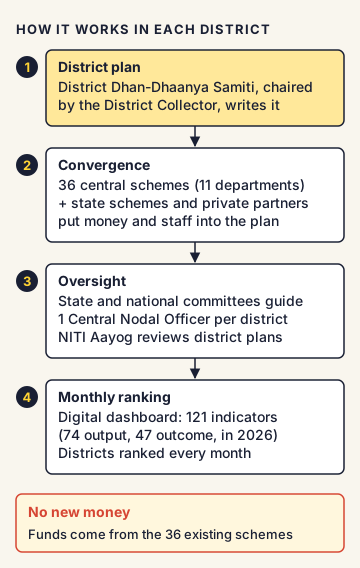
- District plan: In each district, a District Dhan-Dhaanya Samiti, chaired by the District Collector, prepares a District Agriculture and Allied Activities Plan. Progressive farmers are also members of this committee.
- Convergence: The 36 central schemes, along with state schemes and private-sector partners, put their money and staff into the activities in that plan.
- Oversight: Committees at the state and national levels guide the work. The Centre has appointed one senior Central Nodal Officer for each district (100 in all), mostly at Joint Secretary level, to review progress. NITI Aayog also reviews and guides the district plans.
- Monthly tests: A digital dashboard tracks each district on a set of indicators (117 KPIs at launch; 121 indicators, 74 output and 47 outcome, reported in 2026). Districts are ranked every month on output indicators, and outcomes are compared with a baseline.
Key facts at a glance
- Ministry: Agriculture and Farmers' Welfare
- Outlay: ₹24,000 crore per year for 6 years (2025-26 to 2030-31), drawn from the 36 converged schemes
- Coverage: 100 districts; at least one per state/UT; about 1.7 crore farmers
- Converged schemes include PM-KISAN, Pradhan Mantri Fasal Bima Yojana (PMFBY), Pradhan Mantri Krishi Sinchayee Yojana (PMKSY) and Rashtriya Krishi Vikas Yojana (RKVY)
India's position and examples
The first-year review showed a wide spread. Gaya (Bihar), Nagaur (Rajasthan) and several Madhya Pradesh districts such as Umaria, Dindori and Sidhi led the August 2026 ranking. Hill and north-eastern districts such as Mamit (Mizoram), Tamenglong (Manipur), Dima Hasao (Assam) and Mon (Nagaland) were among the lowest. A September 2026 ministry review reported average score gains between April and July 2026 in irrigation (1.65 to 4.20), credit access (2.81 to 5.59) and post-harvest storage (2.61 to 3.82).
Commonly confused concepts
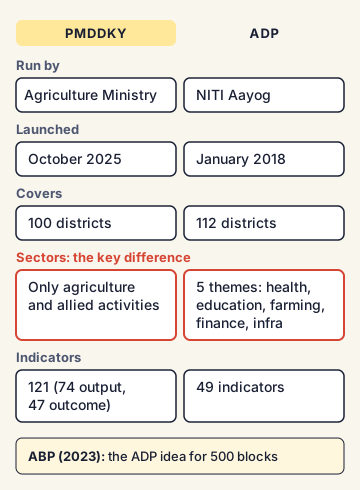
- PMDDKY vs Aspirational Districts Programme (ADP): The ADP (launched January 2018 by NITI Aayog) covers 112 districts and ranks them on 49 indicators under five themes: health and nutrition, education, agriculture and water resources, financial inclusion and skill development, and basic infrastructure. PMDDKY covers 100 districts and only farming and allied activities, and is run by the Agriculture Ministry.
- PMDDKY vs Aspirational Blocks Programme (ABP): The ABP (launched January 2023) takes the ADP idea down to 500 blocks, covering many sectors. PMDDKY works at the district level and only on agriculture.
- PMDDKY vs RKVY: The Rashtriya Krishi Vikas Yojana gives states flexible money for farm projects across all districts. PMDDKY has no separate budget of its own and targets only 100 lagging districts by pooling many schemes.
- Convergence scheme vs new scheme: A new scheme brings new money. A convergence scheme like PMDDKY steers existing schemes' money to chosen places.
Issues, criticism and the way forward
- No dedicated budget: Since money comes from other schemes, a district depends on each department's willingness to prioritise it. If one scheme's funds are delayed, the plan suffers.
- Accountability gaps: The first-year review showed 62 of 100 districts scoring below 50. Experts pointed to poor implementation and unclear responsibility of nodal officers.
- Hard geography: Many low-ranking districts are in hills or the North-East, where small fields, steep slopes and weak roads make irrigation, storage and credit harder to improve quickly.
- Measuring what matters: Output indicators (for example, number of farmers trained) are easier to improve than real outcomes like higher yields or incomes. Rankings can push districts to chase easy numbers.
- Way forward: The Ministry has asked for better coordination, faster implementation, scaling up of successful steps, and a focus on measurable gains in farm output and income. Clear responsibility for each nodal officer and timely release of funds by converging schemes are key.
Concepts to Know
- Cropping intensity: How many times the same land is used for crops in a year. It is gross cropped area divided by net sown area, times 100. If a field grows two crops a year, its cropping intensity is 200%.
- Convergence: Making different schemes work together on the same people or place so their combined effect is bigger.
- Key Performance Indicator (KPI): A number used to measure progress, like hectares under irrigation or farm loans given.
- Output vs outcome: An output is what the government does (trainings held, storage built). An outcome is the change in people's lives (higher yield, higher income).
- Post-harvest storage: Warehouses and cold stores where crops are kept after harvest so they do not rot and farmers do not have to sell at low prices right away.
- Operational holding: A piece of land used for farming as one unit by one farmer or family, whether owned or rented.
- Announced: Union Budget 2025-26 (February 1, 2025); Cabinet approval: July 16, 2025; launched: October 11, 2025 at IARI, Pusa, New Delhi
- Outlay: ₹24,000 crore per year for 6 years (2025-26 to 2030-31)
- 100 districts selected on low productivity, low cropping intensity and low credit disbursement; at least 1 district per state/UT
- Convergence of 36 schemes across 11 departments, plus state schemes and private partnerships
- District Dhan-Dhaanya Samiti chaired by the District Collector; 100 Central Nodal Officers
- Monitoring: 117 KPIs at launch; 121 indicators (74 output, 47 outcome) reported in 2026; monthly district rankings
- About 1.7 crore farmers expected to benefit
- Modelled on NITI Aayog's Aspirational Districts Programme (2018)
● Tracked since October 12, 2026 · last seen October 12, 2026 · updates as the daily brief publishes