Preamble to the Constitution of India
India's Statement of Purpose
The Preamble is the short opening passage of the Constitution of India. In one paragraph, it tells us three things: where the Constitution gets its power from (the people of India), what kind of country India is (sovereign, socialist, secular, democratic republic), and what the Constitution wants to achieve for its citizens (justice, liberty, equality and fraternity). You can think of it as the "introduction page" of a book that tells you what the whole book is about.
The full text of the Preamble
Here is how it reads today:

WE, THE PEOPLE OF INDIA, having solemnly resolved to constitute India into a SOVEREIGN SOCIALIST SECULAR DEMOCRATIC REPUBLIC and to secure to all its citizens: JUSTICE, social, economic and political; LIBERTY of thought, expression, belief, faith and worship; EQUALITY of status and of opportunity; and to promote among them all FRATERNITY assuring the dignity of the individual and the unity and integrity of the Nation; IN OUR CONSTITUENT ASSEMBLY this twenty-sixth day of November, 1949, do HEREBY ADOPT, ENACT AND GIVE TO OURSELVES THIS CONSTITUTION.
Why does a Constitution need a Preamble?
A Constitution has hundreds of articles. Each article deals with one small matter, like how the President is elected or how a state is formed. Without a clear statement of purpose, it would be hard to see the "big picture". The Preamble gives that big picture. It also helps judges. When the words of an article are unclear and can be read in two ways, judges look at the Preamble and choose the meaning that fits its goals better.
Where did it come from?
The Preamble grew out of the Objectives Resolution. Jawaharlal Nehru moved this resolution in the Constituent Assembly on 13 December 1946. The Assembly adopted it on 22 January 1947. It set out the goals the new Constitution should serve. The Preamble is a short, polished form of those goals. The Constituent Assembly adopted the Constitution, including the Preamble, on 26 November 1949.
That is why the Preamble mentions this date, and why 26 November is now celebrated as Constitution Day. The Constitution came into force on 26 January 1950.
What does each key word mean?
UPSC often tests the exact meaning of these words.
- We, the People of India: The power behind the Constitution comes from the people, not from a king or a foreign power. The people "gave the Constitution to themselves".
- Sovereign: India is fully independent. No outside country or body can give orders to India, either on its internal matters or its foreign policy.
- Socialist: The State is committed to reducing inequality and running a welfare state. In India this means democratic socialism: a mixed economy where both government-run and private businesses exist side by side. It does not mean the State must own everything.
- Secular: The State has no official religion. It treats all religions equally and does not favour or oppose any of them. Every person is free to follow, practise and spread their religion.
- Democratic: The government is chosen by the people through regular, free elections, with every adult having one vote. The word covers both political democracy and the wider idea of social and economic democracy.
- Republic: The head of the State (the President) is elected, not a hereditary king or queen. Any citizen can rise to the highest office.
The four goals: justice, liberty, equality and fraternity
- Justice in three forms: social (no discrimination based on caste, religion, sex and so on), economic (no big gaps based on wealth and income), and political (equal political rights, like the right to vote and to hold office).
- Liberty of thought, expression, belief, faith and worship. This means freedom of the mind. It is protected in practice through Fundamental Rights like Article 19 (freedom of speech) and Articles 25 to 28 (freedom of religion).
- Equality of status and of opportunity. No special privileges for any group, and the same chances for everyone. Articles 14 to 18 give this goal real force.
- Fraternity means a sense of brotherhood among all Indians. The Preamble says fraternity must assure two things: the dignity of the individual and the unity and integrity of the Nation.
Dr. B.R. Ambedkar stressed that liberty, equality and fraternity must be read together as one unit. Liberty without equality would let the strong crush the weak. Equality without liberty would kill individual initiative. Without fraternity, neither would last.
How did the Preamble change in 1976?
The Preamble has been amended only once, by the 42nd Amendment Act, 1976. It added three words:
- "Socialist" and "Secular": India went from a "Sovereign Democratic Republic" to a "Sovereign Socialist Secular Democratic Republic".
- "Integrity": "unity of the Nation" became "unity and integrity of the Nation".
These words were not new ideas. During the Constituent Assembly debates in November 1948, member K.T. Shah proposed that India be called "Secular, Federal, Socialist" in Draft Article 1. The Assembly rejected the proposal. Dr. Ambedkar argued that the Constitution should not fix the economic system for all future generations; the people should be free to decide that for themselves. The 44th Amendment (1978), which undid many other changes of the Emergency period, left these three words in place.
Is the Preamble a part of the Constitution?
The Supreme Court changed its view on this question over time.
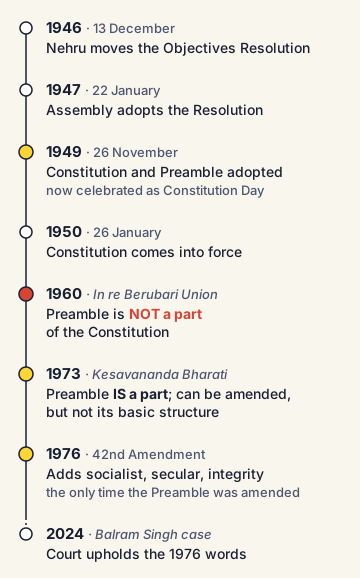
- In re Berubari Union (1960): The court said the Preamble is a "key to open the minds of the makers" of the Constitution, but it is not a part of the Constitution.
- Kesavananda Bharati v. State of Kerala (1973): The court overruled this view. It held that the Preamble is a part of the Constitution and that it can be amended under Article 368, but the basic structure of the Constitution cannot be destroyed.
- Union Government v. LIC of India (1995): The court again said the Preamble is an integral part of the Constitution.
- S.R. Bommai v. Union of India (1994): The court held that secularism is a part of the basic structure of the Constitution, and noted that the idea was present in the Constitution from the start, even before the word was added in 1976.
- Dr. Balram Singh v. Union of India (2024): The court upheld the 1976 insertion of "socialist" and "secular" and confirmed that Parliament's amending power extends to the Preamble.
What can the Preamble do, and what can it not do?
Two points are often tested.
- The Preamble is not a source of power for the government. Parliament cannot make a law only because "the Preamble allows it".
- The Preamble is not a limit on power either, in the sense that it does not by itself forbid anything.
- It is non-justiciable. You cannot go to court and ask the court to enforce the Preamble directly. But courts use it to understand the meaning of other articles.
Famous descriptions of the Preamble
Questions sometimes ask who said what:
- N.A. Palkhivala called it the "identity card of the Constitution".
- K.M. Munshi called it the "political horoscope" of the Constitution.
- Thakur Das Bhargava called it the "soul of the Constitution".
Commonly confused concepts
- Objectives Resolution vs Preamble: The Objectives Resolution (1946–47) was a resolution of the Constituent Assembly that listed goals. The Preamble (1949) is part of the Constitution itself. The Preamble is based on the Resolution, but they are different documents.
- Date of adoption vs date of commencement: The Preamble mentions 26 November 1949, the date the Constitution was adopted. It came into force on 26 January 1950.
- Berubari (1960) vs Kesavananda (1973): Berubari said the Preamble is not part of the Constitution. Kesavananda said it is. The later view is the settled law.
- "Unity" vs "integrity": "Unity" was in the original Preamble. Only "integrity" was added in 1976.
- Sovereign vs Republic: Sovereign means no outside master. Republic means the head of State is elected, not hereditary. A country can be sovereign but not a republic (for example, the United Kingdom has a hereditary monarch).
Issues, criticism and the way forward
- The 1976 additions: Some people argue that "socialist" and "secular" were added during the Emergency, without full public debate, and should be reconsidered. Others reply that both ideas were already built into the Constitution through Fundamental Rights and Directive Principles, and the Supreme Court has now settled their validity.
- Meaning of "socialist" after 1991: Since economic reforms began in 1991, India has opened up to private business and markets. Critics ask whether "socialist" still fits. The Supreme Court's answer is that the word means a welfare state and equal opportunity, not any fixed economic model, so it fits a mixed economy.
- Indian vs Western secularism: In the Western model, the State and religion stay fully separate. India follows a model where the State keeps an equal, respectful distance from all religions but can still step in for reform (for example, opening temples to all castes). Debates continue on whether the State always treats all religions equally in practice.
- Way forward: Experts suggest wider awareness of the Preamble's values through education, and using it as a guide when making laws and policies, so that its goals reach ordinary citizens and do not stay only on paper.
Concepts to Know
- Constituent Assembly: The body of elected and nominated members that wrote India's Constitution between December 1946 and November 1949.
- Amendment: A formal change made to the Constitution, following the procedure in Article 368.
- Non-justiciable: Something that a court cannot directly enforce. You cannot file a case only to make the government follow it.
- Welfare state: A State that takes active responsibility for the well-being of its people, through things like free education, healthcare, food security and pensions.
- Mixed economy: An economy where both government-owned and privately owned businesses work side by side.
- Basic structure: The core features of the Constitution (like democracy and secularism) that Parliament cannot destroy even through an amendment.
- Objectives Resolution: moved by Jawaharlal Nehru on 13 December 1946; adopted on 22 January 1947
- Constitution (with Preamble) adopted on 26 November 1949; came into force on 26 January 1950
- Preamble amended only once: 42nd Amendment Act, 1976 (added "socialist", "secular" and "integrity")
- Berubari (1960): Preamble not a part of the Constitution; Kesavananda Bharati (1973): it is a part, and can be amended subject to basic structure
- LIC of India (1995): Preamble an integral part of the Constitution
- S.R. Bommai (1994): secularism is part of the basic structure
- Dr. Balram Singh v. Union of India (25 November 2024): upheld the 1976 insertion of "socialist" and "secular"
- Descriptions: "identity card" (N.A. Palkhivala), "political horoscope" (K.M. Munshi), "soul of the Constitution" (Thakur Das Bhargava)
● Tracked since June 27, 2026 · last seen October 06, 2026 · updates as the daily brief publishes