Partnership for Global Infrastructure and Investment (PGII)
The Partnership for Global Infrastructure and Investment, or PGII, is a plan by the G7 group of rich democracies to help poorer and middle-income countries build good-quality infrastructure: railways, ports, power lines, digital networks and health systems. It was launched in June 2022 with a goal of mobilising US$600 billion by 2027. Most of this money is not meant to be government grants.
Instead, governments use a smaller amount of public money to attract much larger private investment. PGII is widely seen as the West's answer to China's Belt and Road Initiative (BRI).
Why does it exist?
Developing countries need huge amounts of infrastructure. The G7 has estimated that they need about US$40 trillion worth of infrastructure by 2035. Their own governments cannot pay for all of it.
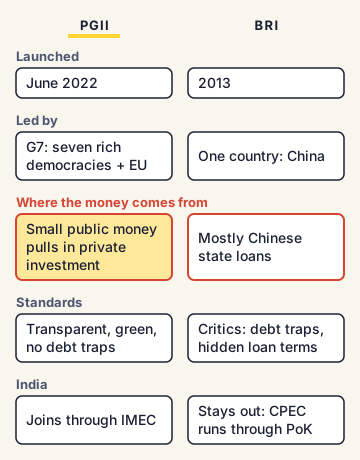
- For about a decade, China filled much of this gap through the Belt and Road Initiative, launched in 2013. China lent large sums for ports, roads and power plants across Asia, Africa and Europe.
- Critics raised worries about debt traps, hidden loan terms and poor environmental and labour standards. A widely cited example is Sri Lanka's Hambantota port, which was leased to a Chinese company for 99 years in 2017 after Sri Lanka struggled with its debts.
- G7 countries wanted to offer developing countries a different option: projects that are transparent, financially sustainable and green, and that also make global supply chains less dependent on a single country.
You can think of PGII like an alternative bank branch opening in a town where only one lender used to operate. Borrowers now have a choice, and the new branch promises clearer terms.
Where did it come from?
PGII grew out of a few earlier ideas.
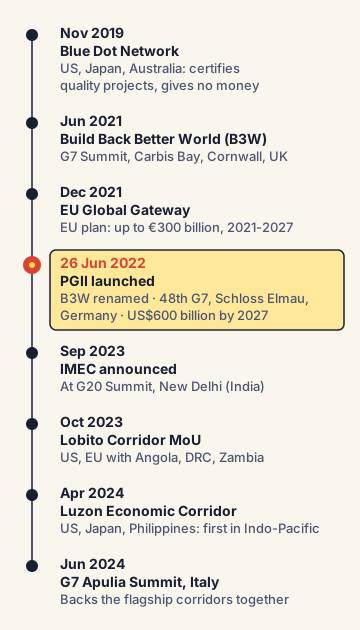
- Blue Dot Network (November 2019): Launched by the US, Japan and Australia. It does not fund projects. It certifies infrastructure projects that meet high standards of transparency, sustainability and good governance, so that private investors trust them.
- Build Back Better World (B3W), June 2021: Announced at the G7 Summit in Carbis Bay, Cornwall (UK). It aimed to help close the infrastructure gap in developing countries in four areas: climate, health, digital technology and gender equality.
- EU Global Gateway (December 2021): The European Union's own plan to mobilise up to €300 billion for infrastructure abroad between 2021 and 2027.
- PGII (26 June 2022): B3W was relaunched under the new name PGII at the 48th G7 Summit at Schloss Elmau, Germany. The United States said it would mobilise about US$200 billion over five years. The EU linked its Global Gateway to the effort. Together, the G7 set the US$600 billion by 2027 target.
How does it work?
PGII is not one big pot of money with one office. It is an umbrella for projects that G7 members support together.
- Public money goes first: Each G7 country uses its development finance institutions (government-owned banks that invest abroad, such as the US International Development Finance Corporation and the European Investment Bank). They give loans, guarantees and equity.
- Risk falls, private money follows: A government guarantee or a first-loss share makes a project less risky. Pension funds, insurers and private companies then become willing to invest too.
- Standards apply: Projects are meant to follow open bidding, clear loan terms, local jobs, environmental care and sound governance, drawing on Blue Dot Network principles.
- Corridors, not single projects: PGII increasingly backs economic corridors: chains of linked ports, railways, power and digital lines across several countries.
The key parts and facts
- Four priority areas at launch: climate and energy security, digital connectivity (secure ICT networks), health systems, and gender equality and equity.
- Flagship economic corridors:
- Lobito Corridor: A rail corridor linking the copper and cobalt mining areas of the Democratic Republic of the Congo (DRC) and Zambia to the Atlantic port of Lobito in Angola. The US and EU announced joint support in September 2023 on the sidelines of the G20 Summit in New Delhi, and signed an MoU with the three African countries in October 2023.
- India-Middle East-Europe Economic Corridor (IMEC): Announced on 9 September 2023 at the G20 Summit in New Delhi, at an event co-hosted with PGII.
- Luzon Economic Corridor: Announced in April 2024 by the US, Japan and the Philippines. It links Subic Bay, Clark, Manila and Batangas in the Philippines, and was the first PGII corridor in the Indo-Pacific.
- Middle Corridor (Trans-Caspian route): Links Central Asia to Europe across the Caspian Sea, avoiding Russia.
- At the G7 Summit in Apulia, Italy (June 2024), leaders agreed to back these flagship corridors together.
India's position and Indian examples
India is not a G7 member, but it is often invited to G7 summits as a guest. India's link to PGII comes mainly through IMEC, which it helped launch during its G20 presidency (2023).
- India does not take part in China's BRI. Its main objection is that the China-Pakistan Economic Corridor (CPEC), a BRI project, passes through Pakistan-occupied Kashmir, which India considers its own territory.
- PGII-style projects let India join large connectivity plans without accepting BRI terms.
- India also runs its own connectivity projects: the International North-South Transport Corridor (INSTC) through Iran to Russia, Chabahar port in Iran, and the India-Myanmar-Thailand Trilateral Highway.
- India's stated approach is that connectivity projects must respect sovereignty and territorial integrity, follow financial responsibility, and avoid unsustainable debt.
Commonly confused concepts
- PGII vs BRI: BRI (2013) is led and largely funded by one country, China, mainly through state loans. PGII (2022) is a G7 group effort that tries to pull in private investment using public support.
- PGII vs B3W: B3W (June 2021, UK) was the first name and plan. PGII (June 2022, Germany) is the relaunched and renamed version.
- PGII vs Global Gateway: Global Gateway is the European Union's own plan (up to €300 billion, 2021-2027). It works alongside PGII and counts toward it, but it is a separate EU programme.
- PGII vs Blue Dot Network: Blue Dot (2019; US, Japan, Australia) certifies projects for quality. PGII helps finance them.
- G7 vs G20: The G7 has seven rich democracies: the US, the UK, France, Germany, Italy, Japan and Canada (the EU also attends). The G20 is much wider: 19 countries plus the EU and the African Union, including India and China. PGII is a G7 initiative, though IMEC was launched at a G20 summit.
- IMEC vs I2U2: I2U2 is a group of four countries (India, Israel, the UAE and the US) for joint economic projects. IMEC is a trade corridor with 8 signatories. Both connect India with West Asia, but they are separate.
Issues, criticism and the way forward
- Slow money: Mobilising private capital is slow. Critics point out that many projects remain at the announcement or planning stage, and it is hard to track how much of the US$600 billion has really been invested.
- Changing priorities: PGII depends on the policies of each G7 government. A change of government can shift priorities and funding, which makes long-term projects uncertain.
- Conflict zones: Corridors like IMEC pass through regions hit by war and tension, which scares away private investors.
- "Anti-China" label: PGII is often presented as a counter to BRI. Many developing countries do not want to choose sides; they want finance from all sources.
- Higher standards, higher costs: Strict environmental, labour and transparency rules make projects cleaner but sometimes slower and costlier than BRI offers.
- Way forward: Experts suggest clearer tracking of money actually spent, a stronger role for multilateral development banks (such as the World Bank and the Asian Development Bank), more local ownership of projects, and linking corridors to each other so trade has several options.
Concepts to Know
- Infrastructure: The basic physical systems a country needs to run: roads, railways, ports, power plants, water supply and internet networks.
- Mobilise (investment): To bring in money from many sources, especially private investors, not just to spend government money.
- Development finance institution (DFI): A government-owned bank or agency that invests in projects in developing countries, often taking risks that private banks avoid.
- Debt trap: A situation where a country borrows so much that it cannot repay, and has to give up control of assets or accept tough terms.
- Economic corridor: A planned route that links places with roads, railways, ports, pipelines and cables so that trade and investment can grow along it.
- Supply chain: The full chain of steps and places through which a product moves, from raw material to the final buyer.
- Guarantee: A promise by a strong party (like a government) to repay a lender if the borrower fails. It makes lending less risky.
- Launched: 26 June 2022, 48th G7 Summit, Schloss Elmau, Germany
- Target: mobilise US$600 billion by 2027; US share about US$200 billion over five years
- Predecessor: Build Back Better World (B3W), G7 Summit, Carbis Bay, Cornwall, UK, June 2021
- Related: EU Global Gateway (December 2021, up to €300 billion for 2021-2027); Blue Dot Network (November 2019; US, Japan, Australia; certification)
- Four priorities: climate and energy security; digital connectivity; health; gender equality and equity
- Flagship corridors: Lobito (Angola-DRC-Zambia), IMEC (India-Middle East-Europe), Luzon (Philippines), Middle Corridor (Trans-Caspian)
- G7 Apulia Summit (Italy, June 2024) endorsed the flagship corridors
- Contrast: China's BRI launched 2013; India stays out of BRI mainly because CPEC passes through Pakistan-occupied Kashmir
● Tracked since October 06, 2026 · last seen October 06, 2026 · updates as the daily brief publishes