Organisation for Economic Co-operation and Development (OECD)
The Rich Countries' Policy Club
The Organisation for Economic Co-operation and Development, or OECD, is an international body of 38 mostly high-income countries, with its headquarters in Paris. It does not give loans like the World Bank, and it does not settle trade fights like the World Trade Organization (WTO). Instead, it collects data, studies policies and helps countries agree on common rules and "best practices". You can think of it as a large research and rule-writing club for governments.
Why does it exist?
Governments face the same problems again and again: how to tax companies fairly, how to improve schools, how to fight bribery, how to grow the economy. The OECD lets them compare notes. It collects data in the same format from every member, so one country can see how it stands against others. When countries agree on a common standard through the OECD, it also becomes harder for businesses to play one country against another. For example, a company cannot easily shift profits to whichever country taxes it least.
Where did it come from?
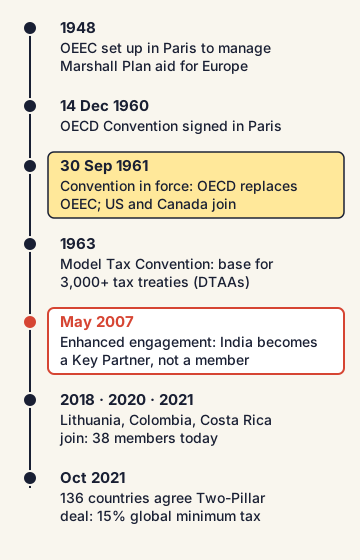
The OECD grew out of an older body, the Organisation for European Economic Co-operation (OEEC). The OEEC was set up in 1948 to manage American and Canadian aid under the Marshall Plan, a US programme to rebuild Europe after the Second World War. By the late 1950s, Europe had recovered, and the members wanted a wider body that included North America.
The Convention on the OECD was signed in Paris on 14 December 1960 and came into force on 30 September 1961. The United States and Canada joined the European members as full members. The headquarters is the Château de la Muette in Paris.
How does it grow?
Membership has expanded slowly, through a strict process called accession (joining). A country first gets an invitation, then follows a "roadmap" in which OECD committees check whether its laws and policies meet OECD standards. Membership needs the unanimous approval of all existing members. As of October 2026, the OECD has 38 members. The latest to join were Lithuania (2018), Colombia (2020) and Costa Rica (2021).
Accession talks are going on with eight countries: Argentina, Brazil, Bulgaria, Croatia, Peru and Romania (talks opened in January 2022), and Indonesia and Thailand (added in 2024).
How does it work?
The OECD has three main parts:
- Council: The top decision-making body. It has one representative (usually an ambassador) from each member country, plus a representative of the European Commission. It is chaired by the Secretary-General and takes decisions by consensus (everyone must agree, or at least not object). Once a year it meets at the level of ministers, in the Ministerial Council Meeting.
- Committees: Hundreds of committees, expert groups and working groups cover almost every policy area, such as trade, tax, education, environment and steel. Officials from member countries, and sometimes from partner countries, meet here to discuss and negotiate.
- Secretariat: The permanent staff of economists, lawyers and statisticians in Paris who do the research and prepare reports. It is led by the Secretary-General. The current Secretary-General is Mathias Cormann of Australia. He took office in June 2021 and began a second and final five-year term on 1 June 2026, running to 2031.
What does the OECD produce?
Its work reaches far beyond its members. The outputs most useful for UPSC are:
- OECD Economic Outlook: A twice-yearly report with growth and inflation forecasts for members and some major non-members, including India.
- OECD Model Tax Convention: A template for tax treaties between two countries. Since 1963, it has been the basic reference for writing Double Taxation Avoidance Agreements (DTAAs), and more than 3,000 tax treaties around the world are based on it.
- Base Erosion and Profit Shifting (BEPS) and the global minimum tax: Through the OECD/G20 Inclusive Framework, about 140 countries work together to stop big companies from shifting profits to low-tax places. In October 2021, 136 countries agreed to a "Two-Pillar Solution". Pillar Two sets a 15% global minimum corporate tax for large multinational groups with yearly revenue above €750 million.
- PISA (Programme for International Student Assessment): A test every three years of the reading, maths and science skills of 15-year-old school students in many countries.
- Development Assistance Committee (DAC): A committee of aid-giving countries. It defines Official Development Assistance (ODA), the official measure of foreign aid. To count as ODA, a loan must be concessional (cheaper than a market loan), with a grant element of at least 25%.
- Global Forum on Steel Excess Capacity: A forum created by the G20 in 2016, with the OECD acting as its facilitator, to share data on steel plants and tackle surplus steel production.
India's position and Indian examples
India is not a member of the OECD. It is one of the OECD's Key Partners. In May 2007, the OECD Council decided to build "enhanced engagement" with five large emerging economies: Brazil, China, India, Indonesia and South Africa. As a Key Partner, India is included in OECD statistics and reports, such as the Economic Outlook and the periodic OECD Economic Survey of India.
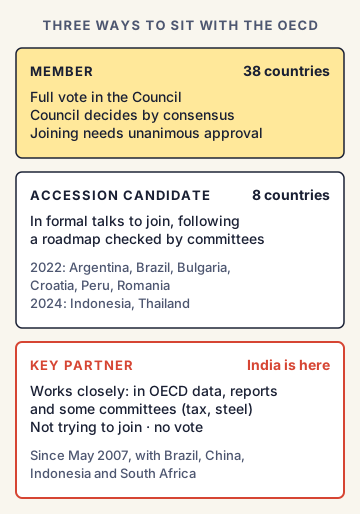
It also takes part in selected OECD committees, for example on taxation, trade, steel, corporate governance and anti-corruption. Some important Indian links:
- India is a member of the OECD/G20 Inclusive Framework on BEPS and joined the October 2021 global tax deal.
- India negotiates its tax treaties using the OECD Model (and the United Nations Model, which gives more taxing rights to developing countries).
- In PISA 2009, India took part through a pilot in Tamil Nadu and Himachal Pradesh. They ranked 72nd and 73rd out of 74 participants. India then stayed out of later rounds. It agreed to join PISA 2022 but pulled out in early 2022, citing COVID-19, and did not join PISA 2025 either.
Commonly confused concepts
- OECD vs OEEC: The OEEC (1948) was a European body to manage Marshall Plan aid. The OECD (1961) replaced it and added the US and Canada, later becoming a global club.
- OECD vs WTO: The WTO makes binding trade rules and has a dispute settlement system that can authorise punishment. The OECD mostly makes "soft law" (guidelines, standards and recommendations) and has no court. India is a WTO member but not an OECD member.
- OECD vs G20: The G20 is a forum of leaders of 19 countries plus the European Union and the African Union. It has no permanent office. The OECD is a permanent organisation with a secretariat, and it often does the research work for G20 decisions (for example, the BEPS project).
- OECD vs OPEC: OPEC (Organization of the Petroleum Exporting Countries) is a group of oil-exporting countries. It has nothing to do with the OECD, though the names sound alike.
- Member vs Key Partner vs accession candidate: A member has full voting rights in the Council. An accession candidate is in formal talks to join. A Key Partner (such as India) works closely with the OECD but is not trying to join and has no vote.
Issues, criticism and the way forward
- A "rich countries' club": Critics say the OECD mainly reflects the interests of wealthy nations. Rules made there, such as tax standards, are later offered to developing countries, which had a smaller say in writing them.
- Tax rules and developing countries: Some developing countries argue that OECD tax rules favour the countries where big companies are based, not the countries where they earn money. This is one reason why discussions on a UN Framework Convention on International Tax Cooperation began in 2024.
- Soft law only: OECD standards depend on countries choosing to follow them. Big decisions, like the global minimum tax, can stall if a major country refuses to apply them.
- Measurement debates: Global rankings such as PISA are sometimes criticised for not fitting every country's language and school system. Indian officials, for instance, questioned how well the 2009 test fitted Indian students.
- India's choice: Supporters of closer ties say adopting more OECD standards would help India attract investment and shape global rules. Others argue that India gains more by keeping its policy freedom, working as a Key Partner, and pushing for reforms in more inclusive forums like the G20 and the UN.
Concepts to Know
- Marshall Plan: A US aid programme, started in 1948, that gave money to rebuild Western European countries after the Second World War.
- Accession: The formal process by which a country joins an international organisation, usually after meeting its standards.
- Consensus: A way of deciding in which no member objects. It is different from voting, where a majority can outvote others.
- Soft law: Guidelines and standards that countries promise to follow but that cannot be enforced by a court.
- Base erosion and profit shifting (BEPS): Tricks used by big companies to move profits on paper to low-tax countries, so they pay little tax where they actually do business.
- Global minimum tax: An agreed floor (15%) on the tax rate that large multinational groups must pay. If they pay less in one country, another country can collect the difference.
- Concessional loan: A loan given at a lower interest rate or with a longer repayment time than a normal market loan.
- Double Taxation Avoidance Agreement (DTAA): A treaty between two countries that decides which country can tax which income, so the same income is not taxed twice.
- Full name: Organisation for Economic Co-operation and Development; headquarters: Château de la Muette, Paris
- Predecessor: OEEC, set up in 1948 to manage Marshall Plan aid
- OECD Convention signed 14 December 1960; in force 30 September 1961
- Members: 38 (as of October 2026); latest members Lithuania (2018), Colombia (2020), Costa Rica (2021)
- Accession candidates: Argentina, Brazil, Bulgaria, Croatia, Peru, Romania (talks opened January 2022), Indonesia and Thailand (2024)
- Council decides by consensus; new members need unanimous approval
- Secretary-General: Mathias Cormann (Australia), since June 2021; second term from 1 June 2026 to 2031
- India: not a member; Key Partner (enhanced engagement decided May 2007, with Brazil, China, Indonesia and South Africa)
- Model Tax Convention used since 1963; basis of more than 3,000 tax treaties
- Pillar Two: 15% global minimum tax for groups with revenue above €750 million; agreed by 136 jurisdictions in October 2021
- Economic Outlook published twice a year; PISA every three years (India: 2009 pilot, Tamil Nadu 72nd and Himachal Pradesh 73rd of 74)
- ODA: defined by the DAC; loans must have a grant element of at least 25%
- Global Forum on Steel Excess Capacity: G20 Hangzhou, 2016; OECD as facilitator; China left in 2019
● Tracked since October 08, 2026 · last seen October 08, 2026 · updates as the daily brief publishes