Ombudsman
The Citizen's Complaint Watchdog
An ombudsman (also called an ombudsperson) is an independent official who listens to complaints from ordinary people against a government office or a service provider, looks into them, and suggests or orders a fix. The ombudsman does not work for the office being complained about, which is what makes the job useful. It is usually free and simple to approach, so ordinary people can use it without hiring a lawyer or going to court.
Why does it exist?
Imagine a worker whose wages are three months late. Going to court is slow and costly. Complaining to the same officer who delayed the wages may get nowhere. An ombudsman fills this gap. It is an outside, neutral referee that a common person can reach easily. It checks maladministration: delay, carelessness, unfairness, rudeness, corruption or simply not following the rules. It also helps governments find weak points in their own systems.
Where did it come from?
The word comes from Swedish and roughly means "representative" or "agent" of the people.
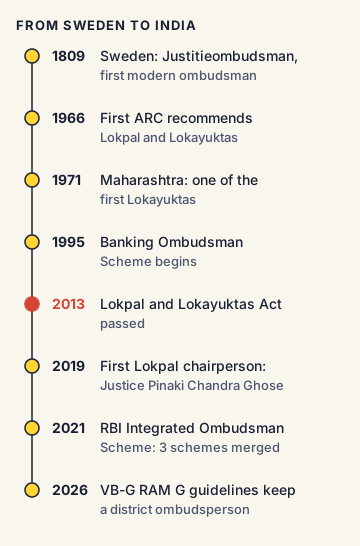
- Sweden, 1809: the Swedish Parliament created the office of the Justitieombudsman (Parliamentary Ombudsman for Justice) to watch over officials and judges on behalf of citizens. This is regarded as the first modern ombudsman.
- Spread: Finland followed in 1919, Denmark in 1955, Norway and New Zealand in 1962, and the United Kingdom in 1967. Today, more than 100 countries have some form of ombudsman.
- India: the idea entered Indian debate in the 1960s. The term "Lokpal" (protector of the people) was coined by Dr L. M. Singhvi. The First Administrative Reforms Commission, set up in 1966, recommended a Lokpal at the Centre and Lokayuktas in the states. Lokpal Bills were introduced many times from 1968 onwards but lapsed. Maharashtra set up one of the first Lokayuktas in 1971. The Lokpal and Lokayuktas Act, 2013 was finally passed, and India's first Lokpal chairperson, Justice Pinaki Chandra Ghose, was appointed in March 2019.
How does an ombudsman work?
The process is usually simple:
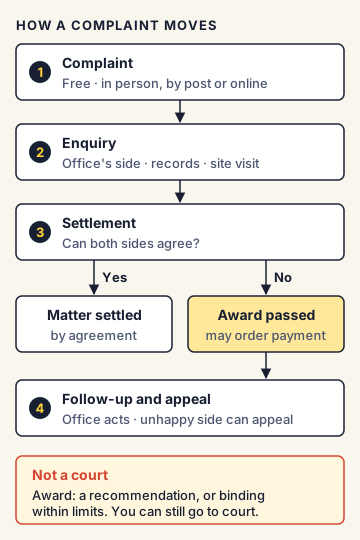
- Complaint: a citizen files a complaint, often free of cost, in person, by post or online.
- Enquiry: the ombudsman asks the office for its side, checks records and may visit the site.
- Settlement or award: the ombudsman tries to settle the matter by agreement. If that fails, it passes a decision, called an award or a recommendation, which may order payment of dues or compensation.
- Follow-up and appeal: the office is expected to act on the award. A party unhappy with the award can usually appeal to a higher authority.
Ombudsmen are of two kinds by power. Some can only recommend (they depend on public pressure and reports to the legislature). Others can pass binding awards within limits.
India's ombudsman family
India now has many sector-specific ombudsmen:
- Lokpal and Lokayuktas: the anti-corruption ombudsman for public servants, at the Centre (Lokpal) and in the states (Lokayuktas). The 2013 Act set up the Lokpal itself. For Lokayuktas, it only told every state to set one up through its own state law within one year of the Act coming into force (16 January 2014).
- RBI Ombudsman: for complaints against banks and other regulated finance companies. The Banking Ombudsman Scheme began in 1995. On 12 November 2021, the RBI merged its three schemes (banks, non-banking financial companies and digital transactions) into the Reserve Bank - Integrated Ombudsman Scheme, 2021, under a "One Nation One Ombudsman" approach.
- Insurance Ombudsman: for complaints against insurance companies, now under the Insurance Ombudsman Rules, 2017.
- Electricity Ombudsman: under the Electricity Act, 2003, for complaints against power distribution companies.
- Rural employment ombudsperson: one per district under MGNREGA (the Mahatma Gandhi National Rural Employment Guarantee Act, 2005), and now under the VB-G RAM G Act (the Viksit Bharat-Guarantee for Rozgar and Ajeevika Mission (Gramin) Act, 2025), which replaced MGNREGA from 1 July 2026.
The ombudsperson in rural job guarantee
Under MGNREGA, the Centre first asked states in 2009 to appoint district ombudsmen using its power to issue directions under the Act. The guidelines were revised several times, including in 2017 and on 21 January 2021. Under the 2021 MGNREGA guidelines, each district was to have an ombudsperson with a tenure of two years, which could be extended based on performance.
The ombudsperson could take complaints, hold enquiries and pass awards, such as directing payment of wages or compensation. In practice, many districts had no ombudsperson for long periods. The VB-G RAM G ombudsperson guidelines of 18 November 2026 keep one ombudsperson per district, widen the pool of candidates, revise tenure and pay, and add a digital platform to register and track complaints.
They also require geo-tagged photos of field visits. Each ombudsperson must attend at least three social audit public hearings or Gram Sabha meetings every month, to hear complaints directly from villagers.
Commonly confused concepts
- Ombudsman vs court: a court is part of the judiciary, follows formal procedure and its judgments are fully binding. An ombudsman is informal, quick and cheap, and its decisions are often recommendations or awards with limited force. Approaching an ombudsman does not stop a person from later going to court.
- Ombudsman vs Grievance Redressal Officer: a Grievance Redressal Officer is an official inside the department. An ombudsman is outside the department and independent of it.
- Lokpal vs Lokayukta: the Lokpal deals with corruption by central public servants; Lokayuktas deal with state public servants. The 2013 Act itself creates the Lokpal. It does not create the Lokayuktas: it only requires each state to set one up by passing its own Lokayukta law. A common trap is "the Lokayuktas are set up directly by the 2013 Act": this is false.
- Lokpal vs Central Vigilance Commission (CVC): the Lokpal is an ombudsman that can order enquiries and prosecution in corruption cases; the CVC is the main vigilance (anti-corruption watch) body that advises central departments.
- Ombudsman vs social audit: a social audit is done by the people themselves to check a scheme; an ombudsman is a single appointed official who decides on individual complaints.
Issues, criticism and the way forward
- Vacant posts: in rural employment, many districts had no ombudsperson for years, so the right to complain existed mostly on paper.
- Weak enforcement: where awards are only recommendations, officials can ignore them.
- Independence: when the ombudsperson is appointed and paid by the same government it must check, critics fear it may hesitate to act against officials.
- Low awareness: many rural workers do not know the ombudsperson exists or how to reach them.
- Digital divide: online platforms help tracking, but workers without smartphones or literacy may still need in-person options.
- Way forward: experts and the Second Administrative Reforms Commission have stressed filling posts on time, giving ombudsmen secure tenure and their own staff, making awards time-bound and enforceable, publishing action-taken reports, and linking ombudsmen with social audits and Gram Sabhas, which is the direction the new guidelines take.
Concepts to Know
- Maladministration: poor or unfair working of a government office, such as delay, negligence, bias or not following rules.
- Award: the written decision of an ombudsman on a complaint, which may order a payment, compensation or corrective action.
- Appellate authority: a higher official or body that hears an appeal from a person who is not satisfied with a lower decision.
- Muster roll: the attendance register at a public worksite, which records who worked on which day. Wages are paid based on it.
- Job card: a document given to a rural household under the job guarantee law that records its members and the work they have done.
- Geo-tagged photograph: a photo that carries the exact location (latitude and longitude) and time it was taken, so it can be checked later.
- First modern ombudsman: Sweden, 1809 (Justitieombudsman)
- First Administrative Reforms Commission (set up 1966) recommended Lokpal and Lokayuktas; term "Lokpal" coined by L. M. Singhvi
- Lokpal and Lokayuktas Act, 2013 (in force 16 January 2014): sets up the Lokpal; each state must set up its Lokayukta by its own law within one year; first Lokpal chairperson, Justice Pinaki Chandra Ghose, appointed March 2019
- Banking Ombudsman Scheme: 1995; RBI Integrated Ombudsman Scheme: 12 November 2021 (merged 3 schemes)
- Insurance Ombudsman Rules, 2017; Electricity Ombudsman under the Electricity Act, 2003
- MGNREGA ombudsman: first introduced through central instructions in 2009; revised guidelines 21 January 2021 (one per district, two-year tenure, extendable)
- VB-G RAM G ombudsperson guidelines: 18 November 2026; one per district; each ombudsperson must attend at least 3 social audit public hearings or Gram Sabha meetings a month; digital complaint platform; geo-tagged photos
● Tracked since November 18, 2026 · last seen November 18, 2026 · updates as the daily brief publishes