Official Development Assistance (ODA)
Official Development Assistance, or ODA, is money that rich countries' governments give or lend on very soft terms to poorer countries, to help them develop. It can be a gift (a grant), a loan at very low interest repaid over many decades, or expert help (technical cooperation). The key word is "soft": ODA must be far cheaper than a normal bank loan.
India has been the largest receiver of Japan's ODA for about two decades, and Japan's yen loans have built some of India's best-known projects, like metro railways and the Mumbai-Ahmedabad bullet train.
Why does ODA exist?
Poor countries often need roads, power plants, water systems and hospitals, but cannot raise money cheaply. Private banks charge high interest because lending to them looks risky. ODA fills this gap. Donor countries also gain: aid builds friendship, opens markets for their companies and spreads their influence. So ODA is both an act of help and a tool of foreign policy.
Where did the idea come from?
After the Second World War, the USA's Marshall Plan (1948) used aid to rebuild Europe. As colonies in Asia and Africa became free in the 1950s and 1960s, rich countries started regular aid programmes for them. In 1961 they set up the Development Assistance Committee (DAC) inside the OECD (Organisation for Economic Co-operation and Development, a club of mostly rich countries based in Paris).
The DAC wrote the official definition of ODA in 1969 and made it firmer in 1972. In 1970, the UN General Assembly set a target that each rich country should give 0.7% of its Gross National Income (GNI) as ODA every year. Very few countries meet this target.
What counts as ODA?
The DAC rules say money counts as ODA only if all of these are true:
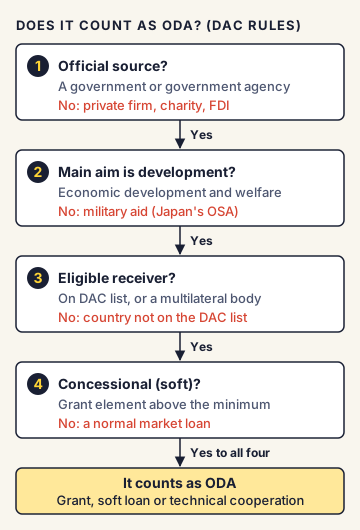
- It comes from an official source (a government or a government agency), not a private company or charity.
- Its main aim is the economic development and welfare of developing countries. Military aid does not count.
- It goes to a country on the DAC's list of countries eligible for ODA, or to a multilateral body that works for them.
- It is concessional, meaning softer than a market loan.
How is "concessional" measured?
The test uses the grant element: how much of a loan is, in effect, a gift. A pure gift has a grant element of 100%. A normal bank loan has about 0%. Before 2018, a loan needed a grant element of at least 25% to count. Since 2018 data, the DAC uses a grant-equivalent method agreed in 2014, with different minimums for different groups of countries:
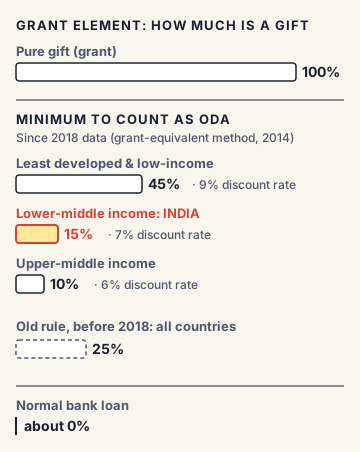
- Least developed countries and other low-income countries: grant element of at least 45% (calculated at a 9% discount rate).
- Lower-middle-income countries: at least 15% (7% discount rate).
- Upper-middle-income countries: at least 10% (6% discount rate).
India is classified as a lower-middle-income country, so the 15% minimum applies to loans to India.
How does Japan's ODA work?
Japan began aid in 1954 when it joined the Colombo Plan, a scheme for development in South and Southeast Asia. Japan's very first yen loan (ODA loan) anywhere in the world was to India, in 1958. Today Japan's aid is run mainly by JICA (Japan International Cooperation Agency). Japan gives three main types:
- ODA loans (yen loans): long-term, very low-interest loans for big projects. About 95% of Japan's ODA to India is yen loans.
- Grant aid: gifts, usually for smaller projects like health or water.
- Technical cooperation: sending experts, training Indian officials and sharing know-how.
Japan's aid follows a policy document. The ODA Charter (1992) was revised in 2003, renamed the Development Cooperation Charter in 2015, and revised again on 9 June 2023. The 2023 version added "offer-type" cooperation, where Japan itself proposes project packages using its strengths, instead of only waiting for requests.
India's position and Indian examples
India is both a receiver and a giver of aid.
- As a receiver: India has been Japan's largest ODA recipient since 2003-04. Famous yen-loan projects include the Delhi Metro, the Western Dedicated Freight Corridor, the Mumbai Trans Harbour Link and the Mumbai-Ahmedabad High Speed Rail (bullet train). Bullet train loans carry about 0.1% interest a year, a 50-year repayment period and a 15-year grace period (years in which no repayment is due). In Japan's financial year 2024-25 (April to March), JICA signed loans worth about ¥276 billion with India.
- Selective acceptance: In 2003, India decided to take government-to-government aid from only a few large partners (including Japan), and asked smaller donors to work through non-government channels. After the December 2004 tsunami, India declined foreign government aid for relief, saying it had enough resources. This showed India's wish to be seen as a capable nation, not an aid-dependent one.
- As a giver: India gives Lines of Credit (LoCs), soft loans to other developing countries, under the Indian Development and Economic Assistance Scheme (IDEAS) through the EXIM Bank of India. By 2025, India had offered more than 300 LoCs worth about US$32 billion to 68 countries. The Development Partnership Administration (DPA) in the Ministry of External Affairs, set up by 2012, manages India's aid work.
Commonly confused concepts
- ODA vs Foreign Direct Investment (FDI): ODA comes from a government, on soft terms, for development. FDI is private money that a company puts into a business abroad to earn profit. Japan's "¥10 trillion private investment" target is mostly FDI and other private flows, not ODA.
- ODA vs Lines of Credit (LoC): An LoC is one form of soft loan. When India gives LoCs it is acting like a donor, but India is not a DAC member, so its LoCs are not counted in OECD ODA figures.
- Tied vs untied aid: Tied aid must be spent on goods and services from the donor country. Untied aid can be spent anywhere. The bullet train loans are tied: a large part of the equipment must come from Japan.
- ODA vs military aid: Military aid is not ODA. Japan created a separate tool in April 2023, Official Security Assistance (OSA), to give defence equipment like coastal radars to friendly countries. The first four countries chosen were the Philippines, Malaysia, Bangladesh and Fiji.
- "0.7% of GNI" vs "0.7% of GDP": The UN target is set on Gross National Income, not Gross Domestic Product.
Issues, criticism and the way forward
- Debt risk: Even soft loans must be repaid. Large loans, especially in foreign currency, can create debt burdens. Japan's 2023 Charter stresses transparency and debt sustainability, partly to set itself apart from lenders accused of "debt traps".
- Currency risk: Yen loans are repaid in yen. If the rupee weakens against the yen, India pays more in rupees, which can cancel some of the benefit of low interest.
- Tied aid concerns: Tied loans can raise costs and limit Indian firms' share, though they also bring advanced technology and training.
- Donor interests: Critics say ODA often follows the donor's strategic and business interests more than the poorest people's needs.
- Missed targets: Most rich countries give far less than 0.7% of GNI.
- Way forward: Experts suggest more grants for the poorest countries, more untied aid, better project monitoring, and pairing ODA with private investment so that public money "pulls in" larger private funds.
Concepts to Know
- Gross National Income (GNI): The total income earned by a country's people and companies in a year, including income from abroad. It is close to GDP but adds income earned overseas and removes income sent out to foreigners.
- Discount rate: A rate used to work out what future repayments are worth today. A higher discount rate makes future repayments look smaller today, so the same loan looks more like a gift.
- Concessional loan: A loan on much easier terms than the market: lower interest, longer repayment time, or both.
- Grace period: The years at the start of a loan when the borrower does not have to repay any of the main amount.
- OECD: A Paris-based group of 38 mostly rich democracies that sets common rules and collects data on economic policy. India is not a member.
- Multilateral body: An organisation with many member countries, like the World Bank or the Asian Development Bank.
- DAC set up in 1961 (inside the OECD); ODA defined in 1969, made firmer in 1972
- UN target: 0.7% of GNI as ODA, set by the UN General Assembly in 1970
- Old rule: grant element at least 25%; since 2018 data: 45% (LDCs/LICs), 15% (lower-middle income), 10% (upper-middle income)
- Japan joined the Colombo Plan in 1954; first-ever Japanese yen loan: India, 1958
- India: largest recipient of Japanese ODA since 2003-04; about 95% of it is yen loans
- Bullet train loans: about 0.1% interest, 50 years repayment, 15-year grace period, tied
- Japan's Development Cooperation Charter: 1992 → 2003 → 2015 (renamed) → 9 June 2023
- Japan's Official Security Assistance (OSA), April 2023, is separate from ODA
- India's LoCs under IDEAS via EXIM Bank: 300+ LoCs, about US$32 billion, 68 countries (as of 2025)
● Tracked since July 01, 2026 · last seen November 20, 2026 · updates as the daily brief publishes