Supply Chain Resilience Initiative (SCRI)
The Supply Chain Resilience Initiative, or SCRI, is a partnership between India, Japan and Australia to make the supply of goods in the Indo-Pacific region more reliable. A "supply chain" is the full path a product travels: from raw material, to factory, to parts maker, to final assembly, to the shop. SCRI tries to make sure this path does not break easily when one country or one factory suddenly stops supplying. It was formally launched on 27 April 2021 by the trade ministers of the three countries.
What is a supply chain, simply?
Think of a mobile phone. Its screen may come from one country, its chip from another, its battery minerals from a third, and it may be assembled in a fourth. Each step is a link in a chain. If one link breaks (a factory shuts, a port closes, or a country stops exports), the whole chain stops and the phone cannot be made. A resilient supply chain is one that can absorb such a shock and keep working, or recover quickly.
Why does it exist?
The COVID-19 pandemic in 2020 showed the world how fragile supply chains had become. Factories shut, ships were stuck and countries ran short of medicines, masks, chips and car parts. One big reason was concentration: for many goods, most of the world's production sat in one country, mainly China. Countries realised that the cheapest supply chain is not always the safest one.
If one supplier can stop supplies, it can also use that power to pressure others. SCRI was created to spread production across more trusted partners, so that no single break can paralyse the region.
Where did it come from?
Japan had experienced the risk of depending on one supplier much earlier. In 2010, during a diplomatic dispute with China, Japanese companies faced a halt in rare earth shipments from China. Japan then started investing in other rare earth sources, including in Australia. In 2020, after the pandemic shock, Japan, India and Australia began high-level talks from September 2020 on working together on supply chains.
These talks led to the formal launch of SCRI at a virtual meeting of trade ministers on 27 April 2021. The three ministers were Piyush Goyal (India), Hiroshi Kajiyama (Japan) and Dan Tehan (Australia).
How does SCRI work?
SCRI is not a trade agreement. It does not cut tariffs and does not create a legal treaty. It is a cooperation platform that works in these ways:
- Sharing best practices: governments and companies share methods to find weak points in their supply chains and plan for disruptions.
- Investment promotion and buyer-seller matching: events that connect companies in one country with suppliers and buyers in another, so that firms can find alternative sources.
- Risk management and continuity planning: helping firms prepare a "plan B" (a backup supplier or route) before a crisis hits.
- Use of digital technology: using digital tools to track goods and spot problems early.
The ministers agreed to meet at least once a year to guide the work. In a March 2022 joint statement, they agreed to work on common supply chain principles for the region, and decided that the chair and secretariat role would rotate among the three countries (in the order Japan, Australia, India). They also agreed that new members could be added later, but only if all three agree (by consensus).
The key facts to remember
- Members: India, Japan, Australia (three countries; the US is not a member)
- Launched: 27 April 2021, at a virtual trilateral trade ministers' meeting
- Nature: a cooperation initiative, not a free trade agreement and not a legally binding treaty
- First projects: best-practice sharing, and investment promotion with buyer-seller matching
- Expansion: possible later, by consensus of the three members
- Main idea: diversification, meaning having many trusted sources instead of one
India's position and Indian examples
India sees SCRI as part of a wider plan to become a trusted manufacturing base, often described as the "China plus one" option for global companies. Inside India, this is supported by:
- Production Linked Incentive (PLI) schemes, launched in 2020, which give companies cash incentives linked to extra production in sectors like mobile phones, electronics, medicines and solar modules.
- The India Semiconductor Mission, which supports chip-making and chip-packaging plants.
- The National Critical Mineral Mission (2025), which aims to secure minerals like lithium and rare earths at home and abroad.
India also takes part in other supply chain groupings. India signed the Indo-Pacific Economic Framework (IPEF) Supply Chain Resilience Agreement in San Francisco on 14 November 2023. It was among the first five countries to ratify it, and the agreement came into force on 24 February 2024. In July 2025, the Quad foreign ministers launched the Quad Critical Minerals Initiative to diversify critical mineral supplies.
Commonly confused concepts
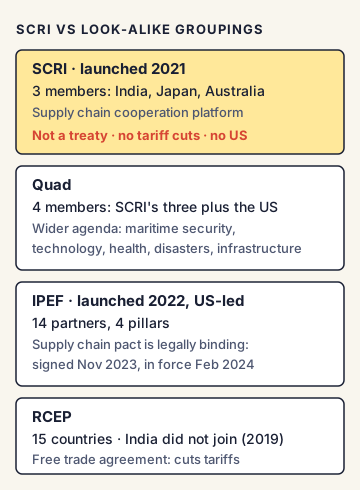
- SCRI vs the Quad: SCRI has three members (India, Japan, Australia) and is about trade and supply chains. The Quad has four members (adds the US) and covers a wider agenda: maritime security, technology, health, disasters and infrastructure.
- SCRI vs IPEF: IPEF is a US-led framework launched in May 2022 with 14 partner countries and four pillars (trade, supply chains, clean economy, fair economy). Its supply chain agreement is legally signed and ratified. SCRI is smaller, with only three members, and is not a treaty.
- SCRI vs RCEP: The Regional Comprehensive Economic Partnership (RCEP) is a free trade agreement of 15 countries that cuts tariffs; India chose not to join it in 2019. SCRI does not cut any tariffs.
- Resilience vs self-sufficiency: Resilience means the chain does not break easily, usually by having many trusted suppliers. Self-sufficiency means producing everything at home. SCRI aims for resilience, not complete self-sufficiency.
Issues, criticism and the way forward
- Low visibility: after its launch, SCRI has had few public, large projects. Critics say it has stayed more a statement of intent than a working programme.
- No dedicated money: SCRI has no common fund. Moving factories costs a lot, and companies decide based on profit, not government statements.
- Cost of diversification: building a second supply source is often more expensive than buying from the cheapest supplier. Someone has to pay this "insurance premium", either governments through subsidies or consumers through higher prices.
- Deep dependence remains: for items like rare earth processing, solar parts and battery materials, alternative sources will take years to build.
- Overlap with many groupings: SCRI, IPEF, the Quad and other platforms work on similar goals, which can spread effort thin.
- Way forward: experts suggest linking SCRI with funding and investment bodies, adding like-minded members by consensus, joint stockpiles of critical items, shared early-warning systems for disruptions, and coordination with the Quad and IPEF so the work is not duplicated.
Concepts to Know
- Supply chain: The full chain of steps and companies needed to turn raw materials into a finished product and get it to the buyer.
- Diversification: Spreading your sources across many suppliers or countries, so that losing one does not stop everything. Like not keeping all your eggs in one basket.
- "China plus one": A business strategy where a company keeps its factories in China but adds at least one more production base in another country, to reduce risk.
- Trilateral: Involving three countries. (Bilateral means two; multilateral means many.)
- Consensus: A decision that every member agrees to, with no one objecting.
- Ratify: When a country formally confirms an agreement it has signed, so that it becomes binding on that country.
- SCRI members: India, Japan, Australia
- Formally launched: 27 April 2021 (virtual trade ministers' meeting); preparatory talks from September 2020
- Not an FTA, not a legal treaty; a cooperation platform
- Chair/secretariat rotates: Japan, Australia, India (as agreed by ministers)
- Expansion only by consensus
- IPEF Supply Chain Agreement: signed 14 November 2023 (San Francisco); in force 24 February 2024; India among the first five ratifiers
- Quad Critical Minerals Initiative: launched by Quad foreign ministers in July 2025
● Tracked since November 17, 2026 · last seen November 18, 2026 · updates as the daily brief publishes