Nuclear Suppliers Group (NSG)
The Nuclear Suppliers Group (NSG) is a group of 48 countries that supply nuclear materials and technology. They follow a common set of rules (called guidelines) to make sure that nuclear fuel, reactors and related equipment are sold only for peaceful use, such as making electricity, and not for making nuclear weapons. It is not a treaty or a UN body. It is an informal club whose members voluntarily agree to follow its rules through their own national export laws.
Why does it exist?
Nuclear technology has two faces. The same uranium and reactors that light homes can also be used to make bombs. If any supplier could sell to anyone, a country could buy "peaceful" technology and quietly build weapons. The NSG works like a set of shopkeepers who agree on a common list of sensitive items and promise not to sell them to a buyer who does not accept international checks.
Where did it come from?
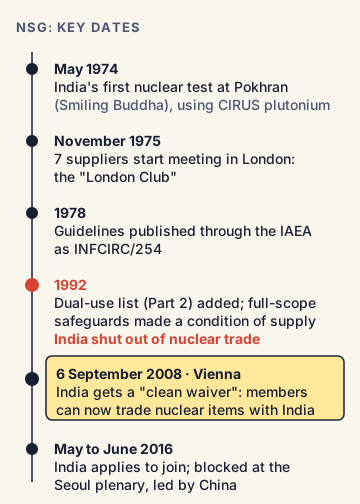
- In May 1974, India carried out its first nuclear test at Pokhran (code name Smiling Buddha). India called it a "peaceful nuclear explosion".
- The plutonium for this test came from CIRUS, a research reactor supplied by Canada (with heavy water from the United States) at Trombay, Mumbai, which first ran in 1960.
- This alarmed supplier countries: technology given for peaceful use had been used for an explosion. So, in November 1975, seven supplier countries began meeting in London. The group was first called the "London Club".
- In 1978, its guidelines were published through the International Atomic Energy Agency (IAEA) as document INFCIRC/254.
- In 1992, after it was found that Iraq had secretly built a weapons programme with "dual-use" imports, the NSG added a second list for dual-use items. It also made full-scope safeguards a condition of supply: a country that does not have nuclear weapons under the NPT must put all its nuclear facilities under IAEA checks to receive supplies.
- This 1992 rule shut India out of world nuclear trade, because India had not signed the NPT and kept some facilities outside IAEA checks.
How does it work?
- Two sets of guidelines:
- Part 1 covers items made especially for nuclear use: nuclear material (like uranium and plutonium), reactors, and key equipment. This list is called the trigger list, because exporting these items "triggers" the need for IAEA safeguards.
- Part 2 covers dual-use items: things with normal industrial uses that can also help make nuclear weapons, such as special machine tools.
- Consensus: All decisions, including admitting a new member, need the agreement of every member. So even one member can block a decision.
- No secretariat: The NSG has no permanent office. It meets in a yearly plenary (a meeting of all members), and the chair rotates among members.
- National action: Each member puts the guidelines into its own export control law. The NSG cannot punish anyone; it works through members' own rules.
India's position and the 2008 waiver
India has always said its record on non-proliferation is clean, even though it is outside the NPT. Under the India-US Civil Nuclear Agreement (the 123 Agreement), the United States pushed the NSG to make an exception for India.
- On 6 September 2008, at a special meeting in Vienna, the NSG gave India a "clean waiver" from the full-scope safeguards rule.
- In return, India had separated its civil and military nuclear facilities, placed the civil ones under IAEA safeguards, and promised to keep its voluntary halt on nuclear testing.
- This waiver allowed India to sign nuclear cooperation deals with the United States, France, Russia, Canada, Australia, Kazakhstan, Uzbekistan and others, and to import uranium.
- The Canada-India Nuclear Cooperation Agreement (signed 2010, in force 2013) and the Cameco uranium contracts of 2015 and 2026 were possible only because of this waiver.
India's membership bid
A waiver is not the same as membership. India applied to join in May 2016. At the Seoul plenary (June 2016), a few members, led by China, blocked it, arguing that only NPT members should join. China has also linked India's case to Pakistan's application. India argues that its 2008 waiver, its separation plan and its strong record make it fit to join, as the NPT is not a rule of NSG membership. India has joined the three other export control groups:
- Missile Technology Control Regime (MTCR): joined June 2016
- Wassenaar Arrangement (conventional arms and dual-use goods): joined December 2017
- Australia Group (chemical and biological weapons): joined January 2018
Commonly confused concepts
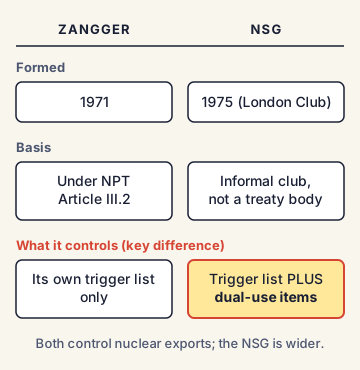
- NSG vs Zangger Committee: Both control nuclear exports. The Zangger Committee (formed 1971) works under Article III.2 of the NPT and keeps its own trigger list. The NSG (1975) is wider: it also covers dual-use items and technology, and it includes some states that are not linked to the NPT in the same way.
- NSG vs IAEA: The IAEA is a UN-linked international organisation in Vienna that inspects nuclear facilities (safeguards). The NSG is an informal group of suppliers that decides the rules for selling nuclear items.
- NSG waiver vs NSG membership: The waiver (2008) lets members trade with India. Membership would let India sit at the table and help make the rules, including on future exceptions.
- NPT vs NSG: The NPT (Treaty on the Non-Proliferation of Nuclear Weapons, 1968; in force 1970) is a binding treaty. The NSG is a voluntary group. India is outside the NPT but follows NSG guidelines in its own export laws.
Issues, criticism and the way forward
- Consensus as a veto: Because every member must agree, one country can block a decision for years, as seen with India's bid.
- NPT link: Some members want NPT membership as a test for joining. Others say India's record and its waiver show that strict rules can be met without the NPT.
- Fairness debate: Some non-proliferation experts argued that the 2008 waiver weakened the global rules by rewarding a country outside the NPT. India and its supporters argue it brought India's civil programme under IAEA checks that did not exist before.
- Energy security: India plans a large rise in nuclear power. Stable uranium supply from countries like Canada, Kazakhstan and Uzbekistan matters for this.
- Way forward: India continues to build support through its membership of MTCR, Wassenaar and the Australia Group, which shows it follows global export rules, and through steady diplomacy with members that have objections.
Concepts to Know
- Safeguards: Inspections and checks by the IAEA to make sure nuclear material in a facility is not secretly diverted to weapons.
- Full-scope safeguards: IAEA checks on all nuclear facilities and material of a country, not just some of them.
- Dual-use items: Goods or technologies that have normal civilian uses but could also help make weapons.
- Plutonium: A man-made radioactive element produced inside reactors; it can be used as nuclear fuel or to make nuclear bombs.
- Uranium ore concentrate (yellowcake): Processed uranium powder made from mined ore; it is later turned into fuel for reactors.
- Plenary: A meeting where all members of a group take part.
- NPT: The 1968 treaty that recognises only five countries (the US, Russia, the UK, France and China) as nuclear-weapon states and asks others not to make nuclear weapons. India has not signed it, calling it discriminatory.
- NSG: 48 participating governments; formed after India's May 1974 test; first met November 1975 in London ("London Club")
- Guidelines published as IAEA document INFCIRC/254 (1978); Part 1 = trigger list (nuclear items); Part 2 = dual-use items (added 1992)
- 1992: full-scope IAEA safeguards made a condition of supply to non-nuclear-weapon states
- Decisions by consensus; no permanent secretariat; annual plenary
- India-specific "clean waiver": 6 September 2008, Vienna
- India applied for membership in May 2016; blocked at the June 2016 Seoul plenary
- India joined MTCR (2016), Wassenaar Arrangement (2017), Australia Group (2018)
● Tracked since May 21, 2026 · last seen October 14, 2026 · updates as the daily brief publishes