New Drugs and Clinical Trials Rules, 2019
The New Drugs and Clinical Trials Rules, 2019 (often called the NDCT Rules) are India's main rulebook for two things: approving new medicines and running clinical trials (tests of medicines on human volunteers). They decide who must give permission, what proof a company must show, how fast the regulator must reply, and what happens if a trial volunteer is hurt. The central government made these rules under the Drugs and Cosmetics Act, 1940, and they are applied by the Central Drugs Standard Control Organisation (CDSCO).
Why does India need these rules?
A new medicine can save lives, but it can also harm people if it is unsafe or does not work. Before a medicine reaches the market, someone must check the proof that it is safe and that it works. Clinical trials are also risky for volunteers, who are often poor and may not fully understand what they agree to. The rules protect patients and volunteers, and at the same time give companies a clear, time-bound process so that good medicines are not delayed.
Where did they come from?
Earlier, new drugs and clinical trials were handled under Part XA and Schedule Y of the Drugs and Cosmetics Rules, 1945. In the early 2010s there were serious complaints about unethical trials, deaths of volunteers and poor compensation. A public interest case, Swasthya Adhikar Manch, Indore v. Union of India (Writ Petition (Civil) No. 33 of 2012), reached the Supreme Court, and the Court asked the government to finalise new clinical trial rules urgently.
A draft was published on 1 February 2018. The final rules were notified on 19 March 2019 (G.S.R. 227(E)). They replaced Part XA and Schedule Y. One chapter (Chapter IV, on ethics committees for general biomedical and health research) came into force later, on 15 September 2019, 180 days after publication.
How are the rules organised?
The rules have 13 chapters, 107 rules and 8 Schedules (the Schedules hold the forms, data requirements and fee lists). The chapters cover, in order (some lines below group two or three chapters together, so there are fewer lines than chapters):
- Preliminary matters and definitions
- The authorities in charge
- Ethics committees for clinical trials, and separately for biomedical and health research
- Clinical trials and bioavailability/bioequivalence (BA/BE) studies
- Compensation for injury or death of volunteers
- Registration of BA/BE study centres
- Making and importing new drugs for trials, and for sale
- Use of unapproved new drugs for patients in government hospitals
- Changes to the 1945 rules, and miscellaneous rules (such as pre-submission meetings)
Who is in charge?
Under Rule 3, the Drugs Controller General of India (DCGI), appointed by the central government in the Ministry of Health and Family Welfare, is the Central Licensing Authority (CLA). The DCGI may hand over some of these powers to CDSCO officers not below the rank of Assistant Drugs Controller. State drug controllers, called State Licensing Authorities, still give the actual licences to make and sell medicines under the Drugs and Cosmetics Rules, 1945.
What counts as a "new drug"? (Rule 2(1)(w)) This definition is the heart of the rules, because only a "new drug" needs the CLA's permission. A medicine is a new drug if it falls in any of these five groups:
- A drug (including an active ingredient or a phytopharmaceutical drug, meaning a purified plant-based medicine) that has not been used in India to any significant extent and has not been approved by the CLA as safe and effective for its claims.
- An already approved drug that a company now wants to sell with new claims, such as a new use (indication), a new route (for example, injection instead of tablet), a new dose or a new dosage form.
- A fixed dose combination (FDC): two or more separately approved drugs combined for the first time in a fixed ratio, or an approved combination whose ratio is being changed.
- A modified or sustained-release form of an approved drug, or a novel drug delivery system.
- A vaccine, r-DNA derived product, living modified organism, monoclonal anti-body, cell or stem cell derived product, gene therapeutic product or xenograft, meant to be used as a drug.
How long does a drug stay "new"?
The Explanation to Rule 2(1)(w) says drugs in groups 1, 2 and 3 stay new drugs for four years from the date the CLA gives permission. After that, they are treated like ordinary drugs, and a state regulator alone can license other makers. But drugs in groups 4 and 5 are always deemed to be new drugs.
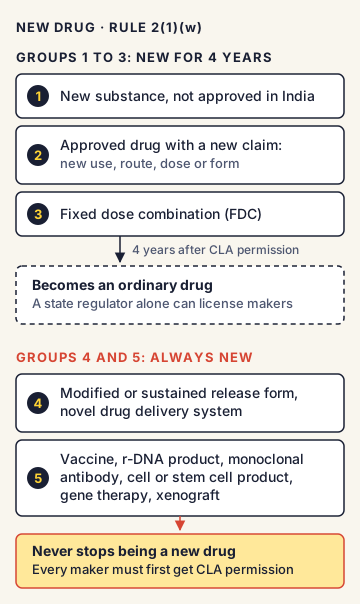
This means every company that wants to make them must go to the CLA first, no matter how many years the product has been on the market. You can think of group 5 as a permanent "high-risk" list that never leaves central control.
How does approval to make a new drug work? (Chapter X)
The steps run in this order:
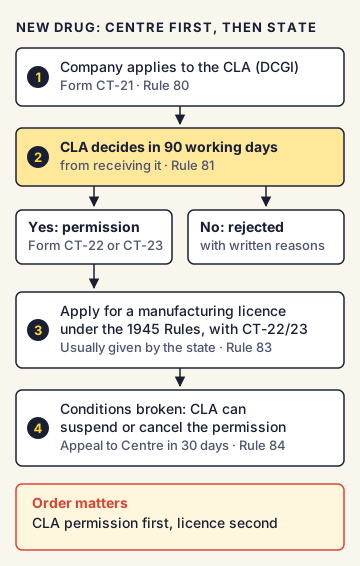
- The company applies to the CLA in Form CT-21 (Rule 80), with the data listed in the Second Schedule and the fee in the Sixth Schedule.
- The CLA checks the data. Within 90 working days of receiving the application, it either grants permission (Form CT-22 for an active pharmaceutical ingredient, Form CT-23 for a finished formulation) or rejects it with written reasons (Rule 81).
- Only after getting this permission can the company apply for a manufacturing licence under the Drugs and Cosmetics Rules, 1945, attaching the CT-22 or CT-23 permission (Rule 83). The licence itself is usually given by the state.
- If a maker breaks the conditions, the CLA can suspend or cancel the permission after hearing the company. The company can appeal to the central government within 30 days of receiving the order (Rule 84).
A simple comparison: the CLA permission is like a central "entry pass" that says the medicine itself is acceptable, and the state licence is the "shop licence" that lets a particular factory produce it.
How are clinical trials approved?
A sponsor (the company or body running the trial) applies to the CLA, and the trial must also be cleared by a registered ethics committee (a panel of doctors, scientists, lawyers and lay members that checks if the trial is safe and fair to volunteers). The key timelines are:
- For a new drug discovered in India, or one whose research and development is being done in India and which is also meant to be made and sold in India, the CLA must decide within 30 working days of receiving the application (Rule 23). If it does not reply in that time, the trial is deemed approved (treated by law as approved).
- For other applications, the CLA must decide within 90 working days of receiving the application, and there is no deemed approval.
- A permission to start a trial stays valid for two years from the date it is issued, unless the CLA extends it (Rule 26). This is the time within which the trial must start. It is not a limit on how long the trial may run.
Compensation and care for volunteers (Chapter VI)
Compensation is paid when the death or injury is related to the trial. Rule 41 lists when it counts as related, for example a harmful effect of the medicine being tested, a breach of the trial plan, or negligence. If a trial volunteer dies in this way, the sponsor must pay financial compensation to the legal heirs.
If the volunteer suffers permanent disability or another injury, the sponsor must pay the volunteer (Rule 39). This money is in addition to free medical management for as long as the investigator thinks it is needed, or until it is shown that the injury is not related to the trial, whichever comes first. For a temporary injury, the amount is linked to the volunteer's lost wages, as worked out under the Seventh Schedule.
Other key provisions
- Academic clinical trial: a trial of an already approved drug, started by a researcher or institution for a new use, route, dose or form, with results meant only for research and not for getting marketing approval. Under Rule 28, such trials need no permission from the CLA, but they must first be approved by an ethics committee and their results cannot be used for promotion.
- Orphan drug: a drug for a condition that affects not more than five lakh persons in India. No fee is charged for an application to run a clinical trial of an orphan drug, and the CLA may waive local trials for such drugs.
- Waiver of local trials (Rule 101): the CLA, with the central government's approval, can name countries whose approvals it will consider when waiving local trials. By an order of 7 August 2024, it named the USA, UK, Japan, Australia, Canada and the European Union. The waiver applies to certain categories only: orphan drugs for rare diseases, gene and cellular therapy products, new drugs for pandemic situations, new drugs for special defence use, and new drugs with a significant therapeutic advance over current standard of care.
- Pre-submission meetings (Rule 98): a company can meet CDSCO before filing to understand what data is needed.
- Unapproved drugs for patients: a government hospital or medical institution can import or make a small quantity of an unapproved new drug for patients with life-threatening diseases (Chapter XI).
India's position and examples
The rules have been changed several times since 2019. A January 2022 amendment widened group 5 of the definition from "stem cell derived product" to "cell or stem cell derived product". Every vaccine, including COVID-19 vaccines, and every monoclonal antibody falls under group 5, which is why such products always need central approval in India. India is a large hub for clinical trials and for generic medicines, so these rules affect both patient safety and the pharmaceutical industry.
Commonly confused concepts
- New drug vs investigational new drug: An investigational new drug is a new chemical or biological entity that is not yet approved anywhere and is still being tested in trials. A new drug is the broader legal category in Rule 2(1)(w), which also includes already approved drugs with new claims, FDCs and always-new products like vaccines.
- Four years vs always: Groups 1 to 3 stop being new drugs four years after CLA permission. Groups 4 and 5 never stop being new drugs. A common trap is to think every new drug becomes "ordinary" after four years.
- CLA permission vs manufacturing licence: CLA permission (Form CT-22/CT-23) approves the product. The manufacturing licence, issued under the Drugs and Cosmetics Rules, 1945, allows a factory to produce it. For a new drug, both are needed, and in this order.
- NDCT Rules, 2019 vs Drugs and Cosmetics Rules, 1945: Both are made under the Drugs and Cosmetics Act, 1940. The 1945 rules cover licensing, labelling, standards and sale of all drugs. The 2019 rules cover only new drugs, clinical trials, BA/BE studies and ethics committees.
- 30 working days vs 90 working days: Only a new drug discovered in India, or one researched and developed in India and also meant to be made and sold in India, gets the 30-working-day timeline with deemed approval. All other trial applications get 90 working days and no deemed approval. Both are counted from the day the CLA receives the application.
Issues, criticism and the way forward
- Deemed approval: Supporters say it pushes the regulator to act quickly and helps Indian research. Critics worry that a trial could start without any real review if the regulator is short of staff.
- Waiving local trials: The industry says waivers bring life-saving drugs to Indian patients faster. Public health experts point out that Indian patients may respond differently because of genetics, diet and disease patterns, so some local data is still useful.
- Compensation: Volunteer groups say compensation formulas still undervalue harm to poor volunteers. Companies say clear formulas make costs predictable.
- Weak link between Centre and states: The CLA approves a product, but quality depends on the factories that states license. Experts have long asked for stronger, uniform inspections and a single digital licensing system. Expanding the "always a new drug" list is one way to bring high-risk products under central checks. In 2026 the Drugs Technical Advisory Board (the expert body that advises the government on drug rules) agreed in principle to add all antimicrobials (medicines that kill or stop germs, such as antibiotics) to it, but this is a proposal, not yet law.
Concepts to Know
- Clinical trial: A careful test of a medicine on human volunteers to check if it is safe and if it works. It is done in phases, from a small group of healthy people (Phase I) to thousands of patients (Phase III).
- Bioavailability / bioequivalence (BA/BE) study: Bioavailability is how much of a medicine reaches the blood, and how fast. A bioequivalence study checks whether a copy of a medicine (a generic) reaches the blood in the same amount and speed as the original. If it does, it should work the same way.
- Stability study: A test that keeps samples of a medicine in set conditions of heat and moisture over time, to check that it stays strong and safe until its expiry date.
- Fixed dose combination (FDC): A single pill or syrup that contains two or more medicines in a fixed ratio.
- Monoclonal antibody: A lab-made protein that copies the body's natural antibodies and attaches to one specific target, such as a virus or a cancer cell.
- Working day: A day when government offices are open. Weekends and public holidays are not counted, so 30 working days is longer than 30 calendar days.
- Notified: 19 March 2019, G.S.R. 227(E), under Sections 12 and 33 of the Drugs and Cosmetics Act, 1940
- Replaced Part XA and Schedule Y of the Drugs and Cosmetics Rules, 1945
- 13 chapters, 107 rules, 8 Schedules
- Central Licensing Authority (Rule 3): Drugs Controller General of India
- "New drug" defined in Rule 2(1)(w), with five groups; groups 1 to 3 stay new for 4 years from CLA permission; groups 4 and 5 (including vaccines, r-DNA products and monoclonal antibodies) are always deemed new drugs
- Manufacture of a new drug: Form CT-21 to CLA (Rule 80) → permission in Form CT-22/CT-23 within 90 working days of receiving the application (Rule 81) → manufacturing licence under the 1945 Rules (Rule 83)
- Clinical trial decision, counted from receipt of the application: 30 working days (deemed approval) for a drug discovered in India, or researched and developed in India and meant to be made and sold in India; 90 working days (no deemed approval) for others
- Clinical trial permission: valid for 2 years from issue to start the trial, unless extended (Rule 26)
- Compensation (Rule 39): only for death or injury related to the trial (Rule 41)
- Orphan drug: condition affecting not more than 5 lakh persons in India
- Rule 101 order (7 August 2024): USA, UK, Japan, Australia, Canada, EU named for considering waiver of local trials in five categories
● Tracked since May 21, 2026 · last seen November 20, 2026 · updates as the daily brief publishes