Neutral Rate of Interest (r-star)
The Rate That Neither Pushes Nor Pulls
The neutral rate of interest is the interest rate at which the economy is neither being pushed to grow faster nor being held back. At this rate, the economy runs at its full normal capacity and inflation stays steady. It is usually written as a real rate, that is, after removing inflation, and economists call it r-star (written r*).
If a central bank keeps its rate above r, it is slowing the economy. If it keeps its rate below r, it is speeding the economy up.
Why does it exist?
A central bank needs a yardstick. Saying "the repo rate is 5.5%" does not tell you whether money is cheap or costly. Think of a thermostat (a device that keeps a room at a set temperature). To know whether the heater is warming or cooling the room, you need a "neutral" setting where it does neither.
The neutral rate is that setting for an economy. Without it, the RBI could keep money too cheap for too long, letting inflation build, or too costly, hurting jobs and growth.
Where did it come from?
- 1898: The Swedish economist Knut Wicksell, in his book Interest and Prices, described a "natural" rate of interest on loans that is neutral towards prices and tends neither to raise nor lower them. If banks lend below this rate, prices rise; if above, prices fall.
- 1993: John Taylor proposed his famous rule for setting interest rates. For the US, it assumed a neutral real rate of 2% and added adjustments for inflation and the output gap.
- 2001-2003: Economists Thomas Laubach and John Williams built a model to estimate a neutral rate that changes over time. Their work made the term "r-star" popular. It also showed that such estimates are very uncertain.
- Since then, most central banks, including the RBI, publish or discuss estimates of the neutral rate when explaining their decisions.
How does it work, step by step?
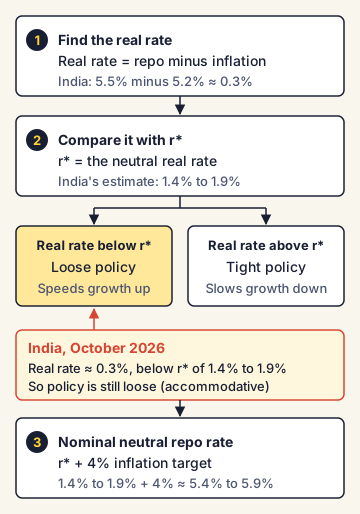
- Find the real policy rate. Real rate = nominal (stated) rate minus expected inflation. This idea is linked to the American economist Irving Fisher and is called the Fisher relation. If the repo rate is 5.5% and inflation is expected to be 5%, the real repo rate is about 0.5%.
- Compare it with r*. If r is about 1.5% and the real repo rate is 0.5%, the policy is still accommodative* (loose): money is cheaper than neutral.
- Move towards or away from neutral. If inflation is too high, the central bank raises the real rate above r. If growth is weak and inflation is low, it lowers the real rate below r.
- Nominal neutral rate. To turn r into a repo rate level, add the inflation target. With r of 1.5% and a 4% target, the neutral repo rate would be about 5.5%.
A simple example: think of a home loan at 9% when prices rise 4% a year. Your real cost of borrowing is about 5%. If prices start rising 7% a year and the loan rate stays at 9%, your real cost falls to about 2%. Borrowing has become cheaper in real terms, even though the stated rate did not change. This is why central banks raise rates when inflation rises, just to keep the real rate from falling.
What moves the neutral rate?
r* is not fixed. It depends on slow-moving forces:
- Potential growth: faster growth in productivity and the workforce raises r*.
- Savings: when people save a lot (for example, an ageing population), r* tends to fall.
- Investment demand: a strong investment cycle raises r*.
- Government borrowing: large deficits compete for savings and can raise r*.
- Global rates: in an open economy like India, world interest rates and capital flows also matter.
India's position and Indian examples
- An RBI Bulletin study in July 2024 estimated India's neutral real rate at 1.4% to 1.9% for January to March 2024. This was up from 0.8% to 1.0% for October to December 2021.
- The study linked the rise mainly to stronger potential growth after the pandemic, along with a large working-age population, a stronger investment cycle, fiscal consolidation (the government cutting its deficit) and infrastructure spending.
- With the 4% inflation target, this range implies a nominal neutral repo rate of roughly 5.4% to 5.9%.
- The RBI's Annual Report for 2025-26 lists refining its estimate of the neutral rate as a goal for 2026-27.
- As of October 2026, the repo rate is 5.50%, and the RBI projects CPI inflation of 5.2% for 2026-27 and 5.6% for April to June 2027. So the real repo rate is only slightly above zero, below the estimated neutral range.
Commonly confused concepts
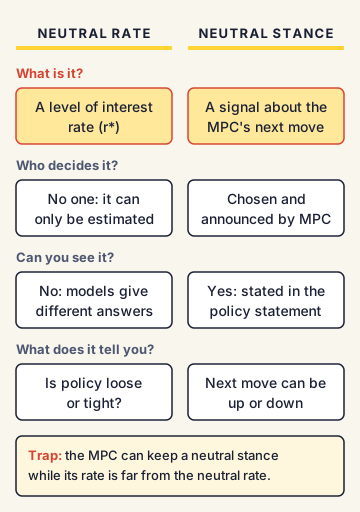
- Neutral rate vs neutral stance: This is a big trap. The neutral rate is an economic level (an estimate of r). A neutral stance* is the MPC's announced signal that its next move could be up or down. The MPC can have a neutral stance while its rate is far from the neutral rate.
- Real vs nominal interest rate: The nominal rate is the stated rate (for example 5.5%). The real rate is the nominal rate minus inflation. Savers and borrowers really feel the real rate.
- Neutral rate of interest vs natural rate of unemployment (NAIRU): Both are "no-pressure" levels. r* is an interest rate; NAIRU is the unemployment rate at which inflation does not speed up.
- Repo rate vs neutral rate: The repo rate is chosen and announced by the MPC. The neutral rate cannot be seen or chosen; it can only be estimated.
Issues, criticism and the way forward
- It cannot be observed: r* is estimated from models, and different models give very different answers. Laubach and Williams themselves warned that the estimates are imprecise.
- Circular reasoning: Some critics argue that measured r* simply reflects past central-bank policy, so using it to guide policy can go in circles.
- Supply shocks muddy the picture: When inflation comes from oil or food, the "right" real rate is harder to judge. Raising the real rate too fast can hurt growth without fixing supply problems.
- Open-economy pressures: For India, the gap between Indian and US interest rates affects capital flows and the rupee, so the RBI cannot look only at domestic r*.
- Way forward: Experts suggest using a range rather than a single number, updating estimates regularly, and explaining clearly how the MPC uses them.
Concepts to Know
- Real interest rate: The interest rate after removing inflation. If you earn 7% on a deposit and prices rise 5%, your real return is about 2%.
- Accommodative policy: A policy that keeps interest rates low to encourage borrowing and spending.
- Potential growth: The speed at which an economy can grow over time without pushing up inflation, based on its workers, machines and technology.
- Fiscal consolidation: When the government reduces its deficit (the gap between what it spends and what it earns).
- Capital flows: Money that foreign investors bring into or take out of a country, for example to buy shares or bonds.
- Knut Wicksell, Interest and Prices, 1898: the idea of a "natural" rate neutral to prices
- Taylor rule, 1993: assumed a 2% neutral real rate for the US
- Laubach-Williams model: first draft 2001, published 2003; popularised "r-star"
- Real rate ≈ nominal rate minus expected inflation (Fisher relation)
- RBI Bulletin, July 2024: India's neutral real rate 1.4% to 1.9% (January to March 2024), up from 0.8% to 1.0% (October to December 2021)
- Implied nominal neutral repo rate with a 4% target: about 5.4% to 5.9%
- As of October 2026: repo rate 5.50%; RBI projected CPI inflation 5.2% for 2026-27
● Tracked since October 21, 2026 · last seen October 21, 2026 · updates as the daily brief publishes