National Social Assistance Programme (NSAP)
The National Social Assistance Programme (NSAP) is the Union government's main scheme to give a small, regular cash pension to the poorest old people, widows and persons with severe disabilities. It also gives a one-time cash help to a poor family when its main earning member dies. The Centre pays the full central share of the money, and states usually add their own top-up. It is India's basic "social safety net" for people who cannot earn.
Why does it exist?
Most Indian workers are in the informal sector, like farm labourers, street vendors or domestic workers. They have no employer pension and no provident fund. When they grow old, lose a spouse or live with a serious disability, they may have no income at all. NSAP gives them a minimum, guaranteed amount every month, so they are not left completely dependent on others.
What is its constitutional base?
The NSAP is the Centre's way of acting on Article 41 of the Constitution, a Directive Principle of State Policy. Article 41 asks the State, within its economic capacity, to make effective provision for the right to work, to education and to public assistance in cases of unemployment, old age, sickness and disablement. Directive Principles cannot be enforced in court, but they guide the government's policy.
Where did it come from?
The NSAP was launched on 15 August 1995. It was the first time the Union government took direct financial responsibility for the poorest people's social security.
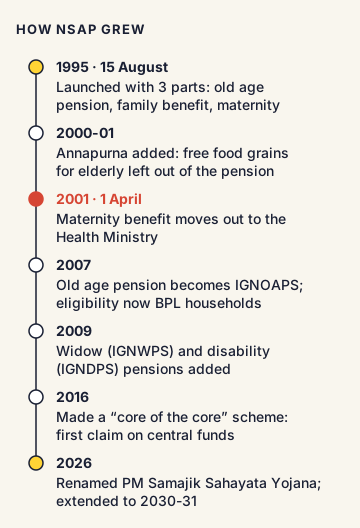
- At the start it had three parts: the National Old Age Pension Scheme, the National Family Benefit Scheme, and the National Maternity Benefit Scheme.
- In 2000-01, the Annapurna scheme was added to give free food grains to poor elderly people left out of the pension.
- On 1 April 2001, the maternity benefit part moved to the Ministry of Health and Family Welfare.
- In 2007, the old-age pension was renamed the Indira Gandhi National Old Age Pension Scheme (IGNOAPS), and eligibility shifted to people from Below Poverty Line (BPL) households.
- In 2009, two new parts were added: the widow pension (IGNWPS) and the disability pension (IGNDPS).
- In 2026, the Cabinet extended it to 2030-31, renamed it the Pradhan Mantri Samajik Sahayata Yojana, and made the disability pension more generous.
The five components (before the 2026 changes)
- Old age pension (IGNOAPS): BPL persons aged 60 and above. Central help: ₹200 a month for ages 60 to 79, and ₹500 a month at 80 and above.
- Widow pension (IGNWPS): BPL widows aged 40 to 79. Central help: ₹300 a month. At 80, she moves to the old-age pension of ₹500.
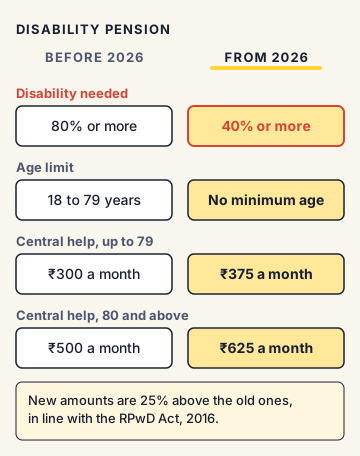
- Disability pension (IGNDPS): BPL persons aged 18 to 79 with severe or multiple disability (80% or more). Central help: ₹300 a month, and ₹500 at 80 and above.
- National Family Benefit Scheme (NFBS): a one-time ₹20,000 to a BPL family when its primary breadwinner (the main earner, aged 18 to 59) dies.
- Annapurna: 10 kg of food grains a month, free, for poor senior citizens who are eligible for the old-age pension but are not getting it.
How does it work?
Think of it like a shared family budget. The Centre fixes the minimum amount and pays it. The state identifies the beneficiaries, pays the money and usually adds its own top-up, so the final pension differs from state to state.
- The Ministry of Rural Development runs the scheme at the Centre, for both rural and urban areas.
- The Centre fixes a ceiling (maximum number of beneficiaries) for each state.
- States and local bodies, including Gram Panchayats and municipalities, find eligible people and approve applications.
- Money is paid into bank or post office accounts through Direct Benefit Transfer (DBT). Since July 2025, pensioners can prove they are alive through a Digital Life Certificate app, instead of a yearly paper check.
How is it funded?
Although it is a Centrally Sponsored Scheme (CSS) run through the states, the Centre gives 100% of the central assistance, so the basic amount is the same everywhere. In the 2016 rationalisation of CSSs, the NSAP was placed in the top group called "core of the core" schemes, along with MGNREGA and the umbrella schemes for SCs, STs, minorities and other vulnerable groups. These are the first claim on central funds.
What changed in 2026?
- Total outlay: ₹53,428 crore for 2026-27 to 2030-31.
- New name: Pradhan Mantri Samajik Sahayata Yojana, with each component renamed.
- Disability pension: disability needed falls from 80% to 40%; no minimum age; amount rises to ₹375 (up to 79) and ₹625 (80+). These are exactly 25% above the widow pension (₹300) and the 80-plus rate (₹500), in line with the Rights of Persons with Disabilities Act, 2016.
- The new disability rules apply within three months of the new guidelines.
Commonly confused concepts
- NSAP vs Atal Pension Yojana (APY): NSAP is a non-contributory pension. The poor person pays nothing; the government pays. APY (2015) is a contributory pension for unorganised workers aged 18 to 40, who pay in every month to get ₹1,000 to ₹5,000 a month after 60.
- NSAP vs PM Shram Yogi Maan-dhan (PM-SYM): PM-SYM (2019) is also contributory: the worker and the government each pay, and the worker gets ₹3,000 a month after 60.
- NSAP vs Employees' Pension Scheme (EPS), 1995: EPS is for formal-sector employees under the EPFO and is funded from the employer's contribution.
- Centrally Sponsored vs Central Sector scheme: A Centrally Sponsored Scheme is carried out by states, usually with shared funding. A Central Sector Scheme is fully funded and run by the Centre itself. NSAP is centrally sponsored, but its central part is 100% Union-funded.
Issues, criticism and the way forward
- Very small amounts: The central share for most old-age pensioners (₹200) has not been raised for many years, while prices have gone up. Without a state top-up, it buys very little.
- Old poverty lists: Eligibility depends on BPL lists, many of which are based on surveys over a decade old. Some poor people are left out, while some better-off people stay in.
- Caps on numbers: Because the Centre fixes a ceiling for each state, eligible people may wait for an "existing beneficiary" to die before getting a slot.
- Unequal state support: Some states pay ₹2,000 or more a month, others add little, so a poor widow's pension depends on where she lives.
- Paperwork and delays: Aadhaar linking, bank account problems and late payments have caused some pensioners to miss money.
- Way forward: Experts and parliamentary committees have suggested raising and indexing the central amount to inflation, using newer data such as the Socio-Economic Caste Census instead of old BPL lists, moving towards covering every eligible person (saturation) and making payments regular and on time.
Concepts to Know
- Below Poverty Line (BPL): A label for households whose income or living standard is below a level fixed by the government. BPL lists are prepared through surveys and used to decide who gets welfare.
- Non-contributory pension: A pension where the person does not pay anything in advance; the government funds it fully.
- Centrally Sponsored Scheme (CSS): A programme designed by the Centre but carried out by states, usually with money from both.
- Direct Benefit Transfer (DBT): Sending welfare money straight into the beneficiary's bank account, without middlemen.
- Directive Principles of State Policy: Guidelines in Part IV of the Constitution (Articles 36 to 51) that the government should follow while making laws and policies. Courts cannot enforce them.
- Launched: 15 August 1995; Ministry of Rural Development
- Constitutional link: Article 41 (public assistance in old age, sickness, disablement, unemployment)
- Original components (1995): NOAPS, NFBS, National Maternity Benefit Scheme (moved to Health Ministry, 1 April 2001)
- Annapurna: 10 kg free food grains a month for eligible elderly not getting pension
- Old age: 60+, ₹200 (60 to 79), ₹500 (80+); Widow: 40 to 79, ₹300; Disability (old rule): 18 to 79, 80% disability, ₹300
- NFBS: one-time ₹20,000 on death of primary breadwinner aged 18 to 59
- 100% central assistance; "core of the core" CSS since 2016
- 2026: ₹53,428 crore for 2026-27 to 2030-31; renamed Pradhan Mantri Samajik Sahayata Yojana; 3.20 crore beneficiaries
- 2026 disability rules: 40% benchmark, no minimum age, ₹375 (up to 79), ₹625 (80+)
● Tracked since May 12, 2026 · last seen October 14, 2026 · updates as the daily brief publishes