National Mineral Policy, 2019
The National Mineral Policy, 2019 is the Government of India's main policy statement on how the country should find, mine and use its minerals. It is not a law. It is a guiding document that tells the Centre and the states what goals to aim for and what kind of laws and rules to make. It was approved by the Union Cabinet on 28 February 2019 and replaced the earlier National Mineral Policy of 2008.
Why does India need a mineral policy?
Minerals are the raw material for almost everything: iron ore for steel, bauxite for aluminium, limestone for cement, coal for power, and lithium for batteries. India has large mineral wealth, but much of it is not yet explored or mined well. Mining also causes problems: it damages forests, displaces tribal communities and can be done illegally. A policy is needed to balance three goals at once: more production, fair sharing of benefits, and protection of the environment and local people.
You can think of a policy as a family's long-term plan ("we will save for a house and our children's education"), while the law is the actual set of rules ("no withdrawal from this account before five years"). The policy gives direction; the law gives force.
Where did it come from?
India has had three national mineral policies:
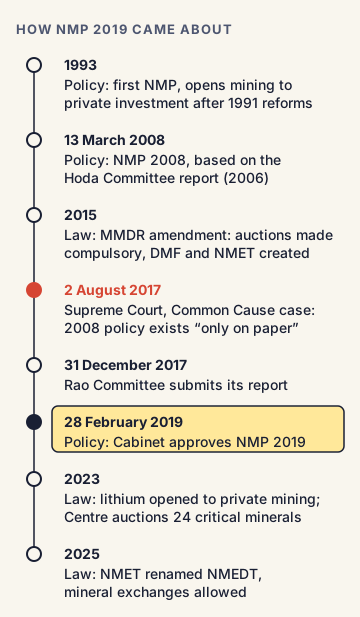
- National Mineral Policy, 1993: the first one. It opened mining to private investment and modern technology after the 1991 economic reforms. Later reviews found it had not achieved this, mainly because of delays in giving mining permissions and poor infrastructure in mining areas.
- National Mineral Policy, 2008: adopted on 13 March 2008. It was based on the report of a high-level committee chaired by Anwarul Hoda, set up by the Planning Commission in September 2005, which reported in July 2006. It aimed at more private investment, transparency in giving mining rights and scientific mining.
- National Mineral Policy, 2019: the current one.
The 2019 policy came from a Supreme Court push. In the case of Common Cause v. Union of India, decided on 2 August 2017, the Court dealt with large-scale illegal mining in Odisha. It observed that the 2008 policy seemed to exist "only on paper" and was not being enforced, and it asked the Centre to bring a fresh and more effective policy.
On 14 August 2017, the Ministry of Mines set up a committee under Dr. K. Rajeswara Rao, an Additional Secretary in the ministry. It included central ministries, state governments, industry bodies and professional bodies, and it consulted NGOs. The committee submitted its report on 31 December 2017. After further consultation, the Cabinet approved NMP 2019 on 28 February 2019.
What are the main features of NMP 2019?
The policy has steps to grow mining and steps to make it fair and sustainable.
Steps to grow the sector:
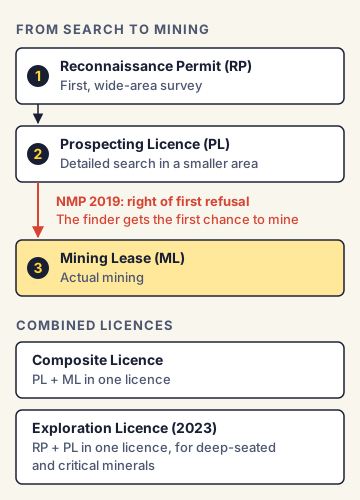
- Right of first refusal: If a company holding a Reconnaissance Permit (RP) or Prospecting Licence (PL) finds minerals, it gets the first chance to take the mining rights, instead of losing the area to an auction. This rewards the risk of exploration.
- Private exploration: incentives to bring private companies into exploration, and auction of unexplored areas on a revenue-share basis for combined exploration-cum-mining rights.
- Industry status for mining: this makes it easier for mining companies to borrow from banks and to buy mineral assets abroad.
- Mergers, acquisitions and transfer of leases: easier rules so that mining companies can combine and so that leases can be transferred.
- Dedicated mineral corridors, and use of coastal shipping and inland waterways to move minerals cheaply.
- Auction of unused reserved areas: areas kept aside for public sector companies but lying unused are to be auctioned.
- Taxes in line with world benchmarks: royalty, levies and taxes are to be harmonised with other mining countries so India stays competitive.
- Long-term export-import policy for minerals, so that investors can plan large projects.
Steps for fairness, transparency and sustainability:
- Inter-generational equity: minerals are limited and cannot be regrown, so today's generation must not use them up in a way that harms future generations. The policy proposes an inter-ministerial body to make sustainable mining a regular practice.
- District Mineral Fund (District Mineral Foundation, DMF): money collected from miners is to be used fairly for the development of people and areas affected by mining.
- E-governance: IT-enabled systems, a database of mineral resources and leases, and an online portal that raises an alarm to higher authorities when state clearances are delayed.
- Focus on Make in India, gender sensitivity, and better handling of project-affected persons, especially in tribal areas.
The policy also set an ambitious goal of raising the production of major minerals by 200% in seven years [Unverified as an official target figure].
How does the policy connect to the law?
The policy is put into action through the Mines and Minerals (Development and Regulation) Act, 1957 (MMDR Act) and its rules. The power comes from the Constitution:
- Entry 54 of the Union List lets Parliament regulate mines and mineral development where it declares by law that central control is in the public interest. The MMDR Act is that declaration.
- Entry 23 of the State List gives states power over mines and minerals, but subject to Entry 54.
So the Centre makes the main law, while the states own most minerals, grant most leases and collect royalty. Minor minerals (like sand, stone and clay) are almost fully handled by the states.
How has the mining framework changed since 2019?
Many changes came after the policy, which is why a review is needed:
- MMDR Amendment Act, 2015 (before the policy) had already made auctions compulsory for new mining rights, and created the District Mineral Foundation (Section 9B) and the National Mineral Exploration Trust (Section 9C). Under the 2015 DMF rules, miners pay 30% of royalty to the DMF for leases granted before 12 January 2015, and 10% for leases granted on or after that date.
- 2021 amendment: removed the difference between captive mines (whose output is only for the owner's own plant) and merchant mines. Captive mines could sell up to 50% of their yearly output in the open market.
- 2023 amendment (in force 17 August 2023): removed six minerals, including lithium, from the list of "atomic minerals", so private companies can now mine them. It gave the Centre the power to auction 24 critical and strategic minerals listed in Part D of the First Schedule, and created a new Exploration Licence for deep-seated and critical minerals.
- 2023: the Ministry of Mines identified a list of 30 critical minerals.
- January 2025: the Cabinet approved the National Critical Mineral Mission (₹16,300 crore government spending plus ₹18,000 crore expected from public sector companies, over seven years).
- 2025 amendment (passed August 2025): renamed the NMET as the National Mineral Exploration and Development Trust (NMEDT) and raised the contribution from 2% to 3% of royalty; removed the 50% sale cap on captive mines; allowed mineral exchanges; allowed adding critical minerals to existing leases; and allowed a one-time extension of lease area for deep-seated minerals.
- July 2024: a nine-judge bench of the Supreme Court, in Mineral Area Development Authority v. Steel Authority of India, held that royalty is not a tax and that states can tax mineral rights and mineral-bearing land. This overruled India Cement (1989) and changed Centre-state money flows in mining.
India's position and examples
India's key mining states include Odisha, Jharkhand, Chhattisgarh, Karnataka, Rajasthan and Madhya Pradesh. Odisha collects the largest DMF funds among states. India is a major producer of coal, iron ore, bauxite and limestone, but depends almost fully on imports for lithium, cobalt and nickel. Public bodies involved include the Geological Survey of India (GSI) for exploration, the Indian Bureau of Mines (IBM) for regulation of mining plans, and KABIL (a joint venture of NALCO, HCL and MECL) for buying mineral assets abroad.
Commonly confused concepts
- Mineral policy vs mineral law: NMP 2019 is a policy (direction, not enforceable in court on its own). The MMDR Act, 1957 is a law passed by Parliament.
- Major vs minor minerals: Minor minerals (sand, gravel, ordinary clay, building stone and others notified by the Centre) are regulated by state rules. Major minerals are governed mainly by the MMDR Act.
- Reconnaissance Permit vs Prospecting Licence vs Mining Lease vs Composite Licence vs Exploration Licence: a Reconnaissance Permit allows a first, wide-area survey; a Prospecting Licence allows detailed search in a smaller area; a Mining Lease allows actual mining; a Composite Licence combines prospecting and mining; the Exploration Licence (2023) allows reconnaissance and prospecting for deep-seated and critical minerals.
- DMF vs NMET/NMEDT: DMF money stays in the district for affected people. NMET (now NMEDT) money goes to a national trust that funds exploration.
- Captive vs merchant mine: a captive mine feeds the owner's own plant (like a steel company's iron ore mine); a merchant mine sells in the market.
Issues, criticism and the way forward
- Weak focus on responsible mining: critics said NMP 2019 talks a lot about growth but gives little practical guidance on environmental repair (restoring land after mining).
- Tribal and forest rights: many minerals lie under forests in Fifth Schedule (tribal) areas. In Samatha v. State of Andhra Pradesh (1997), the Supreme Court barred the transfer of tribal land in Scheduled Areas to private miners. In the Niyamgiri case (2013), the Court let gram sabhas decide on bauxite mining in their area. A policy must respect the PESA Act, 1996 and the Forest Rights Act, 2006.
- Poor use of DMF money: audits have found DMF funds spent on projects far from the mining-affected people.
- Illegal mining: the Common Cause case itself showed how weak enforcement allowed illegal mining.
- Low exploration: India has explored only a small part of its potential area in detail, and private explorers find it hard to recover their costs.
- Way forward: experts suggest a new policy that puts critical minerals, recycling (urban mining from e-waste and old batteries) and deep-sea minerals at the centre; aligns with the 2023 and 2025 amendments; makes exploration data public through a national geoscience data repository; and protects local communities through strong DMF governance.
Concepts to Know
- Royalty: a payment a miner makes to the government (usually the state) for each tonne of mineral taken out, because the mineral belongs to the public.
- Critical minerals: minerals that are very important for the economy and security but whose supply is at risk, like lithium, cobalt and rare earths.
- Auction: an open bidding process where the company offering the highest share of revenue (premium) to the state wins the mining rights. It replaced the older "first come, first served" system.
- Deep-seated minerals: minerals found deep below the surface (like gold, copper, nickel), which are harder and costlier to find.
- Inter-generational equity: the idea that natural resources must be used in a way that leaves a fair share for future generations.
- Fifth Schedule areas: tribal-majority areas in states other than the North-East, where special protections apply to tribal land and self-rule.
- NMP history: 1993 → 2008 (13 March 2008, after Hoda Committee report of July 2006) → 2019 (Cabinet approval 28 February 2019)
- Trigger for NMP 2019: Common Cause v. Union of India, Supreme Court, 2 August 2017
- Review committee: set up 14 August 2017, chaired by Dr. K. Rajeswara Rao; report 31 December 2017
- Constitutional basis: Entry 54 (Union List), Entry 23 (State List)
- DMF (Section 9B): 30% of royalty for leases before 12 January 2015; 10% for later leases
- NMET (Section 9C), renamed NMEDT in 2025, contribution raised from 2% to 3% of royalty
- 2023 amendment: 24 critical and strategic minerals in Part D of the First Schedule; six atomic minerals (including lithium) delisted; Exploration Licence created
- India's critical minerals list (2023): 30 minerals
- Mineral Area Development Authority v. SAIL (2024, nine-judge bench): royalty is not a tax
● Tracked since October 20, 2026 · last seen October 20, 2026 · updates as the daily brief publishes