National Health Policy, 2017
India's Roadmap for Health for All
The National Health Policy, 2017 (NHP 2017) is the Government of India's main policy document on health. It sets the goal of giving every person good health care that they can afford, without falling into poverty because of medical bills. It also sets clear number targets, such as raising government health spending to 2.5% of GDP by 2025. It is a policy, not a law, so it guides governments but cannot be enforced in court.
Why does India need a health policy?
Health in India is spread across many hands. The Centre runs national programmes, the states run most hospitals, and private players provide most treatment. Without a common plan, each would pull in a different direction. A national health policy works like a shared map. It tells the Centre, the states and private providers where the country wants to go and how fast.
Where did it come from?
India has had three national health policies:
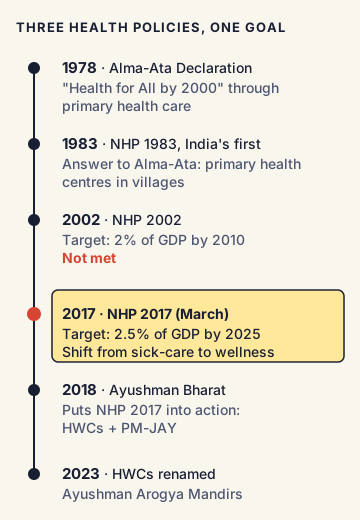
- National Health Policy, 1983: India's first. It was a response to the Alma-Ata Declaration (1978), where countries promised "Health for All by 2000" through primary health care. So it focused on building primary health centres in villages.
- National Health Policy, 2002: It aimed to raise public health spending from about 0.9% of GDP to 2% of GDP by 2010. This target was never met.
- National Health Policy, 2017: Approved by the Union Cabinet in March 2017 (the decision was announced on 16 March 2017). It came 15 years after the 2002 policy, because disease patterns, the economy and technology had changed a lot.
What is the core goal?
The policy's goal is "the attainment of the highest possible level of health and well-being for all at all ages". It wants to do this through preventive and promotive health care (stopping disease before it starts) and by giving everyone access to good care without financial hardship. A key shift was moving from "sick-care" to "wellness": keeping people healthy, not only treating them once they fall ill.
How does it plan to pay for health care?
- Raise public spending: government health spending to rise to 2.5% of GDP by 2025.
- States to spend more: states should spend more than 8% of their budgets on health by 2020.
- Put money into primary care first: the policy asks that a large share of resources (up to two-thirds) go to primary care, because cheap, early care prevents costly hospital care later.
- Strategic purchasing: for hospital (secondary and tertiary) care, the government can "buy" services from public and private hospitals through insurance-type schemes, instead of only running its own hospitals.
How does it change primary care?
The policy proposed turning existing sub-centres and primary health centres into Health and Wellness Centres (HWCs). These would offer a full basket of care: maternal and child health, but also checks for diabetes, blood pressure, common cancers, mental health and eye care. The 2017-18 Budget speech committed to 1.5 lakh such centres. In 2018, Ayushman Bharat put the policy into action with two pillars: the HWCs (renamed Ayushman Arogya Mandirs in 2023) and PM-JAY, the free hospital insurance scheme.
The key targets you must know
UPSC often asks these as number-and-year pairs:
- Life expectancy at birth: from 67.5 years to 70 years by 2025
- Total Fertility Rate: 2.1 by 2025
- Under-five mortality rate: 23 by 2025
- Maternal Mortality Ratio (MMR): 100 by 2020
- Infant Mortality Rate (IMR): 28 by 2019
- Neonatal mortality: 16, and still-birth rate in "single digit", by 2025
- Tuberculosis: cure rate above 85% in new sputum-positive patients, and TB elimination by 2025
- Catastrophic health spending: cut the share of households facing it by 25% by 2025
- Government health spending: 2.5% of GDP by 2025
Where does India stand?
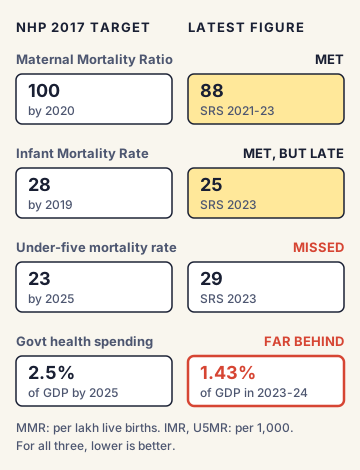
Some targets have been met. For example, the Maternal Mortality Ratio fell to 88 per lakh live births (SRS 2021-23), below the target of 100. Others were missed. The infant mortality rate was 25 (SRS 2023), which meets the 2019 target of 28 but only years later. Under-five mortality was 29 (SRS 2023), still above the 2025 target of 23. Government health spending was 1.43% of GDP in 2023-24, well below the 2.5% target.
Commonly confused concepts
- NHP 2017 vs National Health Mission (NHM): NHP is a policy (a set of goals and directions). NHM (2013, which merged NRHM of 2005 and NUHM of 2013) is a programme with money that the Centre gives states to run health services.
- NHP 2017 vs Ayushman Bharat: NHP 2017 proposed the ideas (HWCs, strategic purchasing). Ayushman Bharat (2018) is the scheme that put them into practice.
- Government health expenditure vs total health expenditure: The 2.5% of GDP target is only for government spending. Total health spending (government + families + insurers + employers) was 3.29% of GDP in 2023-24.
- Health is a State subject: "Public health and sanitation; hospitals and dispensaries" is Entry 6 of the State List (Seventh Schedule). That is why states, not the Centre, pay most of the public health bill (about 68% in 2023-24).
Issues, criticism and the way forward
- The spending gap: Public spending has risen, but 1.43% of GDP is far below 2.5%. Critics also note that the 2% target of 2002 was missed, and the 2017 policy only moved a similar goal to a later date.
- Heavy dependence on states: Many poorer states, which need health spending the most, have the least money. The 15th Finance Commission recommended that states raise health spending to over 8% of their budgets by 2022.
- High medicine costs: Medicines are the largest part of pocket spending. Insurance schemes like PM-JAY mainly cover hospital stays, not the daily medicines and outpatient visits that drain families most.
- Shortage of staff: Buildings can be upgraded quickly, but doctors, nurses and specialists in rural areas remain short.
- Way forward: Experts suggest raising public spending steadily, covering outpatient care and free medicines, strengthening Ayushman Arogya Mandirs with staff and drugs, and using NHA data every year to track progress.
Concepts to Know
- GDP (Gross Domestic Product): The total value of all goods and services made in the country in a year. Saying "health spending is 1.43% of GDP" means about ₹1.43 out of every ₹100 the country produces goes to government health spending.
- Primary, secondary and tertiary care: Primary care is the first contact, like a village health centre. Secondary care is a district hospital with specialists. Tertiary care is advanced care, like AIIMS, for complex problems.
- Strategic purchasing: The government acts as a smart buyer. It pays hospitals (public or private) for treatment given to people, instead of running every hospital itself.
- Alma-Ata Declaration (1978): A world meeting held at Alma-Ata (in today's Kazakhstan) where countries agreed that primary health care is the key to "Health for All".
- SRS (Sample Registration System): A large survey run by the Registrar General of India that gives yearly figures on births and deaths, such as IMR and MMR.
- Earlier policies: NHP 1983 (first; "Health for All by 2000") and NHP 2002 (2% of GDP by 2010, not met)
- NHP 2017 approved by the Union Cabinet in March 2017
- Government health spending target: 2.5% of GDP by 2025; states above 8% of their budgets by 2020
- Targets: life expectancy 70 (2025), TFR 2.1 (2025), U5MR 23 (2025), MMR 100 (2020), IMR 28 (2019), neonatal mortality 16 (2025), TB elimination (2025), 25% fewer households with catastrophic health spending (2025)
- Put into action through Ayushman Bharat (2018): Health and Wellness Centres (now Ayushman Arogya Mandirs) + PM-JAY
- Health is a State subject: Entry 6, State List, Seventh Schedule
● Tracked since May 05, 2026 · last seen November 15, 2026 · updates as the daily brief publishes