National Deep Water Exploration Mission (Samudra Manthan)
The National Deep Water Exploration Mission, called "Samudra Manthan", is India's mission to search for oil and natural gas in the deep and ultra-deep waters of the sea off its coasts. It was announced on 15 August 2025 and approved by the Union Cabinet on 31 July 2026 as the "Samudra Manthan" (National Offshore Exploration Scheme), with an outlay of ₹84,084 crore until 2030-31. Its aim is to find new oil and gas reserves at home so that India depends less on imports.
Why does India need it?
India imports almost 89% of the crude oil it uses (about 88.7% in 2025-26, as per provisional official data). This makes India very exposed to price shocks and shipping disruptions abroad. Meanwhile, India's own oil and gas production is about 62 million tonnes of oil equivalent (MMTOE) a year, and old fields lose about 6 to 7% of output every year as they age.
A large part of India's possible oil and gas lies under deep seawater, where it has barely been explored. Without a push to explore there, domestic production would keep falling.
Where did it come from?
- 2016-2017: India moved to the Hydrocarbon Exploration and Licensing Policy (HELP) and the Open Acreage Licensing Policy (OALP), which let companies choose and bid for exploration blocks.
- 2021: The Ministry of Earth Sciences launched the separate Deep Ocean Mission for ocean research and deep-sea minerals.
- 15 August 2025: In the Independence Day address, the government announced a National Deep Water Exploration Mission, named "Samudra Manthan", to be run in mission mode.
- The government also opened up almost all offshore areas that were earlier "no-go" zones and strengthened the National Data Repository of geological data.
- 31 July 2026: The Union Cabinet approved the Samudra Manthan (National Offshore Exploration Scheme) as a Central Sector Scheme of the Ministry of Petroleum and Natural Gas.
The name comes from the Indian legend of the "churning of the ocean", in which gods and demons churned the sea to bring out treasures. Here, the "treasure" is oil and gas under the seabed.
Deep and ultra-deep water: what do they mean?
Sea areas are grouped by how deep the water is above the seabed. In India, areas beyond the 400-metre depth line are treated as deepwater, and much deeper areas (generally beyond about 1,500 metres [Unverified]) as ultra-deepwater. India's 26 sedimentary basins (rock basins where oil and gas can form) cover about 3.36 million sq km, and about 1.32 million sq km of this lies in deepwater.
Drilling here is costly and risky: a single deepwater exploration well can cost USD 125 to 150 million, and many wells find nothing.
How is the money divided?
The ₹84,084 crore scheme has these main parts:
- ₹43,200 crore for drilling 60 deepwater exploratory wells. The government will support up to 50% of the eligible drilling cost, with a reported cap of about ₹675 crore per well. This shares the risk with companies.
- ₹28,534 crore for collecting and studying seismic data (sound-wave pictures of rocks under the seabed), including 2D and 3D surveys and re-processing old data with AI-based tools.
- ₹10,000 crore for common offshore production and evacuation infrastructure (shared platforms and pipelines to bring oil and gas to shore).
- ₹2,000 crore for an Oil and Gas Manufacturing and Services Zone to build equipment and services in India.
- Smaller amounts for digital programme management, capacity building and international cooperation.
Separately, ONGC (Oil and Natural Gas Corporation) has its own target of drilling about 150 deepwater wells over seven years as part of the Samudra Manthan push.
How does it work, step by step?
- The government collects and shares seismic data so companies can see where oil and gas may lie.
- Blocks are offered to companies through OALP bidding rounds under HELP.
- Companies drill exploratory wells; the scheme shares part of the cost of deepwater wells, lowering their risk.
- If oil or gas is found, common infrastructure helps bring it to shore faster and cheaper.
- Discoveries are developed into producing fields, adding to India's reserves and output.
What are the expected results?
- Over 600 MMTOE of new reserves, if exploration succeeds.
- India's oil and gas resource base could rise from about 1.6 to 2.2 billion tonnes of oil equivalent.
- Domestic production targeted to rise from about 62 MMTOE to 80 MMTOE a year.
- Possible savings of nearly ₹1 lakh crore a year on crude oil imports.
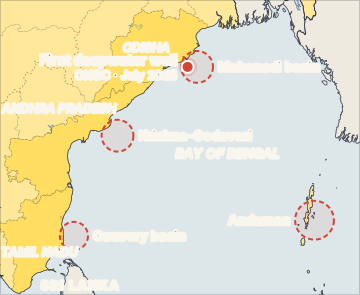
- Key areas include the Krishna-Godavari, Cauvery and Mahanadi basins and the Andaman region. ONGC began drilling its first deepwater well under the push in the Mahanadi offshore basin (off Odisha) in July 2026, and Oil India has reported gas finds in the Andaman area.
Commonly confused concepts
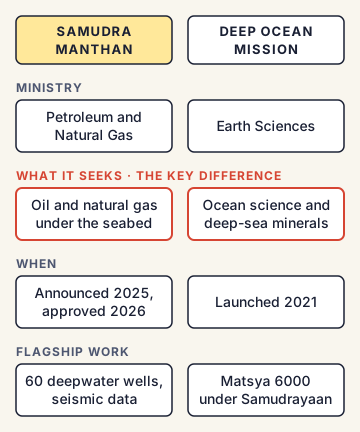
- Samudra Manthan vs Deep Ocean Mission: Samudra Manthan is run by the Ministry of Petroleum and Natural Gas and is about oil and gas. The Deep Ocean Mission (2021) is run by the Ministry of Earth Sciences and covers ocean science, deep-sea minerals and the manned submersible Matsya 6000 under Samudrayaan.
- Samudra Manthan vs HELP/OALP: HELP and OALP are the rules and bidding system for giving blocks to companies. Samudra Manthan is a funding scheme that pays for data and shares drilling costs in deep waters.
- Exploration vs production: Exploration means searching for oil and gas (surveys, test wells). Production means pumping out oil and gas from a proven field. A discovery today may take 5 to 10 years to start producing.
- Strategic Petroleum Reserves vs Samudra Manthan: SPRs store imported oil for emergencies (short-term protection). Samudra Manthan tries to increase home production (long-term protection).
Issues, criticism and the way forward
- High risk, long wait: Deepwater drilling is very costly, and success is uncertain. Results may come only after 5 to 10 years.
- Technology and equipment: India depends on foreign companies for deepwater rigs and expertise. The manufacturing zone and international partnerships aim to build this capacity at home.
- Attracting private and foreign investors: Past bidding rounds often got few bids for deepwater blocks. Cost-sharing and better data are meant to change this.
- Environment: Offshore drilling carries risks of oil spills and harm to marine life, so strict environmental checks are needed.
- Energy transition: Some experts question large spending on fossil fuels when the world is moving to clean energy. Supporters reply that India will need oil and gas for decades, and producing it at home is safer than importing.
- Way forward: steady policy, quick approvals, open sharing of geological data, partnerships with experienced global firms, and linking the mission with natural gas use as a cleaner "bridge fuel".
Concepts to Know
- Crude oil: Oil in its natural form, as it comes out of the ground, before it is refined into petrol, diesel and other fuels.
- Million tonnes of oil equivalent (MMTOE): A single unit to add up oil and gas together, by converting gas into the amount of oil that gives the same energy.
- Sedimentary basin: A large low area of the earth's crust where layers of mud, sand and dead organisms piled up over millions of years; oil and gas form in such rocks.
- Seismic survey: A method of sending sound waves into the ground or seabed and recording the echoes to make a picture of the rock layers below.
- Exploratory well: A test well drilled to check whether oil or gas is actually present.
- Central Sector Scheme: A scheme fully funded and run by the Union government.
- Import dependence: The share of a country's needs that it buys from other countries.
- Announced: 15 August 2025 (Independence Day address) as the National Deep Water Exploration Mission
- Cabinet approval: 31 July 2026 as "Samudra Manthan" (National Offshore Exploration Scheme)
- Ministry: Petroleum and Natural Gas; type: Central Sector Scheme
- Outlay: ₹84,084 crore up to 2030-31
- ₹43,200 crore for 60 deepwater exploratory wells (up to 50% cost support); ₹28,534 crore for seismic data; ₹10,000 crore common infrastructure; ₹2,000 crore manufacturing and services zone
- Expected reserve addition: over 600 MMTOE
- India: 26 sedimentary basins, about 3.36 million sq km (about 1.32 million sq km in deepwater beyond the 400 m depth line)
- Crude import dependence: about 88.7% (2025-26, provisional)
- Deep Ocean Mission (2021) is a separate Ministry of Earth Sciences programme
● Tracked since October 16, 2026 · last seen October 16, 2026 · updates as the daily brief publishes