Narasimham Committees
Banking Sector Reforms in India
The Narasimham Committees were two expert committees, headed by former RBI Governor M. Narasimham, that designed India's banking reforms after 1991. The first committee (1991) looked at the whole financial system and the second (1998) reviewed how those reforms had gone and what should come next. Together they changed Indian banking from a tightly controlled, government-directed system into one that runs on prudent rules, competition and market-linked interest rates.
Many rules that banks follow today, such as the capital adequacy ratio and the way bad loans are classified, came from these committees.
Why were reforms needed?
By 1991, Indian banks were weak. After the bank nationalisations of 1969 and 1980, most banking was in government hands. Banks had to keep a very large part of their deposits in cash with the RBI and in government bonds, so little money was left to lend to businesses. Interest rates were fixed by the RBI, not by the market.
Bad loans were hidden because there were no strict rules to count them. India also faced a severe balance of payments crisis in 1991, which pushed the government towards wide economic reform.
Two big "locks" on bank money
Two rules took most of a bank's money away before it could lend:
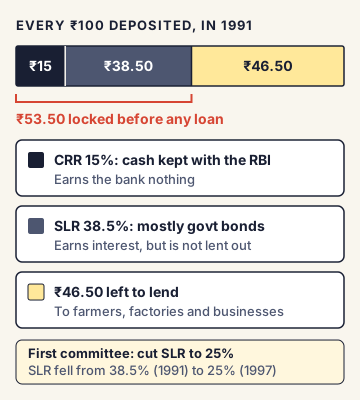
- Cash Reserve Ratio (CRR): the share of deposits a bank must keep as cash with the RBI. It earns nothing. It was about 15% in 1991.
- Statutory Liquidity Ratio (SLR): the share of deposits a bank must keep in safe, liquid assets, mostly government bonds. It was 38.5% in 1991.
Think of it like this: out of every ₹100 deposited, more than half was locked away before the bank could lend a single rupee to a farmer or a factory. Economists call this financial repression.
The first committee (1991)
The government set up the Committee on the Financial System in August 1991. It submitted its report in November 1991, and the report was tabled in Parliament on 17 December 1991. Its main recommendations:
- Cut SLR and CRR in phases. SLR was to come down to 25%, and CRR was also to be brought down steadily. SLR fell from 38.5% (1991) to 25% (1997).
- Capital adequacy ratio of 8%, in line with the Basel norms. The RBI set this norm in April 1992, and all public sector banks reached it by March 1996.
- Prudential norms: clear rules for income recognition, asset classification and provisioning (IRAC). A loan on which interest is not paid for a set period becomes a non-performing asset (NPA) and the bank cannot count unpaid interest as income.
- Free interest rates gradually, so that the market, not the RBI, sets most deposit and lending rates.
- Allow new private banks and more foreign banks to bring competition. The RBI issued guidelines for new private sector banks in January 1993, which led to banks such as HDFC Bank and ICICI Bank.
- Special tribunals for recovering bad loans. This led to the Recovery of Debts Due to Banks and Financial Institutions Act, 1993, which created Debt Recovery Tribunals (DRTs).
- An Asset Reconstruction Fund to take bad loans off banks' books, and a four-tier banking structure with 3 or 4 large international banks at the top, then national banks, regional banks and rural banks.
- Less directed credit: it suggested reducing the priority sector target from 40% to about 10% [Unverified], a proposal the government did not accept.
The second committee (1998)
The Committee on Banking Sector Reforms was set up in December 1997 and gave its report in April 1998. Its main ideas:
- Raise the capital adequacy ratio to 9% by 2000 and 10% by 2002.
- Mergers of strong banks to create large banks, but no forced merger of a strong bank with a weak one.
- Narrow banking for weak banks: a weak bank would put its money only in very safe, short-term assets (like government bonds) until it became healthy again.
- Reduce the government's minimum shareholding in public sector banks to 33%.
- Better technology, computerisation, staff training, and freedom for bank boards from political interference.
- Review of old banking laws and stronger laws for recovering loans. Later, the SARFAESI Act, 2002 let banks seize and sell the property given as security without going to court first.
How did India follow up?
Most of the first committee's ideas were adopted step by step through the 1990s. Basel capital norms, NPA rules, new private banks, DRTs and freer interest rates all became part of the system. Some ideas, such as cutting the government's stake to 33% and the four-tier structure, were not adopted in that form. Later committees continued the reform path: the P. J. Nayak Committee (2014) on bank boards and governance, and the Nachiket Mor Committee (2014) on financial inclusion.
Commonly confused concepts
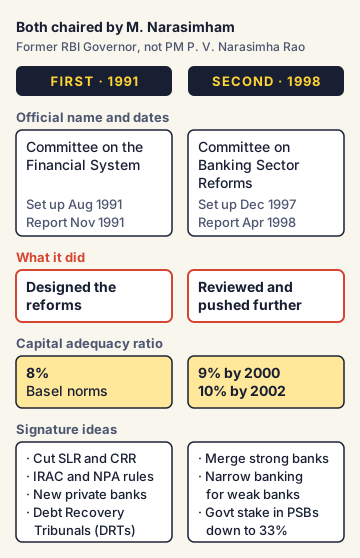
- First vs second Narasimham Committee: The first (1991) was the Committee on the Financial System: it designed the reforms. The second (1998) was the Committee on Banking Sector Reforms: it reviewed progress and pushed further, especially on capital (10%) and mergers.
- Narasimham Committee vs Narasimha Rao: M. Narasimham was a banker and former RBI Governor. P. V. Narasimha Rao was the Prime Minister in 1991. The names are similar but they are different people.
- CRR vs SLR: CRR money is kept as cash with the RBI and earns nothing. SLR money is kept by the bank itself in assets such as government bonds and does earn interest.
- DRT Act (1993) vs SARFAESI Act (2002): The DRT Act set up special tribunals to decide loan recovery cases faster. SARFAESI lets banks take over and sell the security without a court case.
Issues, criticism and the way forward
- Supporters say the reforms made Indian banks healthier, more competitive and better at measuring risk. The rise of strong private banks and digital banking grew from this base.
- Critics point out that stricter NPA rules alone did not stop big bad-loan cycles; India faced a large NPA crisis in the 2010s.
- Some economists argue that cutting directed lending could hurt farmers and small businesses, which is why the priority sector target was kept.
- The question of how much the government should own of public sector banks is still debated.
- Today's challenges are new: digital fraud, cyber risk, AI, climate risk, and the huge capital India's banks will need to fund growth up to 2047. Any new review must deal with these while keeping financial inclusion strong.
Concepts to Know
- Capital adequacy ratio (CAR): A bank's own money (capital) as a share of its risky loans and assets. A higher CAR means the bank can absorb losses without failing.
- Basel norms: Global banking rules set by the Basel Committee on Banking Supervision, which sits at the Bank for International Settlements in Basel, Switzerland. They set minimum capital standards for banks.
- Non-performing asset (NPA): A loan on which the borrower has stopped paying interest or principal for a set period, now 90 days for most loans.
- Provisioning: Money a bank sets aside from its profits to cover expected losses on bad loans.
- Balance of payments crisis: A situation where a country does not have enough foreign currency to pay for its imports and foreign debts. In 1991 India had foreign currency for only a few weeks of imports.
- Financial repression: Government rules that force banks to lend to the government or keep money idle at low returns, leaving less for the rest of the economy.
- Chair of both committees: M. Narasimham (former RBI Governor)
- First committee: Committee on the Financial System, set up August 1991, report November 1991
- Second committee: Committee on Banking Sector Reforms, set up December 1997, report April 1998
- 1991: SLR 38.5%, recommended cut to 25% (reached in 1997)
- CAR: 8% (first committee); 9% by 2000 and 10% by 2002 (second committee)
- Follow-ups: RBI private bank guidelines (January 1993), DRT Act 1993, SARFAESI Act 2002
● Tracked since October 30, 2026 · last seen October 30, 2026 · updates as the daily brief publishes