Mission Shakti
Scheme for Safety, Security and Empowerment of Women
Mission Shakti is the Government of India's umbrella scheme for the safety, security and empowerment of women. It is run by the Ministry of Women and Child Development (MWCD). It brings many older women's schemes under one roof, split into two parts: Sambal (for safety and security) and Samarthya (for empowerment). It came into force on 1 April 2022.
Why does it exist?
A woman facing violence often needs many kinds of help at once: police, a doctor, a lawyer, a counsellor and a safe place to stay. Earlier, each of these came from a separate scheme with separate rules, so women had to run from office to office. At the same time, empowerment schemes like hostels for working women, creches and maternity benefits were scattered.
Mission Shakti puts all of them together, so that money, staff and monitoring are better coordinated. It follows a "life-cycle" approach: supporting a woman from before her birth (through efforts against sex-selective abortion) to childhood, working life and motherhood.
Where did it come from?
Many of its parts are older:
- 2013: After the December 2012 Delhi gang-rape case, the government created the Nirbhaya Fund in the Union Budget 2013-14 with ₹1,000 crore. It is a non-lapsable fund for women's safety projects, which means unspent money does not go back at the end of the year.
- 22 January 2015: Beti Bachao Beti Padhao (BBBP) ("Save the daughter, educate the daughter") was launched at Panipat, Haryana, to fight the falling child sex ratio. It began in 100 districts and covered all districts from 8 March 2018.
- 1 April 2015: One Stop Centres (OSC), also called Sakhi centres, started with money from the Nirbhaya Fund.
- 2017: The Pradhan Mantri Matru Vandana Yojana (PMMVY), a maternity benefit scheme, was rolled out nationwide.
- 2021-22: These and other schemes (Ujjwala, Swadhar Greh, Working Women Hostels, National Creche Scheme) were merged into Mission Shakti for the 15th Finance Commission period (2021-22 to 2025-26), with guidelines in force from 1 April 2022.
Part 1: Sambal (safety and security)
It has four components:
- One Stop Centres (Sakhi): A single place where a woman facing violence (at home, at work or in public) gets police help, medical aid, legal aid, counselling and a temporary shelter, all under one roof. As of late 2024, 802 of 870 approved centres were working.
- Women Helpline (181): A free, 24-hour phone line for women in distress. It connects callers to the police, hospitals, ambulance services and One Stop Centres.
- Beti Bachao Beti Padhao (BBBP): A campaign to stop sex-selective abortion, protect girls and keep them in school. It is run jointly by three ministries: Women and Child Development, Health and Family Welfare, and Education.
- Nari Adalat (women's courts): Village-level forums of local women that settle small disputes like domestic quarrels and harassment through talks and mediation, outside formal courts. It started as a pilot in Assam and Jammu and Kashmir.
Part 2: Samarthya (empowerment)
It has these components:
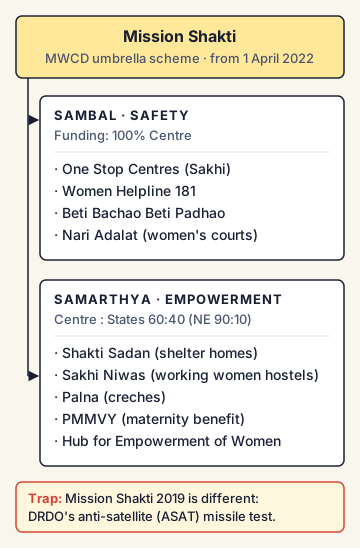
- Shakti Sadan: Shelter and rehabilitation homes for women in difficult situations, including victims of trafficking. It merges the older Ujjwala (anti-trafficking) and Swadhar Greh (homes for women in distress) schemes.
- Sakhi Niwas: Safe and affordable hostels for working women, with day care for their children. It replaces the Working Women Hostel scheme.
- Palna: Creches (day-care for young children of working mothers), now increasingly run as anganwadi-cum-creches. It replaces the National Creche Scheme.
- Pradhan Mantri Matru Vandana Yojana (PMMVY): Cash support to pregnant women and new mothers, sent directly to their bank account (DBT). It gives ₹5,000 for the first child (in instalments) and ₹6,000 for the second child if it is a girl. The second-child benefit was added under Mission Shakti, to encourage the birth of girls. Women in regular government jobs are not covered.
- Hub for Empowerment of Women (HEW): Support offices at the national, State and district levels that help women access schemes and run awareness work. It also covers gender budgeting and research.
Who pays for it?
The total approved cost for 2021-22 to 2025-26 was ₹20,989 crore: ₹15,761 crore from the Centre and ₹5,228 crore from the States. Sambal is fully paid by the Centre (from the Nirbhaya Fund or the MWCD budget). Samarthya is shared 60:40 between the Centre and States with a legislature, 90:10 for North Eastern and special category States, and 100% central for UTs without a legislature.
How does it work, step by step?
Picture a woman in a small town who faces violence at home:
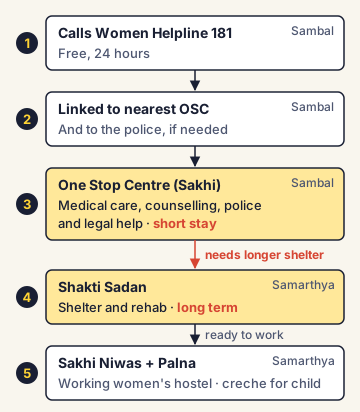
- She (or someone helping her) calls 181.
- The helpline connects her to the nearest One Stop Centre, and to the police if needed.
- At the OSC she gets medical care, counselling and help to file a police complaint or a legal case. She can stay there for a short time.
- If she needs longer shelter, she is moved to a Shakti Sadan.
- Once she is ready to work and live on her own, she can stay in a Sakhi Niwas hostel, and her child can attend a Palna creche.
India's legal backing for women's safety
Mission Shakti supports laws like:
- The Protection of Women from Domestic Violence Act, 2005
- The Sexual Harassment of Women at Workplace (Prevention, Prohibition and Redressal) Act, 2013 (POSH Act)
- The Dowry Prohibition Act, 1961
- The Prohibition of Child Marriage Act, 2006
- The criminal law provisions on crimes against women, now in the Bharatiya Nyaya Sanhita, 2023
Constitutional base
- Article 14: equality before law
- Article 15(3): allows special provisions for women and children
- Article 39(a) and (d): equal right to livelihood and equal pay for equal work
- Article 42: just and humane conditions of work and maternity relief
- Article 51A(e): the duty to renounce practices insulting to the dignity of women
Commonly confused concepts
- Mission Shakti (women) vs Mission Shakti (space): The women's scheme of MWCD (2022) has nothing to do with Mission Shakti of 2019, India's anti-satellite (ASAT) missile test by DRDO. UPSC can use the same name to trap you.
- Mission Shakti vs Mission Vatsalya vs Mission Poshan 2.0: These are the three umbrella missions of MWCD. Mission Shakti is for women's safety and empowerment. Mission Vatsalya is for child protection (children in need of care, child care institutions, adoption, Childline). Mission Poshan 2.0 is for nutrition (anganwadis).
- One Stop Centre vs Shakti Sadan: An OSC gives immediate, short-term help and temporary shelter. A Shakti Sadan gives longer-term shelter and rehabilitation.
- Sambal vs Samarthya: Sambal = safety (OSC, 181, BBBP, Nari Adalat). Samarthya = empowerment (Shakti Sadan, Sakhi Niwas, Palna, PMMVY, HEW).
- Nirbhaya Fund vs Mission Shakti: The Nirbhaya Fund is a pool of money that pays for women's safety projects of many ministries (like safe city projects and fast-track courts). Mission Shakti is a scheme of one ministry that draws part of its money from that fund.
Issues, criticism and the way forward
- Low use of funds: Audits and parliamentary committees have often pointed out that a large part of Nirbhaya Fund money and women's scheme budgets stays unspent.
- Spending skewed to publicity: A parliamentary committee in 2021 noted that a large share of BBBP money had gone to media campaigns rather than to health and education work on the ground.
- Uneven OSC quality: Some centres lack trained staff, 24-hour working or proper shelter, and many women do not know they exist.
- Prevention is weak: Most components respond after violence happens. Changing social attitudes, teaching boys and girls about respect and safety, and making public spaces safer need more effort.
- PMMVY coverage: Paperwork, Aadhaar seeding and bank account issues cause delays and exclusion. The benefit amount is also lower than the wage loss suggested under the NFSA's maternity benefit of at least ₹6,000.
- Way forward: Better convergence of police, health, legal and welfare departments; full use of funds; training for staff; stronger community-level awareness; and gender sensitisation from school age.
Concepts to Know
- Umbrella scheme: One big scheme that groups many smaller schemes under it, so they share funds, staff and monitoring.
- Child sex ratio: The number of girls for every 1,000 boys in the 0 to 6 age group. A low ratio signals sex-selective abortion and neglect of girls.
- Direct Benefit Transfer (DBT): Sending government money straight into the beneficiary's bank account, to cut delays and middlemen.
- Non-lapsable fund: A fund whose unspent money does not lapse (go back to the government) at the end of the financial year. It stays available for later use.
- Gender budgeting: Checking how much of the government budget goes to women and how spending affects men and women differently. India has published a Gender Budget Statement with the Union Budget since 2005-06.
- Mission Shakti in force from 1 April 2022; period 2021-22 to 2025-26; nodal ministry MWCD
- Two sub-schemes: Sambal (OSC, 181, BBBP, Nari Adalat) and Samarthya (Shakti Sadan, Sakhi Niwas, Palna, PMMVY, HEW)
- Total outlay: ₹20,989 crore (Centre ₹15,761 crore, States ₹5,228 crore)
- Sambal: 100% central; Samarthya: 60:40 (90:10 for NE and special category States)
- One Stop Centres from 1 April 2015 (Nirbhaya Fund); 802 operational (late 2024)
- BBBP launched 22 January 2015, Panipat; all districts from 8 March 2018
- PMMVY: ₹5,000 for the first child; ₹6,000 for the second child if a girl
- Nirbhaya Fund: Union Budget 2013-14, ₹1,000 crore, non-lapsable
- Nari Adalat piloted in Assam and Jammu and Kashmir
● Tracked since October 09, 2026 · last seen October 09, 2026 · updates as the daily brief publishes