Mission Amrit Sarovar
Reviving India's Village Ponds
Mission Amrit Sarovar is a national mission to build new ponds, or revive old ones, in villages across India. Its target was to create or restore at least 75 ponds (called "Amrit Sarovars") in every district, which adds up to about 50,000 ponds in the country. It was launched on 24 April 2022 as part of Azadi Ka Amrit Mahotsav, the celebration of 75 years of Independence.
That is why the number 75 is used. It has no separate budget. Instead, it uses money from existing schemes such as MGNREGS.
Why was it needed?
India has about 18% of the world's population but only about 4% of its fresh water. Most of our rain falls in just three to four months of the monsoon. If this water is not caught and stored, it runs off into rivers and the sea. For centuries, Indian villages solved this with ponds, tanks and step-wells.
Over time, many of these were filled with silt, encroached upon, or simply forgotten. Groundwater was pumped out faster than rain could refill it. Mission Amrit Sarovar tries to bring back this old village habit of storing water locally. Think of a pond like a village savings account for water: you deposit rain in the wet months and withdraw it in the dry months.
Where did it come from?
- The mission was announced on 24 April 2022, National Panchayati Raj Day, at Palli gram panchayat in Samba district, Jammu and Kashmir.
- The target of about 50,000 Amrit Sarovars was to be met by 15 August 2023. The government reported that the target was met ahead of time.
- The work continued after that. By early 2025, over 68,000 Amrit Sarovars had been completed. A Phase II now focuses on community-led upkeep of the ponds, climate resilience and better water availability.
How big is each Amrit Sarovar?
Each pond should have:
- a water-spread (pondage) area of at least 1 acre (about 0.4 hectare), and
- a capacity to hold about 10,000 cubic metres of water (1 crore litres).
For small states and hilly or north-eastern states, where flat public land is scarce, the rules were relaxed. The 1-acre minimum and the exact count of 75 per district were not strictly applied there.
How does it work, step by step?
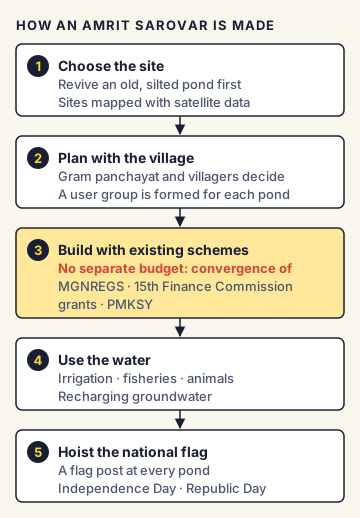
- Choosing sites: Districts identify sites. Reviving an old, silted pond is preferred where possible. Sites are mapped using satellite data.
- Planning with the village: The gram panchayat and local people help decide. A user group of villagers is formed for each pond, to look after it and use its water.
- Building: Work is done by joining (converging) money from existing schemes: MGNREGS (rural jobs scheme), 15th Finance Commission grants to panchayats, and Pradhan Mantri Krishi Sinchayee Yojana (PMKSY) sub-schemes such as Watershed Development and Har Khet Ko Pani. Soil dug out of the ponds has also been used for road and railway projects.
- Using the pond: The water is used for irrigation, fisheries, animal drinking water, duck rearing, water chestnut farming and recharging groundwater.
- A national symbol: Each Amrit Sarovar is to have a flag post. The national flag is hoisted there on Independence Day and Republic Day, often by a local freedom fighter's family member, a Padma awardee or a senior villager.
Who runs it?
The mission follows a "whole of government" approach. The Ministry of Rural Development leads it, with ministries such as Jal Shakti, Agriculture and Farmers Welfare, Panchayati Raj, Environment, Forest and Climate Change, and Drinking Water and Sanitation. BISAG-N (Bhaskaracharya National Institute for Space Applications and Geo-informatics) is the technical partner for satellite mapping and the online portal.
India's position and Indian examples
Amrit Sarovars sit beside other water-saving efforts:
- Jal Shakti Abhiyan: Catch the Rain asks people to "catch the rain, where it falls, when it falls".
- Atal Bhujal Yojana (2019) works on community groundwater management in water-stressed blocks of seven states.
- Traditional systems like the johads of Rajasthan, eris of Tamil Nadu, zings of Ladakh (small tanks that collect glacier melt), and kuhls of Himachal Pradesh show that local water storage is an old Indian idea.
- In Ladakh, the UT administration runs its own Project Amrit Sarovar (launched 2026), designed for the cold desert. It stores winter snowmelt and glacier melt in village ponds so that water is ready for spring sowing.
Commonly confused concepts
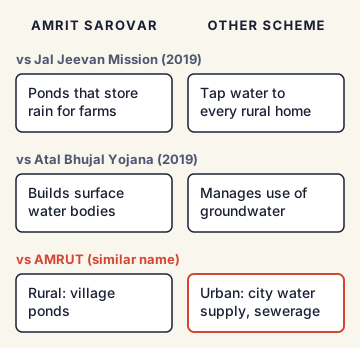
- Mission Amrit Sarovar vs Jal Jeevan Mission: Amrit Sarovar is about storing water in ponds (mainly for farming and recharge). Jal Jeevan Mission (2019) is about giving every rural home a tap connection for drinking water.
- Mission Amrit Sarovar vs Atal Bhujal Yojana: Atal Bhujal Yojana is about managing groundwater use with communities. Amrit Sarovar builds surface water bodies, which also help recharge groundwater.
- Amrit Sarovar vs AMRUT: AMRUT (Atal Mission for Rejuvenation and Urban Transformation) is an urban scheme for water supply and sewerage in cities. Amrit Sarovar is a rural pond mission.
Issues, criticism and the way forward
- Quality over numbers: Critics point out that some ponds were dug at unsuitable sites, without proper catchment, so they stay dry. Counting ponds is easier than checking whether they hold water.
- Upkeep: Ponds silt up again within a few years if not cleaned. Without active user groups and money for maintenance, many may decline.
- Hill and desert areas: In cold deserts like Ladakh, rainfall is very low and the ground freezes in winter, so pond design must suit local conditions.
- Way forward: Experts suggest geo-tagged before-and-after monitoring, water-level checks across seasons, strong user groups, and linking ponds to village water budgets.
Concepts to Know
- MGNREGS: The Mahatma Gandhi National Rural Employment Guarantee Scheme. It gives every rural household up to 100 days of paid manual work a year. Much of this work is water conservation, like digging ponds.
- Convergence: Using money and staff from several existing schemes together for one goal, instead of creating a new scheme with its own budget.
- Groundwater recharge: Water from ponds slowly seeps into the ground and fills underground water layers (aquifers), so wells and borewells nearby do not dry up.
- Catchment area: The land around a pond from which rainwater flows into it. A pond without a good catchment will not fill.
- Cubic metre: A box 1 metre long, 1 metre wide and 1 metre high. It holds 1,000 litres of water.
- Launched: 24 April 2022 (National Panchayati Raj Day), Samba district, Jammu and Kashmir
- Part of Azadi Ka Amrit Mahotsav; target: at least 75 Amrit Sarovars per district (about 50,000) by 15 August 2023
- Each pond: at least 1 acre area, about 10,000 cubic metre capacity (relaxed for small, hilly and north-eastern states)
- No separate budget; convergence of MGNREGS, 15th Finance Commission grants, PMKSY and others
- Lead ministry: Ministry of Rural Development; technical partner: BISAG-N
- Over 68,000 Amrit Sarovars completed by early 2025; Phase II focuses on community participation and climate resilience
● Tracked since November 15, 2026 · last seen November 15, 2026 · updates as the daily brief publishes