Minimum Import Price (MIP)
A Price Floor for Imports
A Minimum Import Price, or MIP, is a floor price set by the government for an imported product. If a shipment's declared price is below this floor, it cannot come into the country (or cannot get a tax benefit). Think of it like a shopkeeper who says, "I will not stock any product that is sold to me below ₹50." The aim is to stop very cheap imports from crashing the prices that local farmers and factories get.
Why does it exist?
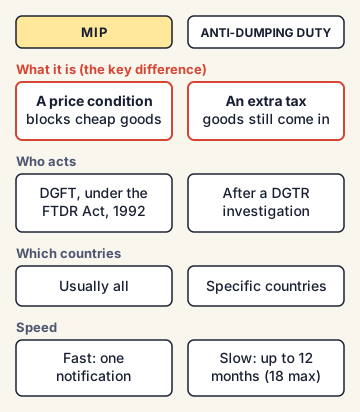
Sometimes foreign goods arrive at prices so low that domestic producers cannot compete. The cause may be dumping (selling abroad below the home price), a global glut, or under-invoicing, where importers show a fake low price on papers to pay less duty. Fighting each case through an anti-dumping investigation is slow: India's anti-dumping rules allow up to 12 months (extendable to 18 months) for a final finding. An MIP works fast. One notification can stop all low-priced shipments from the next day.
Where does the power come from?
In India, MIPs are set by the Directorate General of Foreign Trade (DGFT) under the Foreign Trade (Development and Regulation) Act, 1992. This law lets the central government prohibit or restrict imports and exports. DGFT does this by changing the "import policy condition" of a product in ITC(HS) Schedule I, India's official list of import items. For example, it may say apples are "free" to import only if the price is above a set figure, and "prohibited" below it.
How does it work?
The floor is usually checked on the CIF value, which means Cost + Insurance + Freight: the price of the goods plus the cost of insuring and shipping them to the Indian port. Customs officers compare the CIF value on the import papers with the MIP:
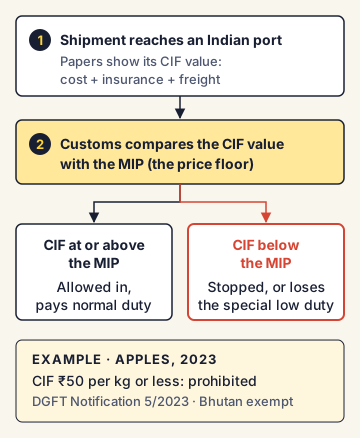
- CIF value at or above the MIP: the shipment is allowed (and pays normal duty).
- CIF value below the MIP: the shipment is stopped, or it loses the special low duty.
India's examples
- Steel (2016): On 5 February 2016, DGFT put an MIP on 173 iron and steel products, ranging from US$341 to US$752 per tonne, for six months. It was a response to a flood of cheap steel, mainly from China.
- Apples (2023): DGFT Notification No. 5/2023 (8 May 2023) prohibited apple imports with a CIF price of ₹50 per kg or less. Imports from Bhutan were exempt. The goal was to stop cheap and under-invoiced apples hurting Indian growers.
- Areca nut: The MIP was raised from ₹251 to ₹351 per kg in February 2023 to protect growers in Karnataka and Kerala. Imports by Export Oriented Units, SEZ units and under Advance Authorisation (where goods are re-exported) are kept outside this floor.
- Inside FTAs: An MIP can also be built into a trade deal. In the India-New Zealand FTA, apples get the low 25% quota duty only if the CIF price is at least US$1.25 per kg; kiwifruit gets zero duty only above US$1.80 per kg. DGFT authorisations even record the "CIF/MIP slab" for each shipment.
Commonly confused concepts
- MIP vs Minimum Support Price (MSP): MSP is the price the government promises to pay Indian farmers for their crops. MIP is a floor on the price of foreign goods entering India. Both protect farm incomes, but from different sides.
- MIP vs anti-dumping duty: Anti-dumping duty is an extra tax on goods from specific countries, imposed after an investigation by the Directorate General of Trade Remedies (DGTR). MIP is a price condition that blocks low-priced goods, usually from all countries, without a long investigation.
- MIP vs tariff value: Under Section 14(2) of the Customs Act, 1962, the Central Board of Indirect Taxes and Customs (CBIC) fixes "tariff values" for items like edible oils, gold and silver. Duty is then charged on this fixed value, not on the invoice price. A tariff value changes how much duty is paid; an MIP decides whether the goods can come in at all.
- MIP vs tariff-rate quota: A TRQ limits the quantity that enters at low duty. An MIP limits the price at which goods may enter. The India-New Zealand FTA uses both together.
Issues, criticism and the way forward
- WTO concerns: The WTO Agreement on Agriculture (Article 4.2 and its footnote) lists "minimum import prices" among the border measures countries were supposed to convert into ordinary tariffs. Trade partners may argue that unilateral MIPs on farm goods go against this. In a 2015 case about Peru's price band system, the WTO Appellate Body held Peru's measure to be inconsistent with Article 4.2.
- Costlier inputs: Users of the product pay more. The 2016 steel MIP was criticised by small engineering firms that buy steel as raw material, and steel importers challenged it in the Delhi High Court.
- Consumers: A floor on fruit imports can keep prices higher for buyers.
- Supporters' view: MIPs give quick relief to millions of small growers, check under-invoicing and help customs collect the right duty.
- Way forward: Experts suggest using MIPs for short periods, with clear review dates, while the long-term fix is raising domestic productivity (for example, better apple orchards and cold storage), which is exactly what the India-New Zealand agricultural productivity partnership aims at.
Concepts to Know
- CIF (Cost, Insurance and Freight): The full landed price of imported goods at the Indian port: the price of the goods plus insurance and shipping charges. Customs uses it as the base to calculate duty.
- Dumping: Selling goods in a foreign market at a price lower than in the home market, often to capture that market.
- Under-invoicing: Showing a lower price on import papers than the real price, so less customs duty is paid. The difference is often paid secretly.
- ITC(HS): Indian Trade Classification based on the Harmonised System, the coded list of all goods used by DGFT to say whether each item is free, restricted or prohibited for import or export.
- Advance Authorisation: A DGFT scheme that lets exporters import inputs duty-free if they use them to make goods for export.
- Legal basis in India: Foreign Trade (Development and Regulation) Act, 1992; set by DGFT via import policy conditions in ITC(HS) Schedule I
- Checked on CIF value
- Steel MIP: 5 February 2016, 173 HS codes, US$341 to US$752 per tonne, six months
- Apple MIP: Notification 5/2023, 8 May 2023, imports at CIF ≤ ₹50/kg prohibited; Bhutan exempt
- Areca nut MIP: raised from ₹251/kg to ₹351/kg in February 2023
- India-New Zealand FTA price floors: apples ≥ US$1.25/kg (CIF), kiwifruit ≥ US$1.80/kg, Manuka honey band US$20 to below US$30/kg
- WTO Agreement on Agriculture, Article 4.2 footnote 1, lists minimum import prices among measures to be converted into ordinary customs duties
● Tracked since October 19, 2026 · last seen October 19, 2026 · updates as the daily brief publishes