M.C. Mehta v. Union of India
The Delhi Air Pollution Case
M.C. Mehta v. Union of India (Writ Petition (Civil) No. 13029 of 1985) was a public interest case about air pollution in Delhi that ran in the Supreme Court for about 40 years. It was filed by the environmental lawyer M.C. Mehta in 1985. Through hundreds of orders in this one case, the Supreme Court shaped almost every major step Delhi has taken against air pollution: CNG buses, cleaner fuel, bans on old vehicles, a charge on trucks entering Delhi and an emergency action plan.
In March 2026, the court closed this old case and replaced it with a fresh suo motu case on NCR air pollution.
Why did the court get involved?
Air pollution harms everyone's health, but no single person can easily go to court over it. In the 1980s and 1990s, Delhi's air was getting worse because of more vehicles, dirty fuel, industries and dust. Government departments were slow to act, and many bodies shared responsibility, so no one was fully in charge. The Supreme Court stepped in because it treats clean air as part of the right to life under Article 21 of the Constitution. When the government does not protect this right, the court can order it to act.
How could one lawyer bring such a case?
The case was a Public Interest Litigation (PIL). In a normal case, only the person who is harmed can go to court. In a PIL, any public-spirited person can approach the court for the good of the public, especially for people who cannot go to court themselves. M.C. Mehta filed the case directly in the Supreme Court under Article 32, which lets anyone go straight to the Supreme Court when a Fundamental Right is violated.
How did the case work?
The court did not give one final judgment and close the file. Instead, it kept the case open for years and kept passing new orders as problems changed. This method is called continuing mandamus. It works like a teacher who does not just give homework once, but checks it every week and gives new instructions.
People and agencies filed interlocutory applications (IAs) (requests for orders in an ongoing case) on new issues, such as firecrackers, trucks or construction dust. The court took help from expert committees and from an amicus curiae (a senior lawyer who helps the court).
The key milestones of the case
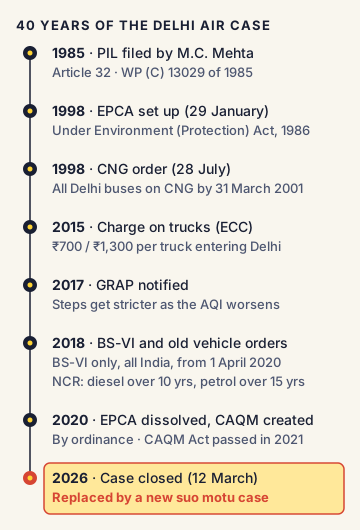
- 1998, EPCA set up: On the court's direction, the Union government created the Environment Pollution (Prevention and Control) Authority (EPCA) by a notification dated 29 January 1998 under Section 3 of the Environment (Protection) Act, 1986. It was chaired by former IAS officer Bhure Lal and advised the court for over 20 years.
- 1998, CNG order: On 28 July 1998, the court ordered that Delhi's entire city bus fleet must switch to Compressed Natural Gas (CNG) by 31 March 2001. In March 2001, it refused a general extension of this deadline. The rule was later extended to other commercial vehicles such as autos and taxis. Delhi's public transport became largely CNG-based.
- 2015, Environment Compensation Charge (ECC): On 9 October 2015, the court ordered a charge on trucks entering Delhi: ₹700 for light commercial vehicles and two-axle trucks, and ₹1,300 for three-axle trucks and above. The idea was to stop trucks not bound for Delhi from cutting through the city to save on tolls. In March 2026, the court approved revised, higher rates with a 5% increase every year.
- 2016-17, GRAP: The Graded Response Action Plan (GRAP), a list of emergency steps that get stricter as the AQI worsens, came out of this case and was notified in 2017. EPCA enforced it first; the CAQM enforces it now.
- 2018, BS-VI order: On 24 October 2018, the court ruled that from 1 April 2020, only BS-VI (Bharat Stage VI) vehicles could be sold and registered anywhere in India. This made India jump straight from BS-IV to BS-VI.
- 2018, old vehicle ban: On 29 October 2018, the court upheld a National Green Tribunal (NGT) direction that diesel vehicles older than 10 years and petrol vehicles older than 15 years must not ply in the NCR. In August 2025, the court said no coercive action would be taken against such owners for the time being. In December 2025, it modified this to allow action against such old vehicles that meet only BS-III or lower standards.
- 2020-21, EPCA replaced by CAQM: An ordinance of 28 October 2020 dissolved EPCA and created the Commission for Air Quality Management (CAQM). That ordinance lapsed in March 2021, and the CAQM was set up again under a law passed by Parliament in August 2021.
- 2026, the case is closed: On 12 March 2026, a bench led by Chief Justice Surya Kant disposed of the 1985 case and said no further IAs would be taken in it. The court registered a new suo motu case titled "Re: Issues of air pollution in NCR". Pending IAs were to be registered as separate writ petitions, so that each issue (vehicles, waste and so on) can be handled faster.
Who is M.C. Mehta?
Mahesh Chandra Mehta is a public interest lawyer who filed many of India's landmark environmental cases. He received the Goldman Environmental Prize (1996), the Ramon Magsaysay Award (1997) and the Padma Shri (2016). Because so many of his cases carry the same title, students must learn to tell them apart (see below).
Why does this case matter for India?
It shows how India's courts have filled gaps left by slow executive action on the environment. Several national changes, such as the early move to BS-VI fuel and vehicles, started from orders in this Delhi case. It also created institutions (EPCA, and through it GRAP) that later became part of the law. At the same time, it raised debates about how far courts should go in running policy.
Commonly confused concepts
- The many "M.C. Mehta v. Union of India" cases: The same title is used for different cases. The Oleum gas leak case (1986-87) gave the principle of absolute liability for hazardous industries. The Ganga pollution case dealt with tanneries and towns polluting the Ganga. The Taj Trapezium case (1996) moved polluting industries away from the Taj Mahal. The Delhi air pollution case (WP 13029 of 1985) is the one about vehicles, fuel and Delhi's air.
- PIL vs suo motu case: A PIL is filed by a person or group for the public good. A suo motu case is started by the court on its own, without anyone filing it. The Delhi air case moved from a PIL (1985) to a suo motu case (2026).
- EPCA vs CAQM: EPCA (1998-2020) was created by a government notification under the Environment (Protection) Act on the Supreme Court's direction, and covered only the NCR. CAQM (from 2020-21) is created by its own Act of Parliament, has more powers and covers the NCR plus adjoining areas of Haryana, Punjab, Rajasthan and Uttar Pradesh.
- Supreme Court vs NGT: The National Green Tribunal (set up under the NGT Act, 2010) is a special court for environmental cases. The Supreme Court is the highest court and can hear appeals from the NGT. The 10-year/15-year vehicle rule started at the NGT and was upheld by the Supreme Court.
Issues, criticism and the way forward
- Judicial overreach debate: Critics say courts are running policy, a job meant for elected governments and expert bodies. Supporters reply that the court acted only because the executive failed to protect the right to life.
- Too long and too wide: One case running for 40 years with dozens of pending applications became slow and hard to manage. This was a key reason for closing it in 2026 and splitting issues into separate cases.
- Orders vs enforcement: Many orders are not fully followed on the ground. The court itself has observed that the more orders it passes, the more violations seem to multiply.
- Air does not stop at borders: Delhi's pollution comes partly from neighbouring states (vehicles, stubble burning, industry). Experts suggest an airshed approach: managing the whole region's air together, which is the reason the CAQM covers several states.
- Way forward suggested by experts: stronger public transport, faster shift to electric vehicles, strict PUC checks, scrapping or moving out very old vehicles, managing traffic jams at Delhi's entry points, and steady year-round action instead of emergency steps only in winter.
Concepts to Know
- Writ petition: A formal request to a High Court or the Supreme Court to issue an order (a "writ") to protect a right.
- Mandamus: A writ that orders a government official or body to do its legal duty. "Continuing mandamus" means the court keeps the case open and keeps checking that its orders are followed.
- Interlocutory application (IA): A request made in the middle of an ongoing case, asking the court for an order on a particular issue.
- Amicus curiae: Latin for "friend of the court". A senior lawyer appointed to help the court understand a case fairly.
- CNG (Compressed Natural Gas): Natural gas stored under high pressure and used as vehicle fuel. It burns much more cleanly than diesel and gives off far less soot.
- Bharat Stage (BS) norms: India's rules on how much pollution a new vehicle may release from its exhaust. BS-VI is the strictest stage now in force.
- Absolute liability: A rule that a company doing hazardous work must pay for any harm it causes, with no excuses allowed.
- Case: M.C. Mehta v. Union of India, Writ Petition (Civil) No. 13029 of 1985, filed under Article 32
- EPCA: notified 29 January 1998 under Section 3, Environment (Protection) Act, 1986; chaired by Bhure Lal; dissolved by ordinance of 28 October 2020
- CNG order: 28 July 1998; Delhi city bus fleet to run on CNG by 31 March 2001
- Environment Compensation Charge: 9 October 2015 (₹700 / ₹1,300 on trucks entering Delhi); revised in March 2026 with 5% annual increase
- GRAP: arose from this case; notified in 2017
- BS-VI nationwide sale and registration from 1 April 2020 (order of 24 October 2018)
- NCR old-vehicle rule: diesel over 10 years, petrol over 15 years (order of 29 October 2018)
- Case closed: 12 March 2026; new suo motu case "Re: Issues of air pollution in NCR"
- M.C. Mehta: Goldman Environmental Prize 1996, Ramon Magsaysay Award 1997, Padma Shri 2016
● Tracked since November 10, 2026 · last seen November 10, 2026 · updates as the daily brief publishes