Market Failure and Externalities
A market is any place or system where buyers and sellers meet and agree on a price. Usually, markets do a good job: prices tell people what is scarce and what is plentiful. Market failure is when a free market, left alone, produces the wrong amount of something, too much of a harmful thing or too little of a useful thing.
The most common cause is an externality: a cost or benefit that falls on people who are not part of the deal, and that nobody pays for.
Why does this idea matter?
Many of India's toughest problems are market failures. Smoke from a burning field, a factory dumping waste into a river, and overuse of groundwater all hurt people who never agreed to it. Because the person causing the harm does not pay for it, he has no money reason to stop. Understanding market failure tells the government why it must step in, and which tool will work best.
A simple way to picture it
Imagine a tea stall that burns old tyres to keep its stove going, because tyres are cheaper than gas. The tea seller saves money. The customers get cheap tea. But the whole street breathes black smoke and people fall sick. The neighbours pay a price (doctor's bills, dirty clothes) that never shows up in the price of a cup of tea.
That hidden cost is a negative externality. Since the tea is "too cheap" compared with its true cost to society, the market produces too much of it.
Where did the idea come from?
- The British economist Arthur Cecil Pigou set out the idea of external costs in his book The Economics of Welfare (1920). He suggested a tax equal to the harm caused. Such a tax is still called a Pigouvian tax.
- Paul Samuelson explained public goods in a 1954 paper, "The Pure Theory of Public Expenditure". He showed why markets supply too little of things everyone can use at once.
- Ronald Coase, in "The Problem of Social Cost" (1960), argued that if property rights are clear and bargaining is cheap, the people involved can negotiate their own solution. This is called the Coase theorem. Coase won the Nobel Prize in Economics in 1991.
- Garrett Hardin wrote "The Tragedy of the Commons" in the journal Science in 1968. He described how a shared resource with no rules gets overused.
- Elinor Ostrom won the Nobel Prize in Economics in 2009. She showed that local communities can often manage shared resources well through their own rules, without full privatisation or full state control.
- George Akerlof, Michael Spence and Joseph Stiglitz won the 2001 Nobel Prize in Economics for their work on markets where one side knows much more than the other (asymmetric information).
What are the main types of market failure?
- Negative externality: A harmful side effect on others. Examples: air pollution from stubble burning, factory smoke, traffic jams, loud noise.
- Positive externality: A good side effect that the doer is not paid for. Examples: vaccination (it also protects your neighbours), education, planting trees. Markets produce too little of these, because the doer gets only part of the benefit.
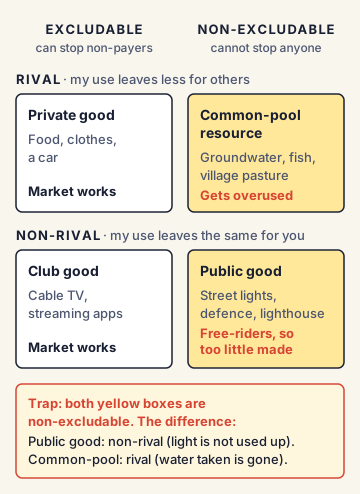
- Public goods: Things that are non-rival (my use does not reduce yours) and non-excludable (you cannot easily stop anyone from using them). Examples: street lights, national defence, a lighthouse. Private sellers cannot charge for them, so people "free-ride" (use without paying), and the market supplies too little.
- Common-pool resources: Things that are non-excludable but rival (one person's use leaves less for others). Examples: groundwater, fish in the sea, a village pasture. Without rules, they get overused. This is Hardin's "tragedy of the commons".
- Asymmetric information: When one side of a deal knows much more than the other. In Akerlof's "market for lemons", buyers cannot tell good used cars from bad ones, so they offer a low price, and good sellers leave the market. Insurance and loans face similar problems.
- Market power: When one seller (a monopoly) or a few sellers control a market, they can charge high prices and supply less. Middlemen who are the only source of credit and the only buyer for a farmer's crop have this kind of power.
- Missing markets: Sometimes a market for something useful simply does not exist, or is too weak. If no one will buy paddy straw at a fair price, the straw has no value to the farmer, and burning it costs him nothing.
How can a government fix market failure?
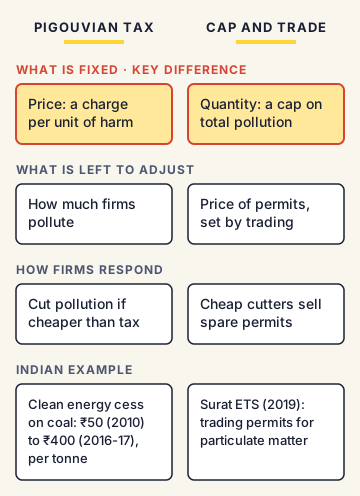
- Taxes on harm (Pigouvian taxes): Make the polluter pay a charge equal to the damage, so the true cost shows up in his decisions. Example: India's clean energy cess on coal, started at ₹50 per tonne under the Finance Act, 2010, raised to ₹400 per tonne in 2016-17, and replaced by the GST Compensation Cess from 1 July 2017.
- Subsidies for good side effects: Pay people to do more of something that helps others. Example: subsidies on crop residue machines so farmers manage straw without fire.
- Rules and bans ("command and control"): Set limits and punish those who break them. Example: emission standards for vehicles and factories, fines for stubble burning.
- Tradable permits ("cap and trade"): Set a total limit (cap) on pollution, give firms permits, and let them buy and sell permits. Firms that can cut pollution cheaply do so and sell their extra permits. Example: Gujarat's Surat Emissions Trading Scheme (June 2019), described as the world's first market for trading particulate matter emissions; a study published in 2025 found it cut emissions by 20 to 30%. India also notified a national Carbon Credit Trading Scheme in 2023 under the Energy Conservation Act, 2001 (as amended in 2022).
- Creating new markets: Build buyers for something that had no value. Example: biomass power plants, ethanol plants and pellet units that buy paddy straw.
- Clear property rights and bargaining (the Coase route): Work best when only a few parties are involved and talks are cheap.
- Public provision: The state itself supplies public goods like roads, defence and street lights, paid for by taxes.
- Information rules: Make sellers disclose facts. Examples: food labels, star ratings on appliances, mandatory disclosures by listed companies.
India's position and Indian examples
Indian law uses market-failure thinking often. The Supreme Court accepted the polluter pays principle in Indian Council for Enviro-Legal Action v. Union of India (1996) and Vellore Citizens Welfare Forum v. Union of India (1996). In the Vellore case, the Court said the precautionary principle and the polluter pays principle are part of the environmental law of the country.
Other Indian cases of market failure include groundwater overuse in Punjab (helped by free farm power), the dependence of small farmers on moneylenders and traders for credit, and the shortage of private investment in public goods like rural roads.
Commonly confused concepts
- Market failure vs government failure: Market failure is when markets left alone give a bad result. Government failure is when a government step meant to help ends up causing harm or waste. For example, a support price that rewards only rice and wheat can push farmers into one crop pattern, which then creates huge amounts of straw. Many problems involve both.
- Public good vs common-pool resource: Both are hard to exclude people from. But a public good is non-rival (a street light is not "used up"), while a common-pool resource is rival (water taken from an aquifer is gone for others).
- Negative vs positive externality: Negative means harm to others, so the market makes too much. Positive means benefit to others, so the market makes too little.
- Pigouvian tax vs cap and trade: A tax fixes the price of pollution and lets the quantity adjust. Cap and trade fixes the quantity of pollution and lets the price adjust.
- Externality vs ordinary cost: A cost is an externality only if it falls on someone outside the deal who has not agreed to it. A high price that a buyer pays willingly is not an externality.
Issues, criticism and the way forward
- Hard to measure harm: It is difficult to put a rupee value on health damage, lost lives or a polluted river. A tax set too low does little; a tax set too high can hurt jobs.
- Who pays? A polluter may be a poor farmer, not a rich factory. Heavy fines on small farmers can feel unfair and are hard to collect. This is why many experts prefer support and incentives over penalties alone.
- Enforcement: Rules work only if they can be checked. Satellites can spot fires, but proving who lit them and collecting fines is slow.
- Cess money used elsewhere: Money raised from green taxes is not always spent on green goals. The coal cess, for instance, moved to compensating states for GST losses.
- Way forward: Experts suggest a mix: price signals (taxes or rewards), new markets for waste, clear rules, good monitoring, and support for those who cannot afford to change. The goal is to make the right choice also the cheapest choice.
Concepts to Know
- Free market: A system where prices are set by buyers and sellers, with little government control.
- Free-rider: A person who enjoys a benefit without paying for it, because nobody can stop him.
- Property rights: Legal rights over who owns, uses and controls something, such as land, water or the right to pollute.
- Cess: A tax collected for a specific purpose. It is added on top of other taxes.
- Particulate matter (PM): Tiny particles of dust, smoke and soot in the air. PM2.5 means particles smaller than 2.5 micrometres, small enough to enter deep into the lungs.
- Adverse selection: When hidden information means the "bad" types (bad cars, risky borrowers) crowd out the "good" types in a market.
- Pigou: The Economics of Welfare (1920), source of the Pigouvian tax
- Samuelson: public goods paper, 1954 (non-rival, non-excludable)
- Coase: "The Problem of Social Cost" (1960); Nobel 1991
- Hardin: "The Tragedy of the Commons", Science, 1968
- Ostrom: Nobel 2009, community management of commons
- Akerlof, Spence, Stiglitz: Nobel 2001, asymmetric information
- Clean energy cess on coal: ₹50 per tonne (2010) → ₹400 per tonne (2016-17) → replaced by GST Compensation Cess (1 July 2017)
- Surat Emissions Trading Scheme: June 2019, particulate matter cap and trade
- Polluter pays principle: Indian Council for Enviro-Legal Action (1996), Vellore Citizens Welfare Forum (1996)
● Tracked since November 09, 2026 · last seen November 09, 2026 · updates as the daily brief publishes