Stubble Burning
Causes, Consequences and Policy Response
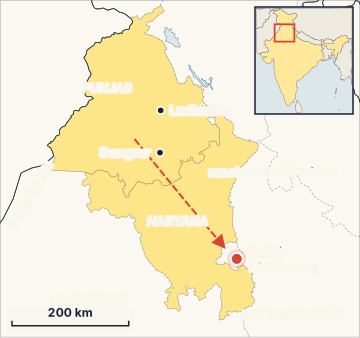
Stubble burning means setting fire to the crop residue (the stalks and stubble left in the field after harvest) to clear the land quickly for the next crop. In India it is linked mostly to paddy straw in Punjab, Haryana and western Uttar Pradesh between early October and late November. The fires release smoke full of fine particles and gases. In winter this smoke adds to the thick smog over Delhi and the Indo-Gangetic plains.
Why do farmers burn the stubble?
Farmers do not burn because they like it. They burn because it is the cheapest and fastest option. After paddy is cut, wheat must be sown by around mid-November for a good yield. That leaves only about 10 to 15 days. Clearing the straw by hand or machine costs money and time. A matchstick costs almost nothing. So for a farmer racing the calendar, fire looks like the only practical choice.
Where did the problem come from?
Burning in Punjab began in the late 1970s and early 1980s, with the spread of combine harvesters (big machines that cut and thresh the crop in one go). They leave a tall stubble that is hard to remove. Over time, three more things made it worse:
- The 2009 groundwater laws: Punjab and Haryana passed laws in 2009 that stop farmers from transplanting paddy before mid-June, to save groundwater. This pushed the harvest into late October and November, so the burning now coincides with cold, still winter air that traps smoke.
- Long-duration varieties: high-yield varieties like PUSA-44 take about 150 to 160 days, which squeezes the window even more.
- Rice-wheat lock-in: assured Minimum Support Price (MSP) procurement and free power make the paddy-wheat cycle the safest income, so farmers do not shift to other crops.
What harm does it cause?
- Air pollution: the smoke carries PM2.5 (very fine particles that go deep into the lungs), carbon monoxide, volatile organic compounds and cancer-causing substances. Its share in Delhi's PM2.5 changes from day to day; on peak days, official forecasting systems have estimated it at around 40% or more, while it is small outside the burning season.
- Soil damage: fire burns away nitrogen, phosphorus, potash, sulphur and other nutrients, and kills useful soil microbes. The heat dries the soil and reduces organic matter, so farmers need more fertiliser for the next crop.
- Health and climate: it adds to breathing diseases and releases greenhouse gases like carbon dioxide and methane.
What does the law say?
- Air (Prevention and Control of Pollution) Act, 1981: States have banned burning by notification in declared air pollution control areas.
- National Green Tribunal (NGT): on 10 December 2015, it banned crop residue burning in Rajasthan, Uttar Pradesh, Haryana and Punjab. In 2018, it said farmers who burn stubble could be kept out of MSP benefits, a view the Supreme Court upheld in 2023.
- Commission for Air Quality Management (CAQM): set up by an ordinance in 2020 and the CAQM in NCR and Adjoining Areas Act, 2021, it replaced the earlier EPCA (Environment Pollution (Prevention and Control) Authority). Farmers are not jailed under this Act; under Section 15 they pay environmental compensation instead.
- Fine rates (from 6 November 2024, doubled): ₹5,000 per incident for land below 2 acres, ₹10,000 for 2 to 5 acres, and ₹30,000 for more than 5 acres.
How can stubble be handled without fire?
Solutions fall into two groups.
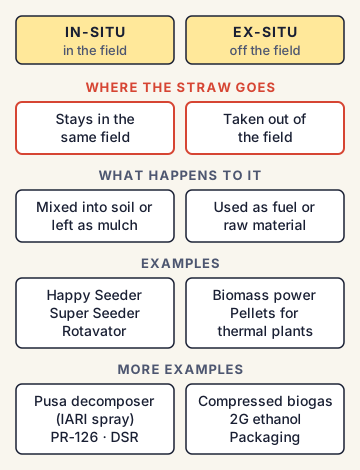
- In-situ (in the field): machines that sow wheat straight into the stubble or mix it into the soil, like the Happy Seeder, Super Seeder and rotavator; the Pusa decomposer, a microbial spray from the Indian Agricultural Research Institute (IARI) that helps straw rot; short-duration rice varieties such as PR-126; and direct seeding of rice (DSR), where seeds are sown straight into the field without a nursery.
- Ex-situ (off the field): collecting straw and using it for biomass power, compressed biogas (CBG), 2G (second-generation) ethanol, pellets for thermal power plants, or packaging.
What has the government done?
- National Policy for Management of Crop Residues, 2014 (Ministry of Agriculture and Farmers Welfare): promotes machines and in-field use of residue.
- Crop Residue Management (CRM) scheme, 2018: a central scheme for Punjab, Haryana, Uttar Pradesh and Delhi. It gives 50% subsidy to individual farmers and 80% to cooperatives, farmer groups and Custom Hiring Centres (centres that rent out machines) to buy CRM machines.
- State incentives: Haryana pays per-acre amounts for using machines, for DSR and for crop diversification, and rewards panchayats with fewer fires.
- Field monitoring: flying squads of the Central Pollution Control Board (CPCB) and thousands of field officials during the season.
How are fires counted?
India counts fires using the CREAMS protocol (Consortium for Research on Agroecosystem Monitoring and Modeling from Space) at IARI, New Delhi. It uses NASA's MODIS and VIIRS sensors on polar-orbiting satellites. These satellites circle the Earth over the poles and pass over India only at fixed times, around late morning and early afternoon. They see only active fires at that moment.
A fire lit in the evening can be missed. Geostationary satellites, which stay above one point of the Earth, watch all day but with coarser detail. Combining both, and measuring burnt area instead of only counting fires, gives a truer picture.
Commonly confused concepts
- In-situ vs ex-situ management: in-situ keeps the straw in the same field (mixing or mulching); ex-situ takes it out for other uses like power or biogas.
- Fire count vs burnt area: fire count is the number of hot spots a satellite sees at one moment; burnt area is the total land actually burnt, which is a better measure.
- Polar vs geostationary satellites: polar satellites give sharp images but visit a place only once or twice a day; geostationary satellites watch one region all the time but with less detail.
- Stubble burning vs forest fire: stubble burning is deliberate burning of farm waste; forest fires burn natural vegetation and are mostly accidental or for clearing land.
Issues, criticism and the way forward
- Costly machines: Happy Seeders and Super Seeders need a 60-horsepower tractor that sits idle most of the year. Hiring one can cost about ₹10,000 with long waits, and ex-situ handling costs about ₹1,500 to ₹2,500 per acre.
- Penalties alone may fail: fines can lead to collusion and "showing" fewer fires, or shifting burning to hours satellites miss.
- Wrong incentives: MSP procurement and free power keep farmers on paddy and wheat, which drains groundwater and creates the residue in the first place.
- Way forward: short-term in-situ and ex-situ support, a guaranteed price for straw, wider use of short-duration varieties, crop diversification away from paddy with real price support for other crops, and better measurement using both polar and geostationary data.
Concepts to Know
- Crop residue: the parts of a plant left after the useful grain is harvested, such as stalks, leaves and stubble.
- PM2.5: particles smaller than 2.5 micrometres (about 30 times thinner than a human hair). They enter deep into the lungs and blood.
- Combine harvester: a machine that cuts, threshes and cleans grain in one go, but leaves tall stubble behind.
- Minimum Support Price (MSP): a price fixed by the Centre at which the government promises to buy certain crops from farmers.
- Environmental compensation: money a polluter must pay for the harm caused, based on the "polluter pays" principle.
- Indo-Gangetic plains: the flat plains of north India along the Indus, Ganga and their rivers, where cold winter air easily traps smoke and dust.
- Season: early October to late November; mainly paddy straw in Punjab and Haryana (about 29 million tonnes of straw)
- Burning began: late 1970s to early 1980s, with combine harvesters
- NGT ban on crop residue burning in Punjab, Haryana, Uttar Pradesh and Rajasthan: 10 December 2015
- CAQM: ordinance 2020; CAQM Act, 2021; Section 15 environmental compensation
- Compensation since 6 November 2024: ₹5,000 (below 2 acres), ₹10,000 (2 to 5 acres), ₹30,000 (above 5 acres) per incident
- National Policy for Management of Crop Residues: 2014; CRM scheme: 2018 (50% subsidy individuals, 80% CHCs/cooperatives)
- Fire monitoring: CREAMS (IARI) using MODIS and VIIRS polar satellites
● Tracked since May 31, 2026 · last seen October 09, 2026 · updates as the daily brief publishes