Maritime Anti-Piracy Act, 2022
The Maritime Anti-Piracy Act, 2022 is India's first law made only to deal with piracy at sea. It defines what piracy is, sets strict punishments for it, and gives Indian courts the power to try pirates even when the crime happened far from India's coast, against a foreign ship, by foreign nationals. It brings into Indian law the anti-piracy rules of the United Nations Convention on the Law of the Sea (UNCLOS), which India ratified in 1995.
Why did India need this law?
Before this Act, India had no special law on piracy. Pirates caught by the Navy had to be tried under general laws like the Indian Penal Code. Those laws were written mainly for crimes inside India or by Indians. So it was legally unclear whether an Indian court could punish, say, a Somali pirate who attacked an Iranian boat on the open sea.
This created a real problem: the Navy could catch pirates, but the legal case against them could fall apart. A country that catches criminals but cannot try them ends up releasing them, and that encourages more piracy.
Why does piracy matter to India?
Most of India's trade, by volume, moves by sea. Indian ships, Indian sailors and India's oil imports all pass through the Arabian Sea and the Gulf of Aden. India is also one of the world's largest suppliers of seafarers, so pirate attacks often put Indian lives at risk even when the ship is foreign.
Where did it come from?
The law took about three years to pass:
- 9 December 2019: The government introduced the Anti-Maritime Piracy Bill, 2019 in the Lok Sabha. It was sent to the Standing Committee on External Affairs for detailed study.
- 11 February 2021: The Committee presented its report with 18 recommendations. The government later said it had included 14 of them.
- 19 December 2022: The Lok Sabha passed the Bill, now renamed the Maritime Anti-Piracy Bill, 2022.
- 21 December 2022: The Rajya Sabha passed it by voice vote.
- 31 January 2023: The President gave assent. It became Act No. 3 of 2023.
- 22 February 2023: The Act came into force through a government notification.
What counts as "piracy" under the Act?
The definition follows Article 101 of UNCLOS. In simple words, piracy is:
- any illegal act of violence, detention (holding people) or depredation (robbing or destroying property),
- done for private ends (for personal gain, like money, not for a political cause),
- by the crew or passengers of a private ship or aircraft,
- against another ship, or the people or property on it, on the high seas or in a place outside any country's control.
It also covers voluntarily taking part in running a pirate ship, and inciting or helping someone commit piracy. So the cook who knowingly sails on a pirate ship can also be guilty.
Where does the Act apply?
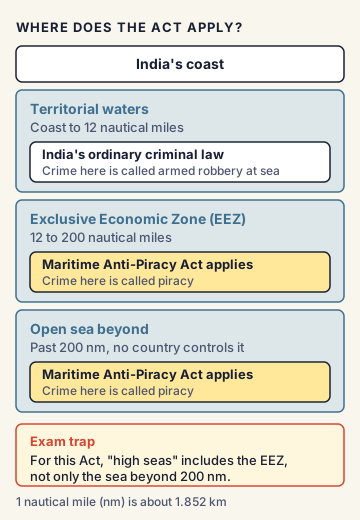
The Act applies on the high seas. For this law, the high seas include India's Exclusive Economic Zone (EEZ), which runs from 12 to 200 nautical miles from the coast, and all the open sea beyond it that no other country controls. Inside India's territorial waters (up to 12 nautical miles from the coast), India's ordinary criminal law already applies, so the Act is not needed there.
What are the punishments?
The Act sets three levels:
- Committing piracy: imprisonment for life.
- Piracy that causes death, or an attempt to cause death: death, or imprisonment for life.
- Attempting piracy, or aiding, abetting (encouraging) or conspiring in it: imprisonment of up to 10 years, a fine, or both.
- Taking part in, organising or directing others to commit piracy: imprisonment of up to 14 years, a fine, or both.
The 2019 Bill had a mandatory death penalty (death as the only allowed punishment) for piracy that caused death. The Standing Committee and legal experts pointed out that the Supreme Court has struck down mandatory death sentences as unconstitutional. They also noted that many countries refuse to hand over accused persons to a country where they may be executed. So the final Act lets the judge choose between death and life imprisonment.
How does it work, step by step?
- Seizure and arrest: Officers of the Indian Navy and Indian Coast Guard, and other officers the government authorises, can board a suspected pirate ship, seize it and arrest the people on it. They must use warships, military aircraft or clearly marked government ships or aircraft.
- Handing over: The arrested persons are brought to an Indian port and handed to the police.
- Special court: The case goes to a Designated Court. The Central Government picks a Sessions Court (a district-level criminal court) to act as one, after consulting the Chief Justice of the High Court of that state.
- Who can be tried: The Designated Court can try a person caught by the Navy or Coast Guard whatever their nationality, and also Indian citizens, foreigners living in India and stateless persons. The Act does not apply to warships or government ships used for non-commercial work.
- Presumption of guilt: In certain cases the court must presume the accused is guilty unless they prove otherwise. For example, if arms, explosives or other equipment for piracy are found with them, or there is evidence that force was used against the crew.
- Extradition: Piracy is made an extraditable offence. This means India can hand over, or ask for, accused pirates with other countries. Where there is no extradition treaty, it can be done on the basis of reciprocity (each side treating the other the same way).
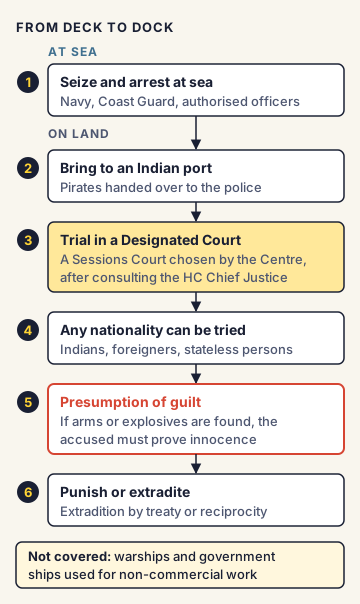
You can think of it like this: the Navy is the police officer who catches the thief at sea, and the Act is the rulebook that lets the judge on land actually punish him.
India's position and Indian examples
The first big test of the Act came in March 2024. The Indian Navy, led by INS Kolkata, recaptured the cargo ship MV Ruen, which Somali pirates had hijacked in December 2023. In that operation, MARCOS commandos were para-dropped at sea for the first time from an IAF C-17. All 35 pirates surrendered and 17 crew were rescued.
The pirates were brought to Mumbai, handed to the police, and charged under the Maritime Anti-Piracy Act along with other laws. A special court in Mumbai later convicted them and sentenced them to life imprisonment. This showed that India could now carry an anti-piracy case "from the deck to the dock", that is, from the ship to the courtroom.
The bigger picture: Somali piracy
Piracy off Somalia rose sharply after the late 2000s. Somalia had no strong government to guard its coast, and many young men turned to hijacking ships for ransom. Attacks peaked in 2011. Strong naval patrols by many countries (including India's patrols in the Gulf of Aden since 2008), armed guards on merchant ships and better ship protection rules brought attacks down to almost nothing by 2017–2020. But attacks returned from late 2023, when many navies were busy with attacks on shipping in the Red Sea.
Commonly confused concepts
- Piracy vs armed robbery at sea: Piracy happens on the high seas (outside any country's territorial waters). The same crime inside a country's territorial waters is called armed robbery at sea, and that country's own criminal law deals with it.
- Piracy vs maritime terrorism or state attacks: Piracy is done for private ends, mainly money. Attacks by a state or an armed political group (for example, missile or drone strikes on ships for a political cause) are not "piracy" under UNCLOS. They fall under other laws, such as the law of armed conflict and anti-terror treaties like the SUA Convention, 1988 (Convention for the Suppression of Unlawful Acts against the Safety of Maritime Navigation).
- UNCLOS vs the Maritime Anti-Piracy Act: UNCLOS (an international treaty) allows every country to seize pirate ships and punish pirates. But a treaty does not punish anyone by itself. Each country needs its own law to actually put pirates on trial. The 2022 Act is India's law that does this.
- Indian Navy vs Indian Coast Guard: The Navy is an armed force under the Ministry of Defence that fights wars and protects India's interests at sea far and wide. The Coast Guard, set up under the Coast Guard Act, 1978, also works under the Ministry of Defence, but it mainly enforces laws in India's own maritime zones. Both can arrest pirates under the 2022 Act.
Issues, criticism and the way forward
- Presumption of guilt: Normally, a person is innocent until proven guilty. Critics say reversing this burden, even in some cases, may conflict with the right to a fair trial under Article 21. The government's view is that evidence at sea is hard to collect, so presumptions are needed when clear signs of piracy are found.
- Death penalty: Some experts say keeping the death penalty may still make some countries unwilling to cooperate on extradition.
- Cost and logistics: Bringing pirates thousands of kilometres to India, keeping them in jail, providing translators (many speak only Somali) and running long trials is costly and slow.
- Juveniles and poor fishermen: Many pirates are very young or are poor fishermen recruited by gangs. Courts must handle questions of age and fair legal help.
- Root causes: Experts say laws and patrols control piracy but do not end it. Lasting peace needs a stable Somali government, jobs on land, and an end to illegal fishing by foreign fleets, which harmed Somali fishermen's earnings.
- Way forward: Experts suggest more information sharing through centres like the IFC-IOR in Gurugram, joint patrols with partner navies, helping coastal states build their own coast guards, and quick legal processing of captured pirates.
Concepts to Know
- High seas: The open sea that does not belong to any country. Under UNCLOS, all countries share it, and ships there follow the law of the country whose flag they fly.
- Exclusive Economic Zone (EEZ): The sea area up to 200 nautical miles from a country's coast. The country has special rights over fish, oil, gas and minerals there, but other countries' ships can still pass freely.
- Territorial waters: The sea up to 12 nautical miles from the coast. Here the country's full laws apply, almost like on land.
- Nautical mile: A unit for measuring distance at sea. One nautical mile is about 1.852 km.
- Mother ship: A larger vessel (often a hijacked fishing boat or dhow) that pirates use as a floating base. It carries fuel, food and small fast boats (skiffs), so pirates can attack ships hundreds of kilometres from the coast.
- Extradition: When one country formally hands over an accused or convicted person to another country so they can face trial or punishment there.
- Designated Court: An existing court chosen by the government to hear all cases under a particular law, so that judges become experienced in that kind of case.
- MARCOS (Marine Commandos): The special forces of the Indian Navy. They were raised in 1987 as the Indian Marine Special Force and renamed the Marine Commando Force in 1991. They are trained to fight at sea, on land and in the air.
- Non-kinetic measures: Actions that put pressure on an enemy without firing weapons, for example blocking a ship's path, radio warnings, or close shadowing by a warship so the ship cannot get away.
- Bill introduced in Lok Sabha: 9 December 2019 (as the Anti-Maritime Piracy Bill, 2019)
- Standing Committee on External Affairs report: 11 February 2021, 18 recommendations (14 accepted)
- Passed: Lok Sabha 19 December 2022; Rajya Sabha 21 December 2022
- President's assent: 31 January 2023 (Act No. 3 of 2023); in force from 22 February 2023
- Definition of piracy based on Article 101 of UNCLOS; Act applies on the high seas, including India's EEZ
- Punishment: life imprisonment for piracy; death or life if piracy causes death or attempts it; up to 10 years for attempt, aiding or conspiracy; up to 14 years for taking part in or organising piracy
- Designated Courts: Sessions Courts notified by the Centre after consulting the High Court Chief Justice
- Powers of arrest and seizure: Navy, Coast Guard and other authorised officers; Act does not apply to warships or government non-commercial ships
- Offences are extraditable; reciprocity where there is no treaty
- First major case: 35 Somali pirates captured with MV Ruen in March 2024, tried in Mumbai
● Tracked since November 03, 2026 · last seen November 03, 2026 · updates as the daily brief publishes